Compare FOUR Items: Own brand or not?
Do they taste as good, are they really better value at their lesser price and what kind of price difference is there anyway?
I did a shop for four everyday products to see.
Supermarkets don’t always have own brand equivalents of popular brands, so you need to shop around for your basics.
Some own brands look similar to popular branded products, but that doesn’t mean they are made by the same company.
Important to watch is size, and also watch that a product that was cheap on one day is the same the next time.
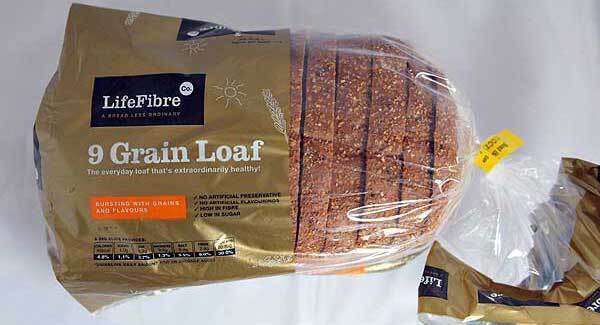
Kibbled wheat, linseed, sunflower seeds, pumpkin seeds, oatbran, millet, toasted soya, flaked wheat and toasted poppy seeds make up the 17% added grain mix to this sliced pan. There is added folic acid, dextrose (a form of sugar), added soya flour and wheat gluten which make this a typically soft sliced pan with little substance compared to an old fashioned white or brown bread. The added grains give it some interest in an otherwise unremarkable loaf.
5
The 15% grain mix comprises wheat flakes, kibbled wheat, millet sunflower seed, brown linseed and poppy seed. Soya flour (for the squeezey texture) is added, along with wheat gluten, and quite a few emulsifiers make this a typical supermarket sliced pan which is best for toast, rather than a sandwich when it goes quite flat when pressed. I see little difference between the extras added to give this an ‘added value’ with health connotactions (though no claims are made) and the Lifefibre loaf at twice the cost.
5.5
Glenisk is an Irish company with integrity which has introduced many people to top quality organic dairy produce. From a wide range, this yoghurt is thick and creamy with just a hint of vibrant yoghurt tang. It is excellent to accompany Asian food (try adding grated garlic for extra zing), as well being as a substitute for cream with desserts or breakfast fruit. A top quality product.
9
Not produced in Ireland, not organic, it is made from whole milk, cream, milk proteins, lactic starter culture, the preservative is potassium sor-bate. Tasters found this less creamy and with less of a yogurt tang. They liked this and would be happy to buy it. Some liked the idea of Glenisk being organic, but it didn’t matter to some. The price difference between this and Glenisk is not large.
8.5
In a glass bottle, which is good, but the bottle is not tinted which it needs to be to avoid deterioration. Colour does not determine quality so ignore this as a yardstick of any olive oil. It needs to be used as soon as possible after making so watch dates and buy oils that have no more than a year to go on the sell by date. Store in a dark cupboard, not in the ‘fridge. Product of Spain. A thick, oily texture has a fresh, acidic finish. Very good.
8.5
Plastic bottles are not ideal for storing olive oil as it can draw out the noxious PVCs in the plastic. As we don’t know when the oil was bottled it means that the oil could be in the plastic for quite a while — not ideal.
7
Oats come from Ireland and the UK and are packed in Co Armagh. This has quite a lot of broken oat flakes with some almost the texture of a heavy powder. This resulted in a heavy porridge. The taste was fine. This one is over half the price of Flahavans per 100g.
6.5
Made from oats all sourced in Ireland, good, firm flakes retained their shape and gave a wholesome, toothsome bite to the porridge. It seemed tastier than the own brand too. 1kg of this goes a long way. Tasters would pay the difference.
8