Find the best black pudding
In Italy they like chocolate in their black pudding, and Japan, the latest country to embrace the black stuff, created a stir when it entered last month’s annual ‘Knights of the Black Pudding’ competition in Normandy.
Irish recipes vary in proportions, but they usually consist of blood, traditionally fresh, but these days, to cope with large quantities, it is usually dried.
Meat, usually minced smoked and/or green bacon is added, along with some form of cereal, often oatmeal, pearl barley or crushed rusk. The final determinants of flavour are the spices and herbs, as well as salt and sugar.
The pudding is always cooked in the factory, so can be eaten without further cooking as the French often do, cubed with an aperitif.
Black pudding can liven up a dish of vegetables, added to salads, or to a tomato sauce for pasta or rice.
It’s delicious as part of a savoury tart, and baked in hollowed out apples and tomatoes.
Fat content can be quite high, so watch quantities. For me, it’s far better enjoyed without bacon and sausage. On brown toast with a grilled tomato or poached egg for breakfast, it is perfectly satisfying.
* See my blog rozcrowley.com for more ideas.
This pudding got a royal nod when it was served to Queen Elizabeth during her Irish visit. Two thick slices in a flat, gold pack have a creamy texture, from cooking the pearl barley in stock and blanching a relatively low amount of oatmeal.
The taste has a rich meatiness from a blend of smoked and green bacon. Spicing is mild and was liked by tasters, except one, who thought it needed more spice.
In selected stores or buy online at www.jackmccarthy.ie.
Using the Irish name for pudding, this has plenty of meatiness from a decent amount of Irish pork (23%), and 22% bacon. There is a chunky texture from the oatmeal and depth is added by fresh onion. While natural spices and herbs are listed, there is also E621 (MSG), part of the 2.15% salt content listed. It doesn’t taste salty, probably due to the addition of dextrose and MSG flavour enhancer which dilute it. Tasters liked this. In Supervalu and other outlets.
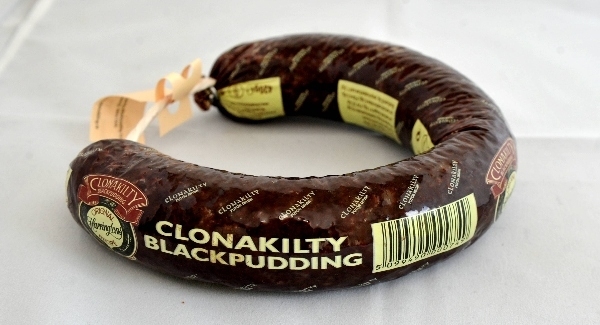
Twenty years ago, this horseshoe shape (available in tube shapes, too) put black pudding on many stylish menus. Tasters were split, with one half loving the loose texture of the hard, pinhead oatmeal, which hardened further when fried.
The other half thought it too spicy and salty (1.5%), and quite fatty, and didn’t like that it fell apart when forked.
29% pork and 20% cured pork is a decent amount of meat, which is processed and smooth. The dried blood is listed as ‘porcine haemoglobin powder’, which amused tasters. Salt, at 1.7%, is quite high, and spices and spice extracts are well-integrated and soft. One taster thought the texture too smooth, like drisheen, but the low fat (7.1%) and meatiness appealed to the others.
Made by Sean Loughnane, Galway, this pudding is nicely creamy and quite highly spiced. Not as meaty as other samples, there is just 5% cured pork, 3% pork and 2% beef, with an unstated amount of beef connective tissue. A lot of oatmeal here, and while the label says there is no artificial flavouring, nitrites are used as preservatives, so watch intolerances.
Made by O’Brien Fine Foods, in Naas, this reddish colour pudding has 25% bacon trim and 9% pork trim, with a high 44% oatmeal. Salt, at 2.3%, is high, and the overall taste was quite spicy.
This is quite red in colour and the texture moist. At 13% pork and 7% bacon, meat content is quite low and the spices a little overbearing. Salt is a very high 2.5%, including E621 monosodium glutamate. Tasters liked it well enough, though most thought the texture was too even and uninteresting.
For those who like oatmeal, this is the one. A light pudding, it is quite chunky and has a lot of gritty minced pork rind, as well as 17.9% pork meat, so it’s not surprising it has quite a low price. Nitrites are the preservatives, so watch for intolerances. Salt, at 1.8%, is fairly high. Made by Country Style Foods, Kilkenny.