'Diversification is not a failure': Hybrid sheep farming the future, conference told
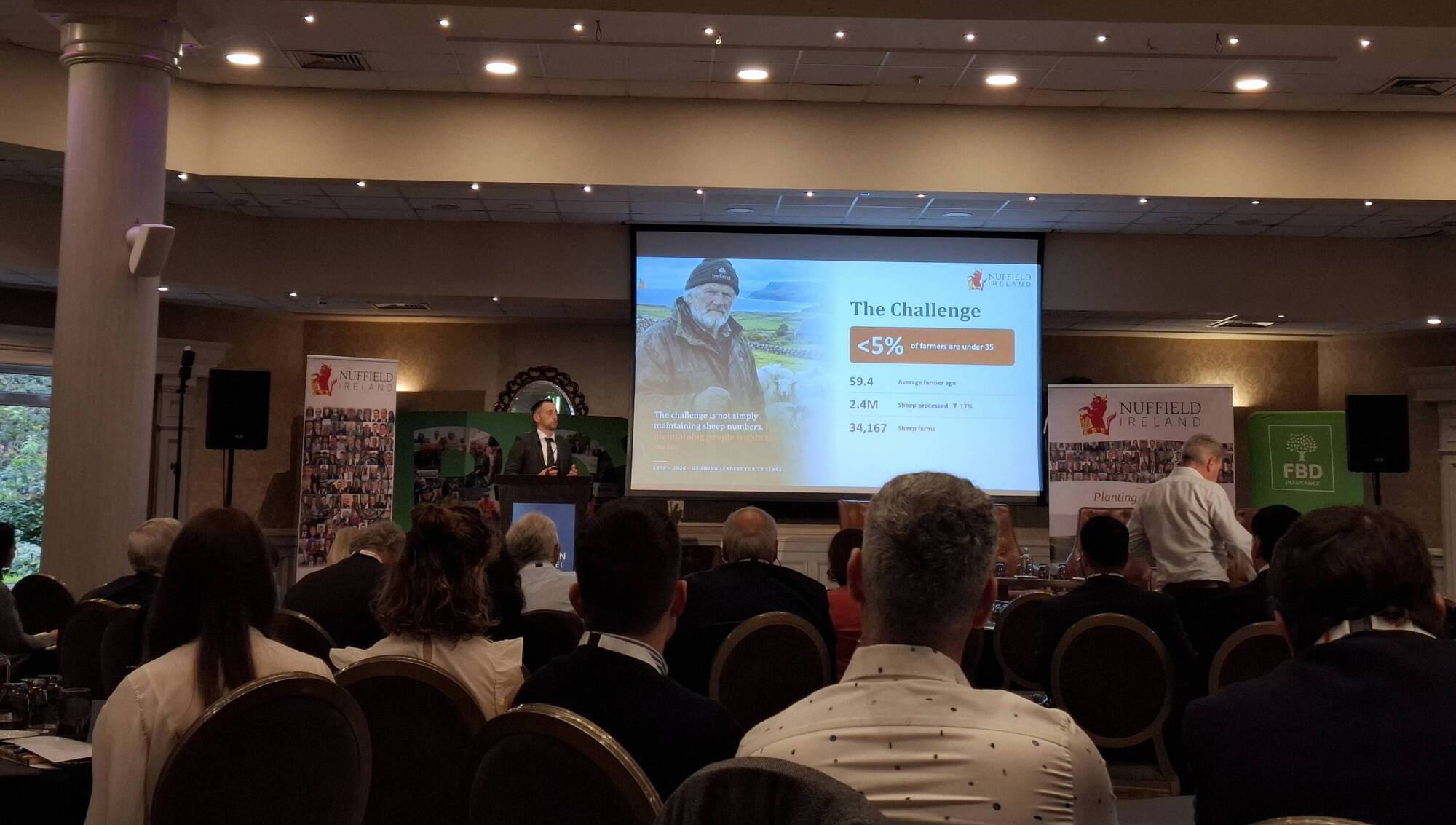
Seamus McMenamin presenting his research at the 2026 Nuffield Ireland Conference on November 6.
Hybrid sheep farming, combining off-farm employment with sheep production, should not be seen as a failure but is likely the future of the sector, according to research.
“Diversification is not a failure. It's an opportunity to open doors and create a more resilient farm business,” Seamus McMenamin told attendees gathered for the 2026 Nuffield Ireland Conference on November 6.
Discussing his research , Mr McMenamin said farming should stop being presented as an ‘all-or-nothing occupation’ and instead be viewed as a career that can work alongside other employment.
He highlighted the low uptake of sheep farming from the younger generation as one of the defining challenges to the sector.
The Irish sheep sector supports a lamb export trade worth approximately €360m and is farmed in some of the country’s most marginal areas but is struggling to establish its next generation.
Referencing the latest CSO statistics, Mr McMenamin highlighted that the average age of an Irish farmer is 59.4 years old and fewer than 5% are under 35. For sheep farming specifically, the average age is closer to 60 years old.
Read More
Citing Teagasc figures, Mr McMenamin explained that 61% of sheep farmers have off-farm employment, which rises to 84% when looking at sheep farmers under 35 years of age.
"We've seen nearly a 20% drop in the number of sheep being processed in the processing sector… Sheep prices today are 50 cents a kilo above where they were last year. They're nearly at record levels, and yet you still can't attract people into the sector," Mr McMenamin said.
He argued that succession alone is not responsible for the shortage of young sheep farmers, with many instead being drawn towards careers offering greater income certainty and work-life balance.
Mr McMenamin identified education, diversification, value creation, succession, industry ambassadors, rural infrastructure and the wider narrative around sheep farming as the key barriers facing the sector.
On the topic of succession, he said that young people need a gradual, structured path to full control of the farm, saying the traditional transfer models are not viable.
"The traditional model was retirement and death, whichever came first, and then inheritance… It needs to become a gradual process, not a single event."
He also highlighted that young people won’t enter farming just because land is available, but the need for rural development to include broadband, suitable housing, childcare, healthcare, public services and social lives are a requirement for many before settling anywhere.
"Access to services, connectivity and a healthy work-life balance are now an expectation rather than a consideration."
Focusing on the part-time reality of the sector, Mr McMenamin’s research concluded that hybrid sheep farming is the likely future of the sector.
He said:
McMenamin argued that sheep enterprises are uniquely suited to hybrid farming models, allowing producers to combine flocks with off-farm employment or alternative farm enterprises.
He offered examples from his research of farms implementing forestry, calf rearing, agritourism, wind and hydro production as diversification avenues to help inject and create value within the sector.
He explained a modern sheep farmer should be multi-faceted, being able to fill the roles of livestock producer, business manager, environmental steward, technology user and entrepreneur.
"The future sheep farmer will not be secured by any single intervention, but rather by creating a sector that's profitable, visible, viable and attractive to the next generation,” he concluded.