She means business: The women claiming their space in Irish agriculture
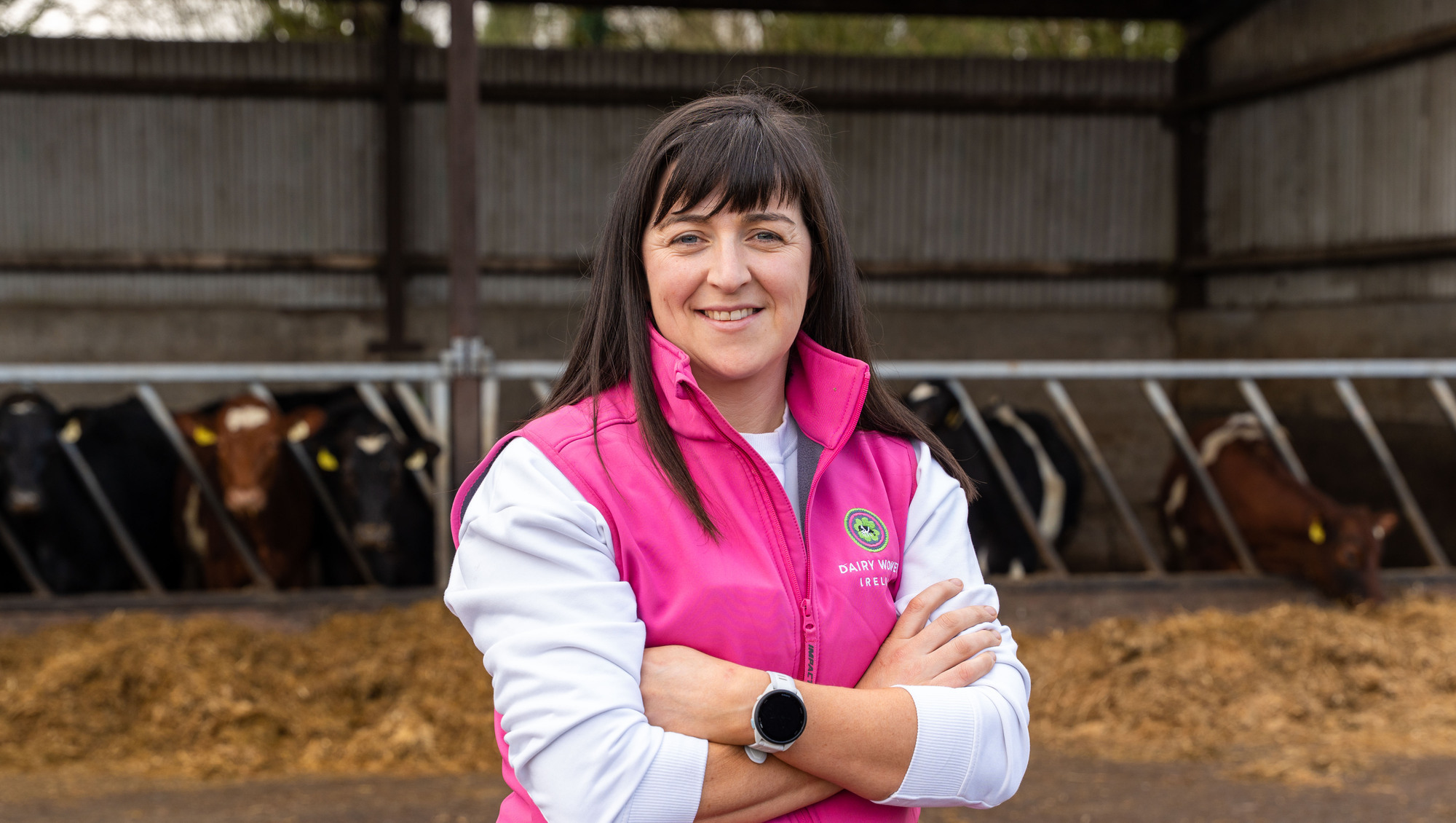
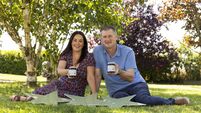
Aileen Sheehan at the farm she rents with her husband in Knockanroe, Whitechurch, Co Cork. Picture: Noel Sweeney
Meet three women pushing back against assumptions in agriculture and forging their own careers in a sector where letters still open with “Sir” or "Mr", and sales reps call looking for “the boss” — only to find she’s standing in front of them.

Ms Sheehan, a dairy farmer and secondary school teacher based in Whitechurch, Co Cork, was the 2025 FBD Young Farmer of the Year.
Ms Sheehan does it all: she’s a dairy farmer, teacher, wife and mother. She, alongside her husband, Philip, milks a herd of 140 Jersey crosses with a few Holsteins, manages 28 heifers and keeps 28 dairy calves a year.
The Sheehans are now in their fifth year of farming, and farm on 100% leased land. The 100-acre milking block caters for their 140 herd, and there is roughly another 100 acres split between two out blocks where the heifers are reared.
Ms Sheehan started with 70 heifer calves and rented land to raise them. She told the one of the highlights of her career in the agricultural sector so far was seeing her original 70 heifers graduate into the milking herd.

Ms Sheehan prides herself on her organisation and being able to balance her multiple responsibilities as a farmer, mother and teacher.
“You go to my shed. It's like a classroom, I have whiteboards everywhere, we have a system and a set-up, and it works.”
From 6.30am, Ms Sheehan is up and working until 6pm, flitting between yard work, teaching and looking after her daughter. She doesn’t seem to stop.
Speaking on barriers for women in agriculture, Ms Sheehan recalls a story many can relate to: “Can I speak to the boss?”, despite the boss being the woman in front of the visitor, many of whom typically look for a man in the yard.
“This is a team effort, really, between Philip and me, in a way, because it has to be, but I did the green cert because it just made more sense that I do it — the farm is in my name.”
“We also have to believe that there are women actively farming, and they're very good at their job… Philip, my husband, is excellent at throwing me into it. That's where I've got my confidence from in dairy farming. He's always been like, ‘don't talk to me, talk to Aileen,’ even though he knew the answer,” Ms Sheehan explains.
She also highlights the need to just "get out there" for women interested in farming, whether to do it themselves, get into partnerships or enter into the sector.
Speaking about the industry, Ms Sheehan says much research and information is at farmers' or new entrants' fingertips.
“If I had the support that I have in the dairy industry, for research now and for learning and for podcasts, if I had that in education, it would make me a far better teacher. The education and the research we have in this country are incredible; you can learn so much,” she says.
Ms Bell, a farmer and content creator located in Cavan, went into partnership on the home farm with her father in 2022.
In an effort to make the farm more profitable and diversify from the beef herd, she began contract rearing Jersey cross dairy heifers in the same year, raising them on the 56 acres at home.
Despite her numerous roles as a farmer, content creator, and civil servant, Ms Bell hopes one day to farm full-time, with more ideas brewing for future projects to integrate onto her farm to make that dream a reality.

Ms Bell studied at Harper Adams University and has recently completed a masters with UCD on the impact of bovine TB on farmers after discovering there was no documented research on the impacts of the disease on farmers and their views.
Ms Bell tells the that she is in the process of publishing her research.
“I realised how much of an impact TB was having, and especially recently, because it's such a huge deal, and it's increasing, and it's not getting better… I've been interviewing lots of farmers who have been affected by it, and they've been so good and produced such valuable information and insights. And they really let you into the emotions behind it, which was so kind of them to do, because that's quite hard,” she explains.
Ms Bell says she never set out to do content creation and only took it seriously a few years ago when she started receiving compliments about her posts and videos on social media, as genuine interest in her platforms began to grow.

Discussing barriers she’s come across so far in her career, Ms Bell mentions women being forgotten in a room, referencing events where a crowd may be asked whether they were "a beef man or dairy man".
“There could be plenty of women there, and they likely have roles on the farm. But you know, you're forgotten about in a room of people who are speaking and teaching you these insights. It's quite frustrating, and it's just not nice,” she says.
She's also come across smaller biases in her day-to-day, explaining farm documents addressed to her for delivery, but start with a presumptive ‘Dear sir’ or have manually correct contracts that list ‘he’ instead of ‘she’.
Despite seeing progress made in these areas, Ms Bell says: “It's just little things like that add up, and it's not appropriate to still have to do things like that in this modern world. I still think there is work, and there are barriers, and there are assumptions to our role, and this unconscious bias also.”
Ms Bell advises all farmers to call out this behaviour if they spot it.
“Time and time again, there are double standards that we face, and we need to hold people accountable for these issues. If I’m too well dressed or made up, ‘I care too much about how I look’, if I turn up, not put together, ‘I don’t care how I look’. You can’t win. I posted about this recently, and it was crazy how many people resonated,” she says.
Discussing what more can be done to encourage young women into farming, Ms Bell suggests the multiple mentorship programmes available to farmers who may be looking for some guidance, but also to encourage young people to go searching in their local area for farmers who may be interested in teaching passionate young people, or even just to allow them to gain experience on working farms.
Ms Bell wants to encourage farmers, no matter gender or sector, to support and uplift one another, whether it is entering the industry or diversifying a business.
“I think the whole supporting each other is very important; we all need to support each other.”
Ms Curley hails from a suckler farm in Co Offaly, but since 2019 has taken up the mantle of principal at Mountbellew Agricultural College.
She began her professional career earning her green cert at the very college she now runs, just 20 years prior. Despite going on and furthering her education, earning a bachelor's, master's, PhD and post-docs to add to her level 5 degree, Ms Curley still sees that first achievement to then return years later to run the college where it all started as one of the highlights of her career.

“My first academic achievement was my level five certificate in agriculture from Mountbellew. And I do remember being proud as punch of that… My green cert from Mountbellew is probably what I would say is the defining moment for me, that I wanted to remain in agriculture, and that it was definitely for me. I loved every minute of it.
Running the college means no two days are the same, with classes for almost 900 students, the smooth running of the oratory on campus and the running of the two commercial farms that make up the 100 hectares owned by the school, all the way down to the signing of the blue cards for the newborn calves, Ms Curley oversees it all.
The Mountbellew farms are home to a 90-pedigree Holstein dairy herd, 30 limousine beef cows and almost 200 breeding ewes.
Ms Curley was one of the first ever female principals of an agricultural college, which she admits did not registered when she was elected to the role.
“I think probably others may have noticed it even more than I did; I’m not entirely sure it registered with me as it did with others.”
Ms Curley credits the support around her from her husband and fellow lecturer at Mountbellew, Dr Michael O’Flynn, Teagasc, who works closely with the school, other agricultural college principals, as well as the rest of her team, ensuring the school runs smoothly under her guidance.

“I remember we had the college principals meeting that was here in Mountbellew. It was here because I was being introduced as the new principal. I still remember the guys who spoke on the day and that offer of support, help and guidance. And it wasn't just lip service. It's there. It's there to this day. And that just has made all the difference,” she says.
Although Ms Curley came from a household where both parents were heavily involved in farming, and she looks back on her experience growing up in the sector as a positive one, she has heard many stories of women in the sector not being afforded the same positive experiences.
“I think we probably need to be a little bit more vocal in a very positive sense. We're very Irish in that we just get on with it like it's grand. We'll be fine. Whereas I think if we were there and maybe telling our own stories, there's an opportunity to speak out, to relate, to guide, to support.
Offering some advice to women and girls looking to farming as a serious career choice or looking to enter the sector, Ms Curley says: “As I say, what doesn't kill you makes you stronger. Now it mightn't feel like that at the time, yeah, might be very hurtful and very demoralising, but I think we need to probably speak up and speak out. And if you know what you want to do, don't let anybody stop you.”