At the forefront: Farmers share their experiences of a changing climate in Ireland
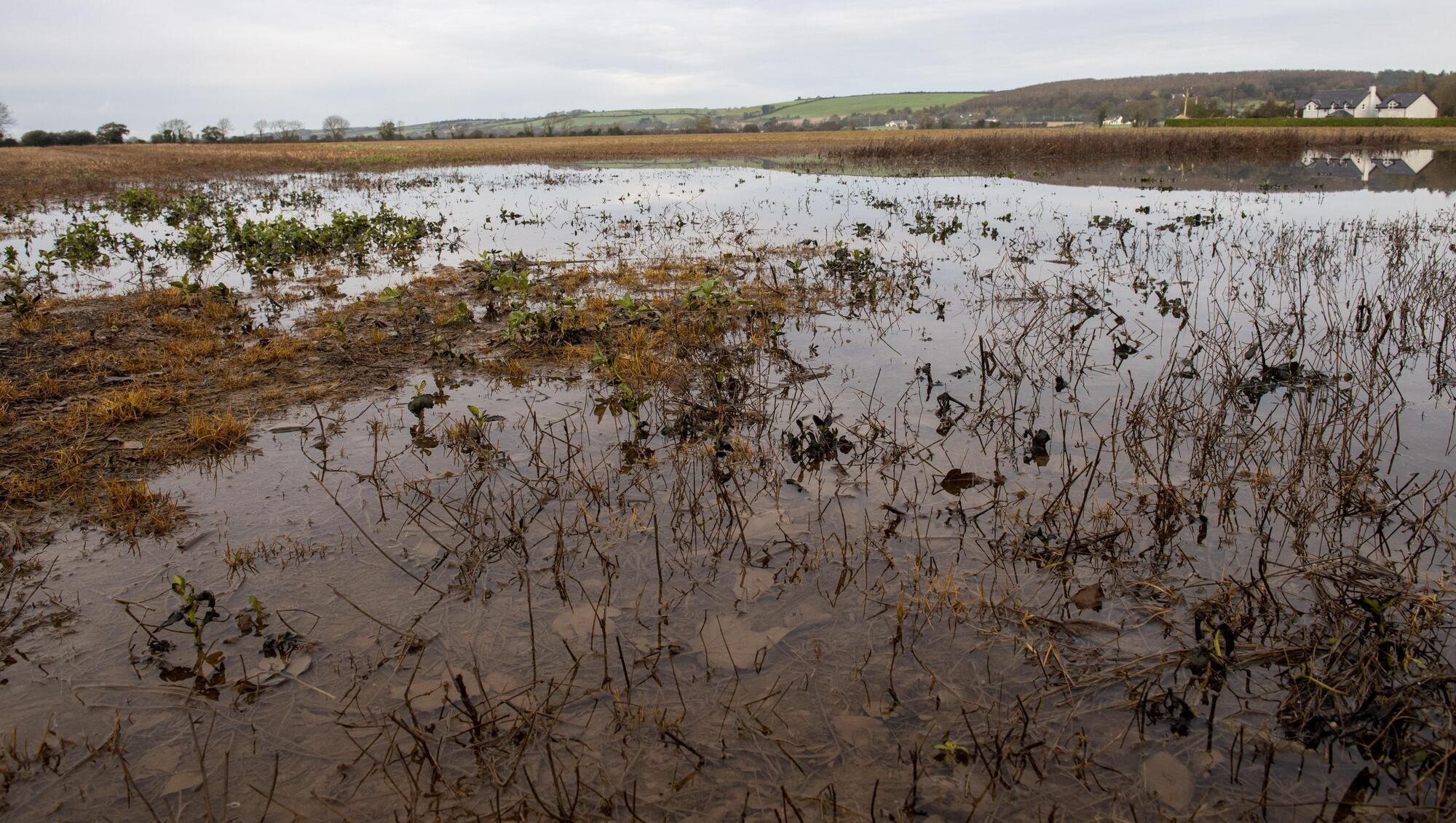
A field flooded with water where winter wheat should be planted only for the very wet conditions on the lands of Tillage farmer Dick Fitzgerald, Loughane, East Cork, in November. Picture: Dan Linehan
Farmers have been telling their weather stories for a report commissioned by the Climate Change Advisory Council.
A tillage farmer said, “Like, there was one field in particular, there was beans in it, and the bean seed was actually washed out onto the laneway. And they were planted four inches deep.” A Shannon Callows farmer involved in agri-environmental schemes described how repeated summer floods in the early 2000s wiped out the corncrake.
“And it flooded the corncrakes in their nests and it flooded the young birds. They were just washed away down the river. And the corncrake population has never recovered since.”
Unpredictable weather, rising costs, and the uncertainty of the future added up to a "constant struggle" for a beef and sheep farmer. “This year, with cold and wet, you’re putting on fertiliser, and it’s not working, and you’re putting a couple of thousand euros down the drain. You have no return from it.
"I’m not very optimistic. Maybe a younger farmer would be, but yeah, it’s kind of, it’s a hard slog all the time. You’re kind of fighting against it all the time. You know, you get up in the morning, 'Is it raining? Ah God, it’s raining, I can’t do that'. Do you know?”
The Shannon Callows farmer described the financial impact. "I was drawing meal the whole winter and trying to supplement the fodder that I had and trying to supplement the fodder that I was buying. And it was a costly winter, I can tell you. And do you know, this year, I mean, whatever money I make from farming is just simply going to pay bills that I acquired, I accumulated last year.” How are farmers adapting?
A tillage farmer said, “A lot of ground can be moved either by wind or by runoff water”. He started experimenting with cover crops, and said, “with the cover crop, it’s just holding everything together”.
The beef and sheep farmer explained why she sheared her breeding ewes before the housing season. “So, when my sheep go out, they don’t have the big fleece of wool.
"So, the mother, she doesn’t like the rain. Then, because she feels it, she’ll tend to go to the shelter, where the ewe with the wool will stand in the middle of the field because she doesn’t notice it, and the lamb is out then beside her, and he’s getting wet. But the ewe that is sheared will go for the shelter in the ditch and bring the lambs with her.”
A dairy farmer's investment in an automatic milking system with automated gates was not driven by the need to adapt to climate. The farmer had converted from a sheep enterprise and directly “started with robots”. However, the farmer recognises the system's flexibility to decide at any point of the day, depending on the weather, if the cows could be let out to graze.
“It's just a click of a button here to let cows out. I have the fences set up so you could literally decide, I don’t need to be here, I can decide on my phone. I could be half an hour away, I could be somewhere else, and the day could change completely. The sun might come out, or it might be a lovely, dry afternoon, compared to a wet morning. And you can decide, 'Right, I let the cows out', and if I land back two hours later, they could have gone out, and all be back in again.”
An organic tillage farmer said organic farming is a potential climate adaptation measure. He said climate change was delaying harvests and reducing the time windows for field operations, adding to pressures of workload and lack of labour availability, along with the affordability of labour. According to him, these are key motivators for farmers to “change the way they’re doing things”.
"Are you better off taking the payment from the organic farming scheme, for example, and producing less, but having more time to do it, you know? You’re not under the same pressures.”
An organic tillage advisor interviewed for the report said organic farmers are less stressed about climate change.
“Once they sow their crop, they’re closing the gate and they’re not putting out fungicides or fertilisers. They’re just waiting until the crop is ripe, and they’re prepared to put up with a few weeds and a few diseases, you know, and they seem to be far happier, far more positive-minded.”
They were among nine farmers and seven Teagasc farm advisors interviewed for the report.
But conclusions were also drawn from 195 questionnaires fully completed by randomly sampled farmers from different regions, in an online survey, or who were at eight advisory events on farms where printed questionnaires were distributed.
These exploratory studies were carried out over the 10 months from January to October 2024.
The Climate Change Advisory Council's (CCAC) aims include investigating farmer resilience against climate change, how their behaviour is changing, and what support farmers get to cope with climate change.
Key findings in their recently published report include that all farmers studied were aware weather changes were occurring, which they viewed as a fundamental shift from the typical weather variations in the past. All reported extreme weather events and non-typical seasons.
Farmers had always adjusted their work to weather fluctuations but now faced new challenges, with more frequent disruptions of farming operations. As a consequence, farmers were at various stages of behavioural change, to do with adaptation.
The CCAC said some farmers may require help in planning for the future, and advisors may need additional training in climate adaptation.
In the survey, 61.6% agreed or strongly agreed that seasons are less typical than 10 years ago. However, 41.5% said the occurrence of floods, droughts, and storms is normal, when asked their opinion of "I think the recent occurrence of floods, droughts, and storms is normal and nothing new".
About one-third (34.4%) of farmers did not believe the weather had changed noticeably in the past 10 years, and 29.7% believed that extreme weather events were occurring no more frequently than ten years ago.
Survey respondents said droughts are the most frequent extreme weather event, cited by 70%, compared to 62% reporting non-typical seasons, 59% floods, and 45% storms.
Almost 93% of farmers working on heavy soils reported that their soils were affected, compared to nearly 65% for farmers working on free-draining soils (the survey was in 2024 when farmers in many parts of the country experienced prolonged high rainfall).
Housing animals for longer than expected was reported by 81.5% of farmers, with 65.6% rehousing animals unexpectedly.
One advisor told interviewers about unseasonably low temperatures affecting grass growth, particularly burdening the drystock sector. “Because you take the months of June and July, which should be the peak growing grass season in this country. And with the cold weather, they’re having to go out with an additional round of fertiliser.”
A pig-tillage farmer noted how climate change worldwide influenced the global grain market, and his feed costs.
The survey ranked farmers' perceptions of the negative impacts of weather events, with not being able to spread slurry or fertiliser as planned the most frequent complaint, followed by grass or crop establishment and growth, and the need to house animals for a longer period.
Farmer adaptation was found to depend on many factors, including experience and unpredictability of weather events, compliance with the Nitrates Directive, farm economic viability, succession, expected benefits, cost and time constraints.
The survey indicated that livestock farmers (who made up 181 of the 195 surveyed) are, on average, only "thinking about" adaptation measures. But livestock farmers were further advanced (to "preparation", or "preparation to action" stages) for actions such as checking the weather forecast, walking the field before letting animals out, and checking soil trafficability.
Tillage farmers (14 surveyed) were at the "preparation" stage on average. Most tillage farmers were at preparation and action stages for no-till or minimal-till farming, and lengthening crop rotations.
Almost all surveyed farmers reported uncertainty about future policies and regulations (91.1%), the lack of financial resources (81.3%), and insufficient communication and sharing of experiences by other farmers and advisors (77.1%) as the main barriers to adoption.
The CCAC said the study highlighted the need to strengthen the climate adaptation strategy in Ireland at the policy level, to better support farmers and co-ordinate the agri-food industry. Adaptation solutions should be systematically studied, validated, and shared through formal research, extension, and education networks.
The CCAC noted that farmers seemed to have limited opportunities to share their thoughts, experiences, and needs on climate adaption with other farmers and advisors, and suggested solutions such as community-based knowledge exchange.
It was noted in an advisor focus group that the number and complexity of CAP schemes tended to take advisors away from on-farm and group-based advice on issues such as climate adaptation.
More research was needed into promoting climate adaptation measures for the most socio-economically vulnerable farms, if large investments are required.
Could the solution be organic tillage? One of the advisors interviewed said conventional crops in a drought “can’t take up all that fertiliser that you’ve spent the money on” and “are just senescing through natural stress of being in drought”.
He said it costs €1,500/ha to grow conventional spring oats, and only €700 for the organic version. Conventional crops could yield better in typical weather years, but with climate change challenging yields, lower-input systems such as organics could be more resilient. and less stressful for the farmer.
“Are you not more resilient with a much lower input system?
"You have less to lose, I suppose. You don’t have all this money tied up and the stress that brings as well on farmers’ health".
However, interviewed farmers did not consider organic farming as a farm-level adaptation measure.