O'Mara: livestock production won't cease anytime soon
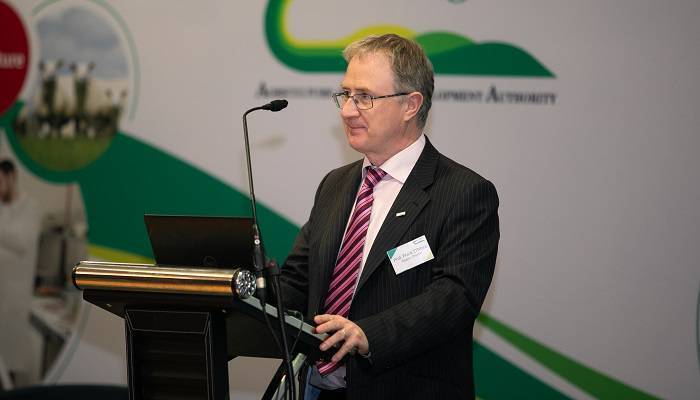
Frank O'Mara: 'You see a lot of people questioning the role of livestock in our food system, going as far as saying we should have none, or we should have less, or whatever, questioning what I consider the legitimacy of livestock.'
Teagasc Director Professor Frank O’Mara has hit back at opponents of livestock in Irish agriculture.
The head of Teagasc said, “You see a lot of people questioning the role of livestock in our food system, going as far as saying we should have none, or we should have less, or whatever, questioning what I consider the legitimacy of livestock”.
“First of all, livestock are critically important for converting forage and low-quality byproduct-type feed from industry into human edible food", he added, during a recent Teagasc Signpost webinar.
"If we didn’t have livestock, we couldn’t do that. There would be huge parts of our country, and huge parts of the world, that would not be available for food production. Livestock, in particular ruminants, but not just ruminants, fill a very important niche in our food ecosystem by doing that.
"The second thing is that when we return the livestock manures back to the soils from which their feed was produced, we’re bringing circularity into the overall system, that relationship between plants and livestock is critical. We can’t have just animals, or we can’t have just crops; we need the two, and the big reason we need the two is the return of livestock manures back to crop-producing areas. That’s hugely important for long-term soil health.
“The challenge for us is how can we ensure that livestock are minimising the negative externalities while they continue to make those really, really important contributions to the food system”, he said.
His comments come as Irish livestock production dips.
“We do have some worrying indicators in terms of output. Milk output year-to-date is down 7% to 8%, probably a lot of it weather-related, but nevertheless that’s a big drop. The beef cattle disposals year-to-date are probably running fairly similar to last year, but yet we’ve indications of another fairly big drop in the suckler herd coming in 2024, coming after a fairly sizable drop in 2023.
"The sheep census figures came out in the last few days, and at the end of December, ewe numbers were down 3.7% compared to the previous year, and we all know the rough autumn and spring we had for tillage and horticulture crops,” said Professor O’Mara.
The pig and poultry sectors are also dealing with difficult challenges. “We have environmental challenges that are quite difficult to meet and that’s where the big challenge is for the sector in the coming decade”, he said.
“But I think the fundamentals are pretty sound for Irish agriculture. We are very competitive in terms of what we produce and we need to be, because we export. Irish food has a very good reputation abroad for safety, for quality and that stands to us in terms of our access into premium markets”, he said.
"The type of food we produce isn’t going out of fashion, and we’re good at producing it”, he said. “We’ve a very good advisory and education sector that you don’t see in many other countries. We’ve good institutions and structures set up, and I think they’re a real bonus and positive for Irish agriculture.”
Asked for his overall perception of Irish agriculture currently, Professor O’Mara said: “It’s a challenging period for farmers. We’ve had a very rough 12 months of weather since about this time last year. Profitability has been very challenged, partly due to the weather, but due to other factors as well. We’ve seen regulations really biting in some sectors, and the change to the maximum organic nitrogen level under the Nitrates Directive.
"And I suppose there’s maybe a sense among farmers that farming is getting more complicated. There are more things to do, there are more boxes that have to be ticked”, he said.
“The average age of farmers is somewhere around 59. That means there are quite a few above that. It’s a huge amount of change for people that maybe have farmed in a particular way or with relatively easy-to-comply-with regulations for maybe 40 or 50 years”, he said.
He acknowledged the importance of Teagasc providing appropriate advice and support. “It is a challenge to give the kind of level of support that some people might need in order to come into the schemes and to comply with all the various regulations”, he said.
The advice he zeroed in on during the podcast interview was to increase silage stocks on farms, for greater resilience, given the probability of increased extreme weather including drought in the summer and extra-long winters, due to climate change.
“Since 2018, the advice has been to carry more reserves”, he said.
Teagasc is concerned about replenishing fodder stocks this year in time for the winter, because grass-growth has not been very good. “We’re about a tonne of dry matter per hectare or thereabouts lower year-to-date than the average”, he said.
“Another adaptation that would be very useful would be to have extra slurry storage capacity on-farm”, he said. That would enable farmers to use slurry optimally.
He anticipates a fall in the number of full-time farmers.
There has been considerable growth in part-time farming within the past 20 years, and Professor O’Mara does not see this trend reducing.
Those coming into the sector as part-timers are by and large getting a good training in agriculture.
“It is a challenging sector to work in. You do have to work hard; the returns are low enough. Even in our best sector, dairying, we had a great year in 2022, but profitability dropped by about 60% in 2023”, he said.
Despite this, there appears to be a strong pipeline of people wishing to enter agriculture.
On the 2030 emissions reduction targets for farmers, Professor O’Mara said there is by and large a willingness on the part of farmers to do the right thing, if it makes sense for them, if it doesn’t cost them money.
“By and large in Ireland, we’ve seen over the last number of years, we’ve maintained and indeed even increased our production, while we have used an awful lot less pesticides, we’ve used an awful lot less fertiliser, maybe in some ways too little fertiliser on some of our soils.
"We’ve got to try to break this link between the inputs and the outputs, or at least to get a lot more efficient in terms of how we’re using those inputs”, he said.
“Agriculture has very challenging targets, as do all sectors, if we are to decarbonise our economy and reduce our climate impact”, said Professor O’Mara, who is a member of the Climate Change Advisory Council, the independent body which assesses and advises on how Ireland can transition to a climate-resilient, biodiversity-rich, environmentally sustainable and climate-neutral economy.
“It does require a lot of measures to be adopted at a very high rate of adoption by farmers, and indeed, some of the measures are still only being fine-tuned in research”.
Rapid adoption of a switch to protected urea, an overall reduction in fertiliser use, a reduction in the age at which animals are brought to slaughter weight, and continuing to improve the genetic merit of cows, are among the key measures required, he said.
“We’re making good progress, maybe not as fast as we’d like in switching to protected urea,” he said.