Slurry spreading season opens this weekend
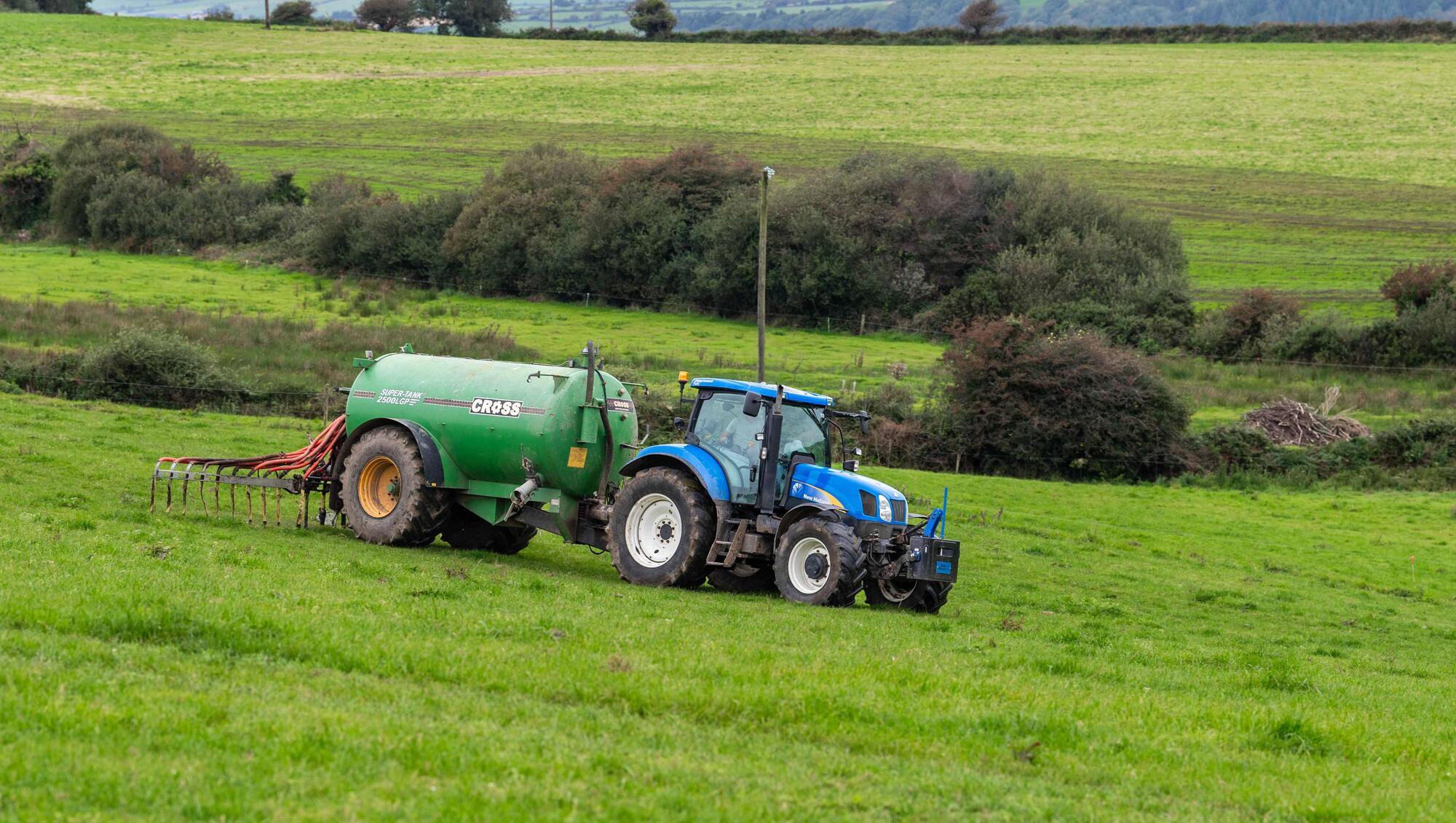
Timoleague-based dairy farmer Pa Harte spreads slurry on a grazing field with a New Holland T6080 tractor and Cross dribble bar spreader last August. Picture: Andy Gibson
The closed period for spreading organic manures will end for farmers in 'zone A' this weekend.
The country is divided into zones, with rules for each zone about minimum storage capacity and the prohibited spreading periods — the times when farmers are not allowed to spread organic and chemical (nitrogen and phosphorus) fertilisers — set out.
Zone A consists of counties Carlow, Cork, Dublin, Kildare, Kilkenny, Laois, Offaly, Tipperary, Waterford, Wexford and Wicklow.
Zone B consists of counties Clare, Galway, Kerry, Limerick, Longford, Louth, Mayo, Meath, Roscommon, Sligo, and Westmeath.
Meanwhile, zone C is divided into two parts of Donegal/Leitrim and Cavan/Monaghan, which have different minimum storage requirements, but have the same rules for the times when fertiliser must not be spread.
Farmers in zone A can spread slurry or farmyard manure from January 13.
In zone B, spreading can take place from January 16, while in zone C, it can take place from February 1.
The dates from which chemical fertilisers can be spread are later: January 27 in zone A; January 30 in zone B; and February 15 in zone C.
The ability to spread is, of course, weather-dependent.
Farmers must not spread when the land is waterlogged; the land is flooded or likely to flood; the land is frozen or covered with snow; or heavy rain is forecast within 48 hours.
They must also not spread if the ground slopes steeply and there is a risk of water pollution, when factors such as surface run-off pathways, the presence of land drains, the absence of hedgerows to mitigate surface flow, soil condition, and ground cover are taken into account.
Chemical fertiliser also cannot be spread on land within 2m of a surface watercourse.
These rules have been introduced through the Nitrates Action Programme, which is designed to prevent pollution of surface waters and groundwater from agricultural sources and to protect and improve water quality.
The purpose of these regulations is to provide a basic set of measures to protect waters, including drinking water sources, against pollution caused by nitrogen and phosphorus from agricultural sources, with the primary emphasis on the management of livestock manures and other fertilisers.
Under the programme, there is also a closed period for the application of soiled water to land. This aims to reduce the loss of nutrients to water at the riskiest time of year. Soiled water storage capacity requirements have been increased in line with the new closed periods.
From December 1, 2023, all milk producers must have a minimum of 21 days soiled water storage capacity on the holding.
From December 1, 2024, all milk producers must have a minimum of 31 days soiled water storage capacity on the holding except for winter/liquid milk producers where this storage must be in place by December 1, 2025.
A phased approach applies to the introduction of requirements for low emission slurry spreading (LESS) for farms above a grassland stocking rate of 100kg of organic nitrogen per hectare.
From January 2023, LESS equipment must also be used for all applications of pig slurry.
It must also be used when applying livestock manure to arable land, or the livestock manure must be incorporated into the soil within 24 hours.
From January 2024, LESS equipment is mandatory for those with grassland stocked of and above 130kg of organic nitrogen per hectare.
Three new excretion rate bands have been introduced for dairy cows as of last year.
Each dairy herd will be assigned to one of the three bands each year, based on the herd’s average annual milk yield per cow.
The three bands applicable for dairy cows are: 80kg of nitrogen per cow per year for farms with annual milk yield up to 4,500kg; 92kg per cow per year for milk yield between 4,501 and 6,500kg; and 106kg of nitrogen per cow per year for milk yield over 6,500.
The excretion rate band for each dairy herd is calculated based on the total volume of milk delivered to the milk purchasers divided by the average number of dairy cows on the holding.
In confirming their assigned band, each dairy farmer can select one of the following options to calculate their average milk yield: select the rolling average for the three preceding years, or select the most recent preceding year.
A dairy farmer must confirm their dairy cow band annually to the Department of Agriculture.
Farmers can submit this via a specifically developed application for banding calculations on the Irish Cattle Breeding Federation website.
An interim review of the Nitrates Action Programme took place last year.
The European Commission’s extension of Ireland’s nitrates derogation to allow a maximum stocking rate of 250kg organic nitrogen per hectare for some farmers also required a water quality review to take place last year.
As a result of this review, derogation farmers across areas of the country have been limited to a maximum stocking rate of 220kg from 2024.
In order to comply this year, farmers will have to either obtain more land, remove stock, or export slurry.
The National Fertiliser Database is now in place.
Annually, a farmer or professional end user will have to declare the closing stock of fertiliser held on their farm in the autumn.
Farmers who are importing or selling fertiliser will have to register as a fertiliser economic operator and comply with the requirements on uploading data.