A fundamental step in developing the apple sector in Ireland
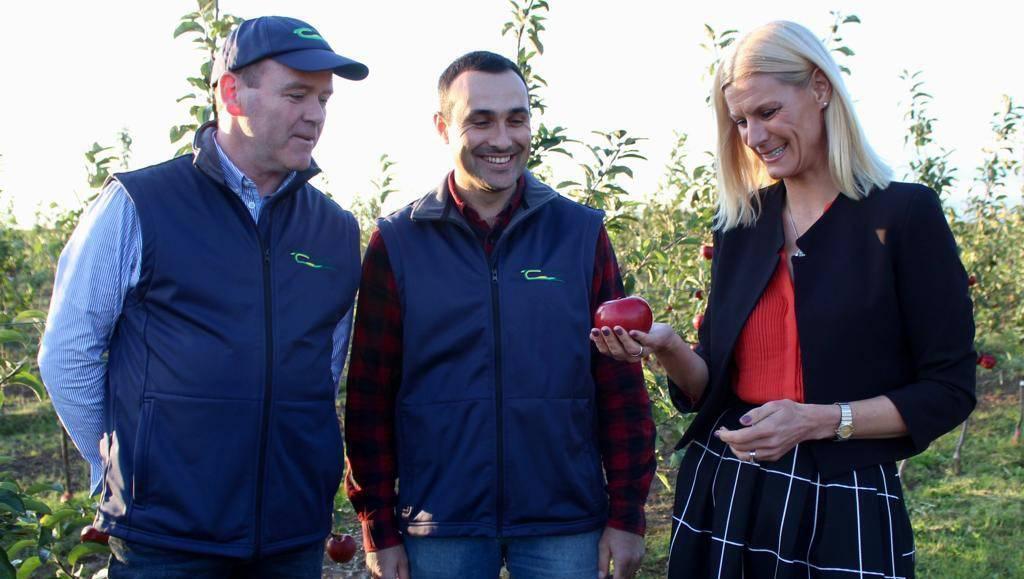
Dermot Callaghan, Head of Horticulture Department, Teagasc; Alberto Ramos Luz, Fruit Research Officer, Teagasc and Senator Pippa Hackett, Minister of State for Land Use and Biodiversity on her recent visit to the new apple research orchard at Teagasc Crops Research Centre in Oak Park, Carlow.
THE snap is being restored to the Irish apple sector ahead of Halloween which has been associated with the fruit for generations.
One of the most popular traditional fun games for children during the trick-or-treat festival involved apples.
They were sometimes presented to the colourfully costumed youngsters on their house-to-house visits.
But they were also dangled from kitchen ceilings on a piece of string during what was known as “Snap Apple Night.” The game was also played with apples floating in a pan of water with children again trying to bite one of them with their teeth without using their hands. Sometimes, one of the apples contained a hidden coin which was the prize for the child that successfully snapped it out of the water.
It created great fun, lots of shouting and wet floors, but the tradition seems to have died out over the years and is unlikely to feature to any great extent next Tuesday night.
However, many people recalled the custom last week after Teagasc announced a new apple research orchard at its crops research centre in Oak Park, Carlow.
It represents a fundamental step in developing the apple sector in Ireland and could be the catalyst to develop the eating apple sector in Ireland.
The domestic retail market for dessert apples is worth €135m with over 90% currently filled by imports, creating the potential for locally grown apples.
Developing a modern and high-efficiency production model with new varieties to achieve high fruit quality and yields and reduced labour costs are among the aims of the Teagasc research.
Another focus will be the evaluation and adoption of new technologies for apple growing in a suitable Irish climate.
The research is expected to deliver essential preliminary data for the future recommendation of apple tree genotypes.
Teagasc says the value of the apple sector could be increased by about €30 million per annum at farm gate with substantial imports being substituted with Irish eating apples.
It also has the potential to offer diversification options for other horticulture and crop producers and provide potential for offsetting CO2 emissions.
Minister of State Pippa Hackett, who visited the Oak Park orchard as the first harvest of apples was being gathered, said the new research project will help to underpin future potential development in a sector worth €135m, the vast majority of which is currently taken up by imports.
Director of Teagasc, Professor Frank O’Mara said there are no shortcuts when it comes to developing the apple sector.
“We start at the beginning where the science behind modern apple varieties and production systems are evaluated in an Irish context so that we can play our part in creating an enabling environment for the sector to expand.
“We have recruited a new research officer, Alberto Ramos Luz, to run the programme and invested resources in the orchard, lab facilities and equipment and I am looking forward to seeing the fruits of this new research programme,” he said.
Mr Luz said a study with high scientific rigour is necessary comparing all possible training systems, considering planting density, cultivars and rootstocks, in order to identify the best options for Irish conditions.
“While we are at the beginning in terms of building the research programme, I am excited to unlock the potential of new varieties and technologies for Irish apple production systems,” he said.