Signpost: Planting later than normal this year, but never again, warns Tom

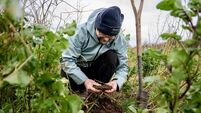
Tom Barry on the Barry family farm at Kilavullen, Co Cork. Picture Dan Linehan
The establishment of winter crops in late 2022 was a difficult task. The removal of the seed dressing ‘Redigo Deter’ from the market has left early sown winter barley vulnerable to barley yellow dwarf virus.
This aphid-transmitted disease can have devasting yield consequences on winter barley crops, and its effects only become obvious in the following May, when all the expense of growing the crop has occurred.
To mitigate this problem, many growers delayed the setting date to October, but due to poor weather conditions, the area sown to winter barley in the south of the country fell dramatically.
Many of the crops which were established have plant stand issues which inevitably will also pull back yield.
The reduced carbon footprint for spring barley is also an important consideration. A carbon initiative to promote spring barley, while helping to offset the extra costs and risk of late harvesting associated with spring cropping, would be very beneficial.
I sowed winter beans on October 24 and November 4. Both farms were previously in winter barley, and the stubble was disked following the removal of the straw.
These fields were allowed to green up before being sprayed off with glyphosate pre-sowing. Winter beans were then spread on the stubble and ploughed down, using a plough and furrow press combination.
No more cultivation is required, and no herbicide will be needed on this crop. This crop received 250 kg/ha of fertiliser 0-10-20 on February 13. Plant stand and crop establishment are excellent.
Considering no nitrogen, no herbicide, a modest fungicide application and a top-up protein payment, this winter bean crop is set to deliver excellent returns in 2023.
This crop received 250kg/Ha of 0-10-20 and 30 units of nitrogen per acre as urea on February 11-13. We rolled these fields on February 14.
On March 3, we applied 3,000 gallons of pig slurry per acre on half the winter wheat. The umbilical system did more damage than normal, given the earlier growth stage of the crop and the loose seedbed.
Thankfully, this crop has recovered and is responding well to the organic manure application and received 250kg per ha of 24-2.5-10 plus S on March 27.
We began setting spring barley on March 4. We set 80 acres of Gangway in perfect conditions on land that would normally be heavy in nature, but subsoiling the previous autumn really improved the drainage. We incorporated 250 kg/ha in the seedbed of 24-2.2-10. This farm will receive a top dressing of slurry in May.
We spread 3,000 gallons per acre of pig slurry from February 28 to March 7 on the remaining ground ahead of sowing spring barley. Unfortunately, the weather has broken for a few weeks and this has delayed setting at this point.
‘Cyclocel’ is now due on the winter wheat to promote tillering along with ‘Pacifica’ on the headlands to control sterile brome. ‘Tebuconazole’ and trace elements are planned for the winter beans, which are showing early signs of chocolate spot.
However, as always, the weather will dictate when we get going, so for the moment, we have all the tractors and equipment serviced and ready for action once conditions improve.