Solar installations on farms will play a major part in farmers “future-proofing” their enterprises.
With ringfenced funding announced in recent days to support farmers with solar developments, Conall Bolger, chief executive of the Irish Solar Energy Association said that considering how big a portion energy bills are of farms’ running costs, “we’d really see it as imperative that farmers are able to make this journey” of generating their own electricity.
“Solar is a very sensible thing we can do today that helps farmers make the transition, helps them on that journey, helps them with cost,” Mr Bolger said, in addition to stressing the role that farmers will play in reaching climate targets in the coming decades.
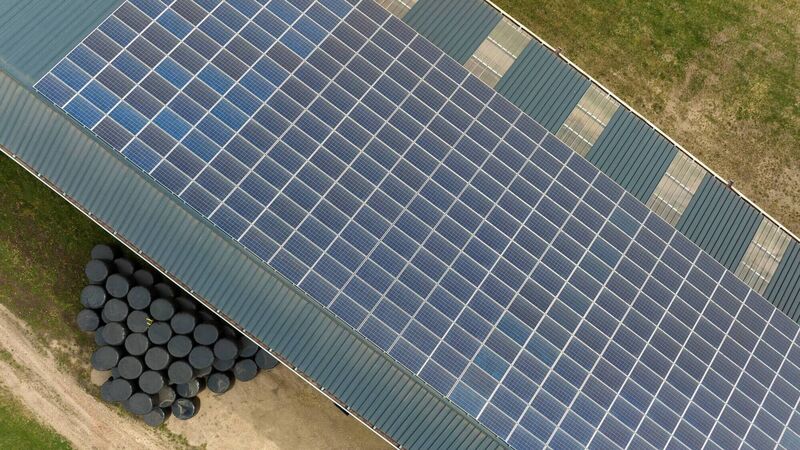
There is a lot of shed roof space on farms across Ireland, Mr Bolger told the Irish Examiner, and he wants to see that potential maximised in the near future.
Last week, applications opened for solar under the new Targeted Agricultural Modernisation Scheme (TAMS 3).
In order to encourage the purchase of solar investments thereby reducing dependence on fossil energy by farmers, the new Solar Capital Investment Scheme will be ringfenced with its own investment ceiling of €90,000 and will be grant-aided at the enhanced rate of 60%.
In addition to the higher grant rates, the size of the available investments has also increased from 11kW to 62kW.
“The scheme will enable every farmer to generate their own power for their dwelling and holding and will help to achieve a more sustainable rural economy, assisting farmers in reducing energy costs on their holdings,” according to Minister for Agriculture Charlie McConalogue.
“This is the beginning of an exciting and bright future for on-farm energy generation.”
Conall Bolger of the Irish Solar Energy Association said that the new scheme is a “bit of a mixed picture”, and it shows that in the development of infrastructure to support farmers in installing technologies such as solar, work is “improving, but must do better”.
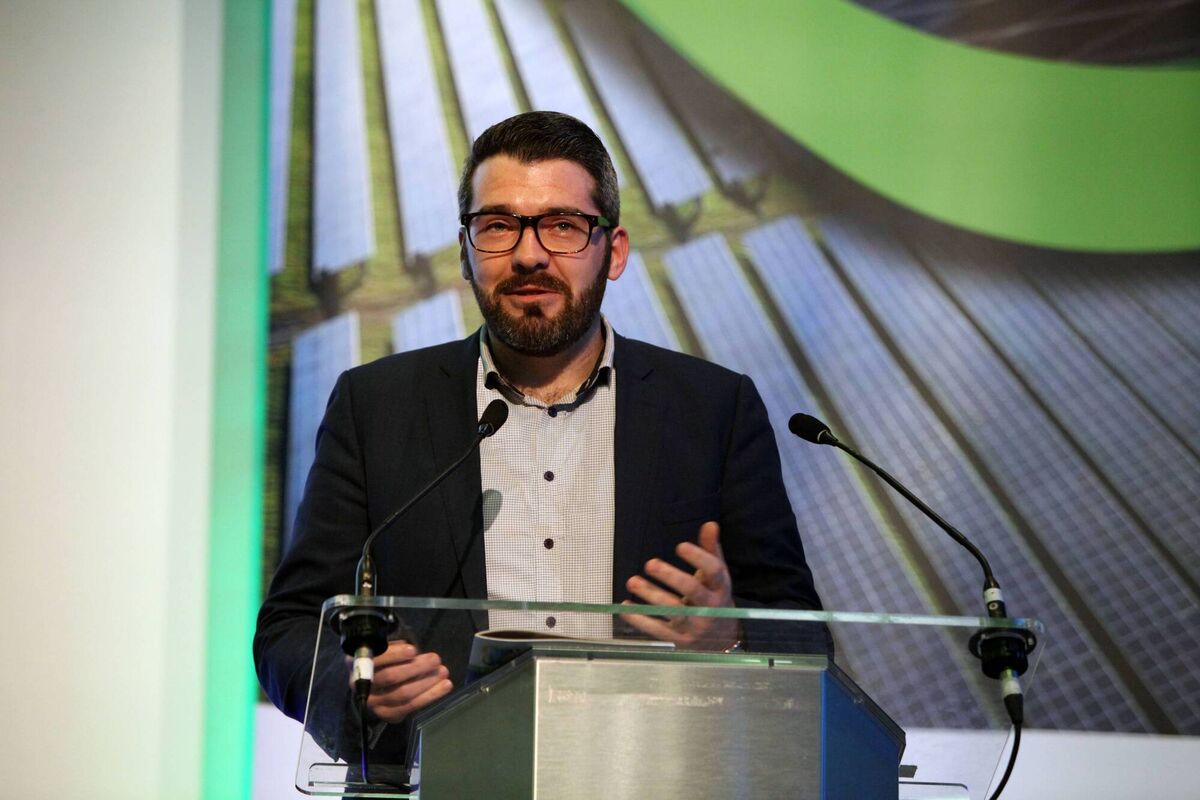
“In the first instance, the increase in the support levels is welcome and the commitment to ringfence the solar funding, and it’s great to see that kind of protection for the funding,” he said.
However, farmers being restricted in their ability to export remains a “bit of a concern”.
“It means that people are likely to install a system that isn’t optimal for their needs, given their energy demand,” Mr Bolger explained.
“So, it would probably mean that they mightn’t build the system as big as they’d like because they can’t export it.”
The focused scheme for agriculture is welcome, and with Ireland going through an energy crisis, some recent measures in this space have been focused on homeowners in particular, and have “probably been trying to deal with the symptom rather than the cause”, Mr Bolger said.
“They’re trying to protect people from the high price in the short-term,” he said, without truly dealing with the “root cause” of this, being “the dependence on fossil markets and fossil pricing”.
“One of the best interventions we could make is helping people with getting a system installed that will generate electricity for effectively free once it’s paid off and help them get over the hump,” he said.
“I think considering how big a portion the energy bills are for farm running costs, we’d really kind of see it as imperative that farmers are able to make this journey, which really emphasises the importance of making it easier.”
In Mr Bolger’s eyes, the future of solar and the future of farming are “inextricably linked, the land bank is likely to be agricultural”.
“It’s a relatively small overall footprint on the agricultural base, and the income diversification that comes from having a solar farm can be significant, it can make a big difference,” he said.
And looking at Teagasc’s National Farm Survey figures around the number of viable farms in Ireland, “there’s definitely a lot of farmers who could do with the income it provides and it gives them that stability of revenue that allows them to make other choices”, Mr Bolger added.
“If you think about it, at a farm level, if I have rental income coming from hosting a solar farm on my land and I have panels on my sheds to reduce my energy cost, that’s a good basis of which you can make other decisions,” he said.
“I think for a lot of farmers, there’s a lot of things they’d like to do if they could afford to do it or had the bit of breathing space to do it, and solar could play a big role in that.
“We really see it as an entry point for new models of farming and we’re really keen to work with farming stakeholders.”
When it comes to climate, Mr Bolger said the debate on the role farms can play is “very polarised”.
However, the importance of increased renewable technology adoption on farms is an area many can agree on.
“It seems like solar is a very sensible thing we can do today that helps farmers make the transition, helps them on that journey, helps them with cost, and potentially if they’re able to export, maybe it becomes a bigger revenue source as well,” Mr Bolger said.
“I think there’s a lot to be done there in terms of the kind of building on-farm solar.
“We talk about no rooftop being left behind, and that’s as true in agriculture as any other sector really.
“So if you remove those export restrictions, there’s a lot more flexibility of what can be done, in terms of scaling up and the options available to them.”
Mr Bolger said that the Government’s solar targets of 5GW by 2025 and 8GW by 2030 will come from a blend of ground-mounted solar and rooftop.
Addressing any concerns there may be about land use change from agriculture, Mr Bolger said: “The volume of land required under lease isn’t that significant in terms of its overall impact on the agricultural estate of land.
“The second side of that is even on the site when you have solar panels, you can do other things.
“We’d normally say that for a MW of solar, you’re probably something in the order of 3.8 to five acres, so if you take the 5,000MW [5GW by 2025] number and assume it’s all coming from ground-mounted - and that’s a big assumption because realistically it’s going to be a blend - you’re talking something equivalent to about 0.2% of all agricultural land in Ireland, so less than one-fifth of 1%.
“In terms of the materiality, we don’t think it’s a significant issue as some people have made out.”
In addition, there is an emergence of agrivoltaics in other countries, Mr Bolger said, which sees solar and agriculture combined on land, with opportunity out there for “grazing of small animals like sheep, and so forth”.
“There are a lot of options, you can have multiple uses of the land and a lot of uses that are agriculturally relevant; we think solar farming is consistent with the definition of farming,” he said.
While installing solar technology may be suitable for many, Mr Bolger said it is indeed an individual decision.
“What is the right solution for you will probably [come down to] a combination of your budget, your roof space, and your own energy needs,” he said.
“In the first instance, I’d always suggest you get a number of qualified installers who have experience in the agricultural space and have them come out, have a look, and talk to you about your options.
“Shop around, but I think it’s important to talk to good reputable installers and get them options laid out.”
Patience throughout the process will also be important.
“The administrative procedures around this are longer than they should be and it’s something we’re working on to see if we can help get them reduced,” Mr Bolger said.
“If you’re going to have a conversation with somebody, your panels aren’t going to be up next week.”


Cancel anytime