Robots on the farm take another step forward
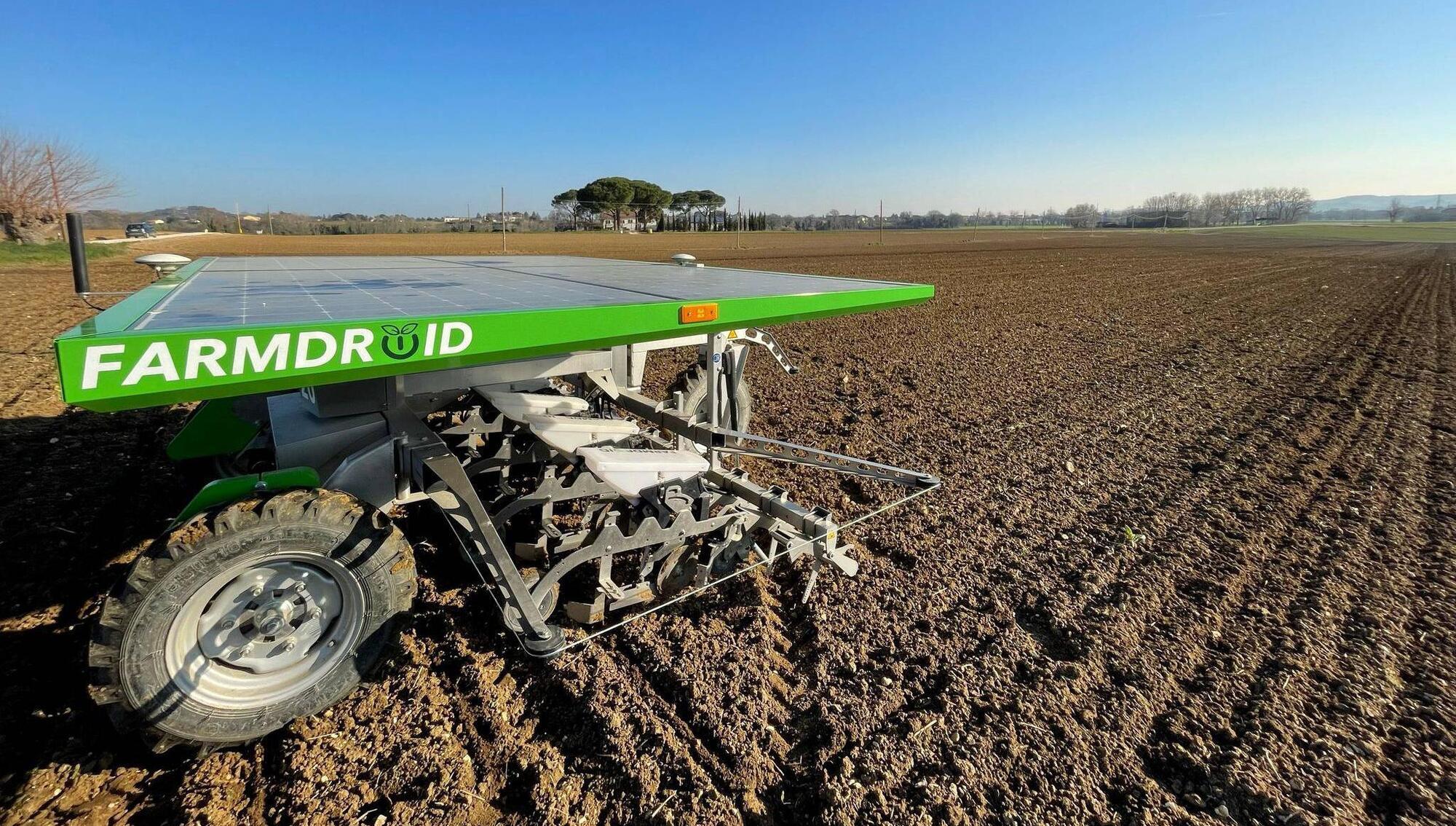
The FarmDroid FD20 robot, which takes care of seeding and weeding, can operate 24/7 as long as the lithium batteries have power. If the batteries go flat, the FD20 stops itself until the sun comes up to start re-powering the batteries.
More and more farmers across Europe are letting the FarmDroid FD20 robot take care of seeding and weeding their crops of sugar beet, onions, spinach, kale, flowers, and rapeseed.
The FD20 was in the limelight last week when EU Commissioner for Agriculture, Janusz Wojciechowski, inspected it at work during his visit to Bavaria in Germany. The robot was also awarded a Silver Award for Innovation at last week's Royal Highland Show.
It was on show at the recent Cereals 2022 and LAMMA 22 events in the UK. The Opico company imports and distributes FarmDroid in the UK. Their Managing Director, James Woolway, says it is tried and tested, with more than 200 of the machines already in use around Europe.
Its UK price is £59,500 (nearly €70,000) for the six-row model, plus £4,243 (nearly €5,000) for an RTK base station (a GPS receiver capable of RTK takes in the normal signals from the Global Navigation Satellite Systems along with a correction stream, to achieve 1cm positional accuracy).
The purchase price and running costs are low compared to traditional machinery, and the period for return on investment may be as little as two years, thanks to the possible savings in herbicides, fuel, labour, and machinery costs.
And because it is carbon neutral, it is likely that grant funding for sustainable farming will become available to assist farmers purchasing such robots.
Organic growers using the FD20 in the UK and Europe are said to have increased beet yields by 40% to 60%, compared with tractor-hoed crops.
Four solar panels power lithium batteries for two electric motors, one for each back wheel, which drive the FD20 up to 950 metres per hour, while seeding or weeding up to six hectares (about 15 acres) per day.
The seeding unit comprises a six-litre hopper, metering unit and double-disc coulter, designed to plant at up to 5cm depth into a fine tilth. Precisely correct spacing for the desired plant population is achieved.
A seed light beam sensor in the unit sends an alert, should any alarm be triggered due to malfunction, to the FarmDroid app on the customer’s mobile phone or device.
High precision GPS pinpoints the position in the field of each seed, making subsequent weeding possible both between rows as well as between plants in the row. The FarmDroid FD20 knows the position of every single plant, having placed each seed in a perfect pattern.
Row distance, plant distance, sowing depth, speed, and tolerances can all be adjusted to fit various crops, various types of soil, and the farmer’s individual wishes. The FD20 automatically stops and notifies the farmer if anything deviates from the settings.
At set-up, the field’s corner points are input. Any obstacles such as trees, electricity poles, etc, are also input. The desired number of headlands, sowing distance between the crops in the row, and sowing depth are chosen, and the start button pressed.
Weighing between 800kg and 950kg, the robot's light footprint is good for soil health, and it can be easily moved between fields.
Fully charged, it has enough power for 18-24 hours of daily operation, depending on weather and working conditions. It can operate 24/7, as long as the lithium batteries have power. If the batteries go flat, the FD20 stops itself until the sun comes up to start re-powering the batteries.
The solar panels need daylight rather than sunlight, so the FD20 can keep working on cloudy days. An additional power bank can be added for up to 12 extra hours of work.
Once the machine has finished its seeding operations, it can be reconfigured for blind weeding operation, even before crop emergence.
From the sowing process, the FD20 knows the precise position of every seed, and therefore knows where it must weed, and where not to weed. This enables the first weeding pass to be a "blind run", before the crop has emerged. This prevents weeds getting ahead of the crop and competing with the crop for nutrition and sunlight.
The FD20 can do mechanical weed control within 5mm of each seedling. Hoe shares run between each row, and blades slice off any weeds between crop plants.
There's no need for the high labour costs of hand-rogueing problem weeds like fat hen.
FarmDroid ApS was founded in Denmark by Jens Warming and Kristian Warming, along with Innovationsmiljøet Syddansk Innovation A/S, and robot expert Esben Østergaard. They launched the machine at Agritechnica 2019.
Founded over 50 years ago, Opico is the largest independent distributor of agricultural machinery in the UK, dealing with manufacturers such as HE-VA, SKY, Strautmann, Maschio, and FarmDroid.
Opico's managing director, James Woolway, said: "In a future where food retailers are progressively looking to be perceived as green, with carbon audits becoming more and more common, the FarmDroid can help provide one step towards energy self-sufficiency and herbicide-free crop production."
However, FarmDroid along with the Südzucker AG agricultural technology company and Amazone have announced a trial project to reduce herbicides and insecticides to a minimum, by using the FD20 robot and a special spot-spraying method.
This could address the difficulty of removing all weeds without touching the crop plant, by applying herbicide precisely onto or next to the beet. Dr Peter Risser of Südzucker said initial trials are promising, and the technology is also interesting for pest control or for fertilising with micronutrients.
A breakthrough could be useful for sugar beet growers facing great challenges due to the limitation of crop protection agents and the spread of diseases and pests.
René Jørgensen, CEO of FarmDroid, said: “The most important thing for us was to invent a sustainable, CO2-neutral, ecological and economically attractive alternative to conventional agricultural machinery.
"This is exactly what we have succeeded in doing with the FD20, which is solar-powered, lightweight, mechanical, and fully automatic. The combination of our field robot with pinpoint spot application is a great fit for us, if it means it can contribute to significantly reducing the application of crop protection products in the future.”