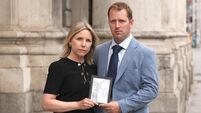
The next 30 years will be critical for feeding the world, according to former Clinton adviser Jack Bobo.
Mr Bobo’s speech entitled “Can agriculture save the world, before it destroys it?” at the Guild of Agricultural Journalists of Ireland Michael Dillon Memorial Lecture on Friday discussed the need to balance low-cost nutritious food with environmental responsibilities.
Mr Bobo spent 13 years with the US Department of State Ministry of Foreign Affairs and is a former advisor to Hillary Clinton.
Today, he is the chief executive of Futurity, a US-based food foresight company.
Mr Bobo warned steps to make Ireland meet its emissions targets could make world emissions go up, as countries with higher emissions for agricultural output will fill the gap.
“It sometimes feels today as if agriculture is under attack — there are many people who believe that agriculture is the problem to be solved,” he told journalists.
“If you look at many of the impacts of agriculture, that might seem to be true. 40% of all land on earth is currently devoted to agriculture. The amount of crop land [farmed] is the size of South America, the amount of pastoral land is the size of Africa.
“There is also the question of water. 70% of all freshwater is used for agriculture. These are not the challenges of 2050 — these are the challenges of today.”
“10-15% of greenhouse gas emissions come from agriculture, another 10-15% from deforestation; 80% of which is caused by agriculture. That’s almost as much as energy and more than anything else.”
On the other hand, the global population is expected to swell to 9.5-10 billion people in less than 30 years.
“That of course is a challenge,” Mr Bobo said. “According to the Food and Agriculture Organisation, we need 50-60% more food by 2050 — as much as 100% more protein.
“But we also have 800m people who will go to bed hungry tonight. As many as nine million people will die each year of hunger — to put it in perspective that’s 25,000 people today that will die today of hunger.
“There’s not a person who wouldn’t go to help a hungry child, and yet when it’s numbers so big it’s hard for people to wrap their minds around.”

However, Mr Bobo said if we farmed today the way we did in 1960, we would need an additional 1bn hectares of land to produce the same amount of food.
“Advancements in agriculture have effectively saved a billion hectares from being cut down,” he said.
Advancements in agriculture had meant that to produce a bushel of corn in the United States in 1980, versus 2011, farmers produce 35% fewer emissions.
“There’s 40%, less land needed to produce that corn, 40%, less energy, 50% less water, and 60% less erosion,” he said.
“By every measure, by every crop, whether we’re talking about the United States or Ireland, or Europe, things are not just better, they’re wildly better.
"And the reason that those impacts exist is not because things are any worse. But because of the demand for food is so much dramatically higher.”
Mr Bobo warned against Europe exporting its agricultural carbon footprint.
Discussing measures such as reducing fertiliser and pesticide use and increasing organic area, set out in the EU’s Farm to Fork Strategy, he said: “All of those things will reduce the impact of agriculture on the land in Europe, but they will also reduce production in Europe.
“There is a reason farmers use pesticides, there is a reason they use fertiliser. And if Europe doesn’t produce that food somewhere else will, and that other place may or may not be as efficient, productive or sustainable. So we need to think about those trade-offs.” With the global population expected to max by 2050, Mr Bobo said the next 30 years would be the most critical in history for agriculture.
“We need to keep in mind, not just the sustainability story of not just one farm or one country, but how all of this plays together,” he said, “We really need to think about where we are going between now and 2050. Imagine if we are able to get to 2050 without cutting down our forests, without draining our rivers and lakes.
“After 2050, population growth slows dramatically - population growth between now and 2050 is because we are living longer, not because we are having more kids.
“Every day between now and 2050 it gets harder to feed the world. But every day after 2050, it gets easier to feed the world. So the challenge is not to do better and better forever, it is to get to 2050 without screwing up the planet.
“The next 30 years are not just the most important 30 years in the future of agriculture, they are the most important 30 years there will ever be in the history of agriculture.”
The biennial event is hosted in honour of the late Michael Dillon, one of Ireland’s foremost agricultural journalists and broadcasters and a founding member of the Irish Guild of Agricultural Journalists.
Previous speakers include Minister for Foreign Affairs Simon Coveney, former President of Ireland Mary Robinson, former European Commissioners Phil Hogan, Ray McSharry and Peter Sutherland.