Decisions to be made when it comes to low emissions slurry spreading
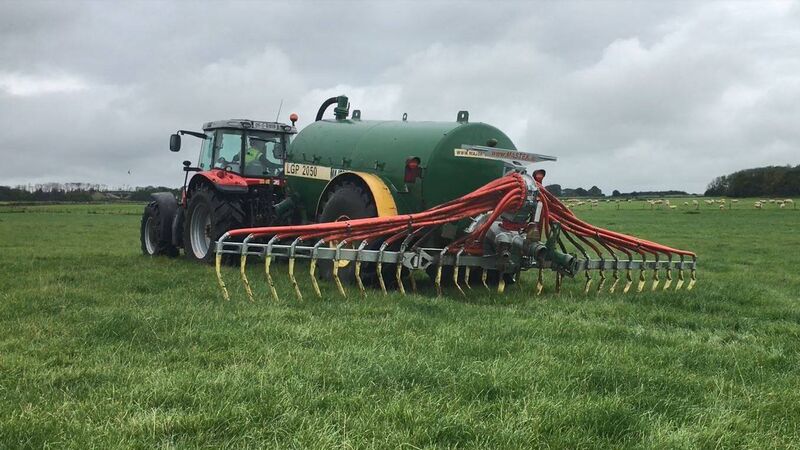
Some farmers will be using Low Emission Slurry Spreading (LESS) equipment for the first time this season. File Picture.
I bit the bullet this week and purchased a dribble bar for the slurry tanker.
I figure the writing is on the wall vis a vis the mandatory imposition of low emission slurry spreading equipment.
Thankfully I had applied for a grant, and this will go some ways towards paying for this piece of kit.
As my grant due date was fast approaching the choice seemed like it was now or never, as those farmers in nitrates derogation found out to their dismay when new applications for grant aid for retrofitting dribble bars was pulled earlier this year.
Like many other farmers I know, the myriad of options was bamboozling.
The option of buying a trailing shoe tanker was considered briefly.
The main advantage to my mind of the trailing shoe option is better placement of slurry between the grass plants with the ‘shoe’ physically placing the slurry directly on top of the ground leading to less soiling.
This option would allow me to spread slurry on heavier swards of grass.
Down south grass does grow well over the winter, and over the last number of years I have found myself having to wait until February to spread slurry, rather than in mid-January when the slurry spreading window opens up.
Soil compaction is a particular bugbear of mine and I am loath to spread slurry when ground conditions are sloppy.
Soil poaching is another bugbear of mine, meaning that cows are brought in off the land relatively quickly usually in early November to avoid damage to the land.
Similarly, I am quite happy to leave cows inside until soil conditions improve usually around late February.
Grass is hard enough to grow without pummeling it into the ground.
The combination of housing in early November and wettish springs can mean that grass covers down south with the benefit of mild air from the coast can become heavy over the winter.
This gives the occasional problems of slurry tanks being full and grass too heavy with covers to allow for spreading via splash plate.
In such circumstances over the past number of years, I have hired in a contractor with a trailing shoe to clear some space in the tanks.
On the face of it, the trailing shoe seemed like a logical option.
Unfortunately, grant aid for retrofitting trailing shoes is not available.
Going for a whole new rig tank and trailing shoe was cost prohibitive, and a ten-month waiting list didn’t fit well with my impending grant deadline.
And in any event, the relative advantage of being able to spread on heavier covers was outweighed by the issues of heavier weight (remember my soil compaction bug bear), increased wear and risk of damage with the shoe being physically in contact with the ground.
Some manufactures are making farmer-orientated less industrial trailing shoe options for retrofitting, but the cost differential again was too high to justify, costing about €7,000 more based on rough quotes than a similarly sized dribble bar.
For the uninitiated, a dribble bar lets out the slurry via soft hosing which trails after the tanker. I also considered Castle Agri’s Moscha swivel spout.
The unit has some great advantages over other low emission spreading technology including high output, bigger droplets resulting in lower emissions than traditional splash plate methods, relatively cheap compared to other options, easy to install and little by way of wearing parts.
To my mind, these units should be supported at policy level as being a big improvement over the standard splash plate.
However, the lack of current clarity as to whether these units could be considered as low emission spreading technology from a Department of Agriculture perspective as well as the impending grant deadline left me with no choice other than to default to the dribble bar option.
Having made the decision to go with a dribble bar, I faced yet another hurdle in deciding which model.
The majority of manufacturers use either a vogelsang or mastek macerator yet others have designed their own macerators.
Again for the uninitiated, a macerator is the bit that chops up the slurry to ensure it can make its way through the pipes to get to the ground.
Some manufacturers offer chassis-mounted options whereas the majority of suppliers make attachments that simply bolt onto the back door opening of the tanker.
Chassis mounting was my initial preference but, in the end, having consulted with the tank manufacturer about what options they were recommending and their knowledge of how other farmers have got on gave me enough confidence to take a leap of faith and go with a door-mounted model.
In the end, the dribble bar chosen was a Mastek 7.5m supplied and fitted by Gearoid O’Sullivan of OS Agri Motion Limited in Innishannon.
After investing a huge quantum of time in considering what seemed like endless permutations I feel I can now move on with my life!
- Kieran Coughlan, Chartered tax adviser Kieran Coughlan, Belgooly, Co Cork.