Now recommended for UK pig farmers
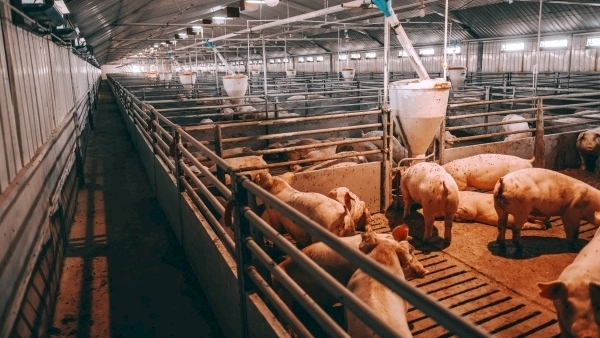
For UK farmers, slurry cooling to reduce emissions is attractive, if combined with the heating of the pig accommodation.
It is now recommended as an option if expanding a unit, for meeting compliance targets, and reducing energy costs.
Cooling reduces ammonia emissions, and the energy cost for ventilation.
As a heating with renewables method, it can qualify the British Government’s Renewable Heat Incentive (RHI).
Slurry cooling reduces emissions at source.
Cooling slurry in storage effectively reduces emissions, and the heat extracted can be used to heat livestock housing, thus reducing the use of conventional heat sources such as gas and oil.
The system uses established heat pump technology to transfer the heat, and can qualify for the Government’s RHI quarterly payments over 20 years, based on the amount of heat generated.
Cooling, together with heat recovery has been developed and successfully used in Finland since 2004, and on more than 300 farms in Denmark.
Successful installations can also be found in the Netherlands, elsewhere in the Baltic area, and in North America and China.
Cooling is not effective for large volumes of slurry, so it can only be installed in housing systems where slurry is removed frequently.
Retrofitting is only possible in systems where cooling pipes can be placed above the concrete floor, which may result in a loss of storage capacity.
Some European installers anticipate that the cost of an installation can be recouped from savings in energy costs in less than five years.
This estimate appears to take into account some subsidies and low-cost loans.
As regulations evolve, to reduce risks to the environment and human and animal health, pressures on the pig industry to reduce emissions of ammonia and odour from slurry have increased.
The most significant source of ammonia in pig production is the breakdown of urea, which is excreted in the urine, by the enzyme urease, which is present in faeces, into ammonia and carbon dioxide.
The factors that influence this process are the concentration of urea in urine, pH, and slurry temperature.