€307m Arla boost as EU drought impact revealed
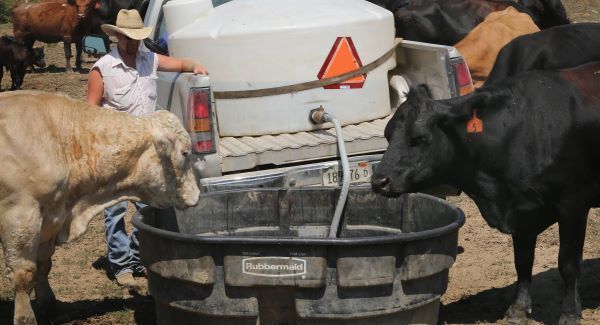
The tough financial situation on EU farms due to drought has led the Arla dairy co-op’s board to propose paying out its entire 2018 net profit to its 11,200 dairy farmer members in the UK, Denmark, Sweden, Germany, Belgium, Luxembourg and the Netherlands.
All these countries were affected by summer drought.
The payment will be worth about £278m (€307m).
“As a farmer-owned dairy company, we care deeply about the livelihood of our farmers, and we recognise that this summer’s drought in Europe has been extraordinary,” said the chairman of Arla Foods, Jan Toft Nørgaard.
“We are proposing that extraordinary measures be taken in this situation, and the Board is satisfied with the positive development of the company’s balance sheet, which makes this proposal possible.”
Arla CEO Peder Tuborgh said: “Our balance sheet has improved significantly over the last few years, and the strength of our balance sheet makes room for this extraordinary initiative, while still maintaining our investment plans for the continued future growth of the company.”
Suppliers to Arla and other processors endured a year in which pasture productivity was estimated to be at one of its lowest ever levels in large parts of central and northern Europe (including Ireland), and north-eastern France, due to drought damage.
One of the repercussions for Irish farmers is that imported feeds are likely to be more expensive, due to low EU crop yields and high demand levels.
The EU’s crop monitor service forecasts green maize (fodder maize) yield 10% below the five-year average.
Non-irrigated maize crops in the most affected regions started to wilt before significant cob development.
Yield forecasts for EU cereals have been revised downwards for the fourth month in a row.

The current forecasts are below the five-year average for soft wheat (4.5% below), spring barley (4.3% below) and rye (14% below).
For sugar beet and potatoes, the EU yield forecast is also below the five-year average, by 5.2% and 6.6% respectively.
However, the yield forecast for grain maize is still above the five-year average, due to good crop performance in south-eastern Europe.
And the forecast for sunflower crops is well above the five-year average, and pasture productivity was above average in Spain, southern and western France, Italy, Austria, Romania, Hungary and Bulgaria.
High prices for imported fodder will make it more important for Irish farmers to grow extra autumn grass.
The good news for farmers is that the economics of using nitrogen fertiliser to grow extra grass this autumn are much improved, according to Teagasc.
Advisers have pointed out that the value of autumn grass will this year rise closer to 15-20c/kg of dry matter than the standard 11c, in line with the higher cost and reduced availability of feeds other than grass in the 2018-19 fodder crisis.
In addition, advisers say that soil temperatures are about three degrees higher than normal, which should increase the response to nitrogen fertiliser, provided it gets an opportunity to work (it will need rain to ‘wash it into’ the soil).
The best economic responses will be achieved on silage ground and on reseeded land.
In normal years, the value of autumn grass is only about 11c/kg of dry matter.
The average cost of a kilogram of nitrogen (CAN) is about €1. Therefore, the breakeven growth response is 9-10kg of grass dry matter per kilogram of N applied.
Normally, using nitrogen fertiliser was a breakeven proposition even in early October, until nitrates regulations made it mandatory to cease spreading fertiliser from mid-September.
In addition to the much improved economics of autumn nitrogen in 2018, an extension of the deadline for spreading fertiliser has been granted by Agriculture Minister Michael Creed.
The deadline has been extended for chemical fertiliser from mid-September to the end of September.
The closed period for slurry will not commence until October 31, instead of the normal October 15..