BT Young Scientist Exhibition project sheds light on dealing with bird pests on farms

I’ll tell you where we would be. We’d be stuck behind a timber plough pulled by an ox, attempting to set a crop that would most likely fail.
We’d be sheltering under a bush, milking a cow by hand.
We’d be scratching our heads wondering why an animal has just died.
And wondering why our heads itch too, probably.
We’d be in big trouble, that is where we would be.
In agriculture, we owe a lot to the scientific endeavours of others. So it’s not surprising that when the annual BT Young Scientist Exhibition (BTYSE) comes around, we are wide-eyed in wonder as to what the scientists of tomorrow might have in store for us.
At this year’s event, in Dublin’s RDS January 11-14, there will, as usual, be many projects with a farming flavour.
We will begin our look at this year’s event by focusing on an investigation into birds.
‘Birds and Their Love Affair with the Milking Parlour,’ is a project undertaken by West Cork students James O’Leary, Timoleague; Jack O’Donovan, Kilbrittain; and Brian Dowling, Ahiohill, transition year students at Hamilton High School in Bandon, Co Cork.
James O’Leary says: “Our project originates from the findings of Bord Bia’s farm audits undertaken over the last few years. These audits found intermittent evidence of bird droppings, in what should be pristine milking environments.
“Birds enter farm buildings to get at cow feed, and to find sheltered locations to build nests.
“Milk is of course a critical part of the food chain, forming the basis for butter, cheese, yogurts, and infant formula.
“Bird droppings are an unwanted source of bacteria that can spread infectious diseases and lead to animal mortality, production losses and public health hazards.”
With the help of Barryroe Co-op Milk Quality Manager, Hugh Holland, the Hamilton High students headed down the biosecurity road.
“Biosecurity involves preventative measures designed to reduce the risk of transmission of infectious diseases, and to protect the human population against consuming harmful food.
“Responsibility for implementing preventative measures is spread across the food chain, but begins with the primary producer, the farmer, in the first instance,” James explains.
“We investigated the bird problem on many farms, to establish the extent of the bird problem, to establish which types of birds are the chief offenders, and to examine what solutions were being employed by farmers to deal with the issue.
“We also spent some time at Bandon Mart, surveying farmers.”
Help was also given to the students by Dr Sorcha Sheehy of UCC, and by Fergal Coughlan, Research Farm Manager at Teagasc Agricultural College, Clonakilty.
“To broaden our research, we visited Cork Airport, interviewing airport police officer and wildlife control co-ordinator, Kieran O’Regan.
“Fire safety officer, James Kelly, organised a half day on patrol for us, to witness first hand their bird scaring operations.
“Cork Airport is innovative with regard to bird control, and all the airport police and fire service staff are qualified wildlife operators.
“Discussions with airport personnel, as well as our research review, indicates that lethal control methods, used sparingly, reduce habituation, and are highly effective at increasing the response rates to deterrence efforts.
“This is preferable to extensive culling of the bird population.
“Dairy farmers struggling with a severe bird infestation should bear this in mind.
“Our survey of farmers also found that academic research, and research results from non-farming arenas, are not being communicated sufficiently to farmers.”
Staying in dairy farming, Sarah Lalor, Eimer Butler Litster and Sadhbh Ni Dhubhslaine, students of Avondale Community College, Wicklow had a bright idea about disposing of unwanted milk.
These students with the scientific spark are proposing that we turn unwanted milk into plastic!
The idea stems from a visit made by Sarah to a friend’s farm where she was told by her friend’s father about waste milk on the farm, milk that is not saleable, because of cows having only just calved, or being treated with a medicine that has a withdrawal period before milk can be sold.
Sarah did some online research, and discovered (on sciencebuddies.org) a method of turning milk into a type of plastic called casein plastic.
Sarah shared her findings with fellow classmates, Eimer and Sadhbh, who thought it was be a good project for the BT Young Scientist exhibition. And how right they were.
“Even with the abolition of milk quotas back on March 31, 2015, there is still an issue with unwanted milk on many farms,” says Sarah.
“And we felt there was an opportunity to try something new, in an effort to find a good use for this leftover milk.
“We approached our science teacher, Ms Murphy, with our project idea, and she encouraged us to use it for the BT Young Scientist.
“At first, the plastic wasn’t turning out great, it crumbled and broke, but then we found if we added glycerol, it lasted longer and didn’t break or crumble.
“We also contacted the National Dairy Council and they were able to give us information which showed us that scientists are looking to produce milk food packaging for the future which is fully biodegradable and could possibly even be edible.
“We are looking forward to the BT Young Scientist next week, as it will be an opportunity to show people what we discovered, and it gives us a chance to meet new people and view other projects.”
BT Young Scientists design app to combat rural loneliness
One of the biggest problems in rural Ireland today is loneliness, feelings of being cut off, isolated, forgotten.
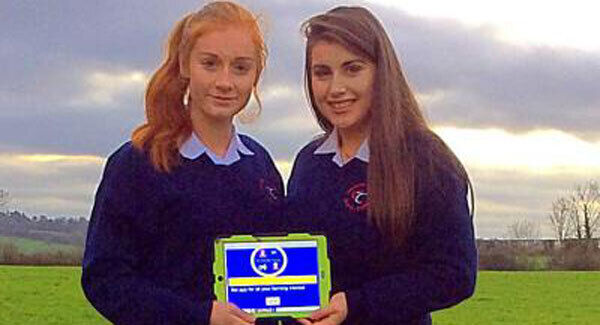
Maeve O’Connor and Aoidhe Sheill, second year students at Colaiste Treasa, Kanturk, are determined to do something about it.
They have developed a mobile phone app to combat rural seclusion, they call it “The Friendly Farmer”.
“While the general public might perceive farming to be a hazardous occupation, physically and physiologically, the issue of isolation and loneliness is just as serious,” Maeve tells me.
“The Irish farmer can be quite isolated in his or her profession, particularly due to the closure of creameries, post offices, local schools, Garda stations and banks.
“As a result, farmers suffer from a high incidence of stress, anxiety and depression, with more than half having been directly affected by suicide in their immediate family or community.
“Our aim is really to combat rural isolation among the farming community through the development of an app which will encourage socialisation and connectivity.”
At last September’s National Ploughing Championships, the Colaiste Treasa students questioned almost 300 farmers on various topics relating to life and general wellbeing — including age, marital status, children, distance from nearest neighbour, whether or not they were a member of a farmer organisation, whether or not they felt isolated in their profession and their feelings on their overall mental health and wellbeing.
Farmers were also asked if they believed there was a need for an app to combat rural seclusion.
“We analysed our results with guidance from the Department of Psychology, UCC and discovered that middle-aged (41–60 years), unmarried farmers reported lower satisfaction with life compared to younger farmers.
"This was irrespective of their gender or farming type. In addition, over 60% of farmers stated that they believed there was a need for such an app,” Aoidhe Sheill explained.
Based on these results, the students designed, developed and produced “The friendly farmer”, an app for the entire community, but targeted specifically at middle-aged, unmarried farmers, because they appeared to have greater need for social intervention.
‘The friendly farmer’ informs the farmer of the local weather forecast, mart prices, local events (including who is attending), and other relevant news.
And it has a discussion board and dating chat-room .
“We have spoken with the Department of Health, the Department of Agriculture, Food and the Marine, farmer organisations, our local vets, and farmers in our locality in North Cork. All were very enthusiastic and made very valuable recommendations to us.
"We collaborated with the Department of Psychology, University College Cork in relation to the statistical analysis and were given very sound advice by a number of software developers in relation to developing our prototype,” said Maeve.
The team also evaluated their app by surveying 405 farmers at Cork and Kerry marts.
“Having viewed our app demonstration, 86.4% of farmers said that they were likely to use the app on their phone, and we were very pleased to note that 92.8% reported that it would be of benefit to them.
“Considerable time had been invested in attempting to make the app user-friendly and it was therefore very rewarding to note that 85.2% of participants said that they found it easy to use, with a further 87.9% reporting that they found it easy to follow. 87.7% of all surveyed stated that they would recommend it to a friend. This was very rewarding for us.
“We are really excited about attending the BT event as we have worked extremely hard on researching, designing and developing our app, and are looking forward now to showcasing it at this renowned national event.
“We have always dreamed of having the opportunity to participate at the BTYSTE and we feel very honoured to have been selected to represent our school, knowing that only 550 entries are accepted every year.” Aoidhe Sheill added.
“We hope that our app will make a real difference to the lives of the regular, Irish farmer.”