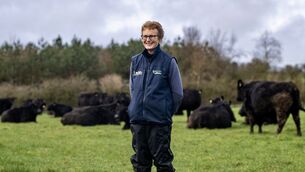
Stephen Cadogan: If paying EU farmers to produce less succeeds...

As if the Brexit threat to our food industry wasn’t bad enough, the EU will soon start paying farmers to produce less.

Stephen Cadogan: If paying EU farmers to produce less succeeds...

The €150m EU-wide measure to support voluntary reduction in milk deliveries by farmers wasn’t supported by Ireland, but was nonetheless agreed last week.

It was only 30% of a €500m aid package for farmers, despite strong demands from some member states for the full €500m to be spent on cutting milk production.


Irish dairy co-ops condemned the €150m scheme, as an inequitable approach, re-introducing supply management as an EU tool to manage dairy markets.

Supply management in the form of milk quotas held back our dairy co-ops since 1983.

It was scrapping quotas in 2015 that enabled former Agriculture Minister Simon Coveney to set a target for a 50% increase in milk production, as part of the Food Harvest 2020 plan to increase agriculture, food and drink exports by 42%.

Food Harvest 2020 has been followed by FoodWise 2025, a 10-year plan to grow exports from €10.8bn in 2015 to €19bn in 2025.

When FoodWise 2025 was launched, the prospect of the EU paying farmers to produce less was far-fetched.

However, times change, and drastic measures have become necessary to solve the current EU farmer income crisis, which is hitting dairy farmers hardest.

Last week’s €500m aid package brought crisis aid for EU farmers to a total of €1.5bn since 2014. That has left the EU with no more spare funds to help farmers, so paying them to produce less is a last throw of the dice.

If it succeeds, paying farmers to produce less could become an established part of the EU’s Common Agricultural Policy (CAP).

The CAP has been relatively settled in recent years, after being slashed from 71% of the EU budget in 1984 to 39% in 2013.

So a big reform may be overdue, and if the new milk reduction scheme works well, it could be central to the next round of CAP reform.

So, whatever about Brexit, Ireland also has to carefully watch CAP reform moves.

The policy was transformed in the 1980s and 1990s, and after the current long-running farmer income crisis, there could be moves towards another big makeover.

Around 1970, the Mansholt Plan was to encourage nearly 5m EU farmers to give up, because CAP price and market support was leading to imbalance in markets.

That idea was successfully opposed, and during the 1970s, generous CAP price and market support for farmers continued.

But the CAP was becoming expensive and wasteful, due to huge over-production.

Big changes followed in the 1980s, including the milk quota in 1983 and, in 1988, a ceiling on CAP expenditure.

In the 1990s, more big moves were designed to limit food production, and move towards a more free agricultural market. Support was cut 29% for cereals and 15% for beef.

Set-aside payments were introduced, to withdraw land from production. There were also payments to limit stocking levels, and to encourage retirement and afforestation.

Later in the 1990s, there were further cuts in market support prices for cereals, milk and milk products, and beef and veal. Instead, direct coupled payments to farmers were increased.

In 2003, subsidies were largely decoupled, so farmers no longer had to produce crops or animals products in order to earn subsidies.

In 2006, the EU started reducing the guaranteed price of sugar by 36% over four years.

Now, into the picture comes paying farmers to produce less. It’s a good move for the EU, which gets more bang for its buck.

Taking the example of the €150m dairy scheme, CAP expert Alan Matthews says it might be worth only 7c per litre to farmers who sign up, but they can quadruple that if the market responds to the supply cut with a higher mlk price.

In other words, the EU spends a euro, and consumers and the dairy industry beyond the farm gate throws in a euro also, in the form of higher prices. It’s no wonder ICMSA has given it a big welcome.

More in this section

Farming

Newsletter

Keep up-to-date with all the latest developments in Farming with our weekly newsletter.

Cookie Policy Privacy Policy Brand Safety FAQ Help Contact Us Terms and Conditions

© Examiner Echo Group Limited