Stephen Cadogan: Forced sale a reminder of rural impact of economic setbacks
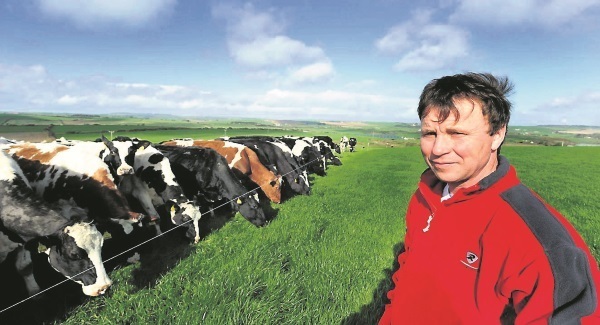
Operation of the farm ground to a halt due to ACC Loan Management securing a judgment against the Kingstons for €2.45m, arising out of their failure to repay loans.
Not only has this removed a major contributor from the local economy; it has also resulted in some major debts for local businesses, which they may not be able to recover.
It may be a symptom of what is happening throughout the Irish dairy industry — the loss of a huge contributor to the wider rural economy, with milk processors warning that a typical dairy farmer could take a €30,000 income hit this year due to low milk prices — leaving a €30,000 hole in the local economy.
These farmers have to drastically cut back their spending, tightening their belts as far as they can go, because no-one knows how long the dairy industry slump will last, and how much further the milk price may fall.
The EU has said it can do no more to help, in as many words, even though dairy farmers in one of its leading member states, Germany, are said to be covering only 64% of their milk production costs.
In 2014, Ireland’s 17,000 dairy farmers were paid as high as 43c per litre.
Now they are getting as little as 22c/l, due to the growing global milk supply dragging down the price on world markets.
ICMSA has calculated how much money the price collapse at farm level has taken out of the rural economy.
It says the 4,754 dairy farmers in Co Cork were paid an average price of 38.4c/l in 2014, which earned them milk sales worth €571.4m in that year.
In 2014, with an average milk price of 30.1cl, their earnings fell to €509.8m.
This year, if an average milk price of 24c is assumed, earnings will be only €405.6m.
Compared to 2014, there’s €165.8m less for Co Cork dairy farmers to spend. But the far-reaching impact of the “disappearance” of this cash no longer trickling through the economy translates into a massive €282m setback for the local economy, according to economists.
That impact will be felt primarily by the suppliers of agricultural inputs to these farms.
It’s already happening; staff in co-ops have noted the increased degree to which farmers are utilising co-op credit to fund their feed, fertiliser, and other input purchases.
An agricultural setback of this nature is the last thing rural Ireland needs, with the independent Social Justice Ireland organisation warning this week that rural areas have higher poverty rates, lower incomes, lower employment rates, and access to fewer public services than urban areas.
This comes as no surprise to rural dwellers who have seen so many of the small businesses they grew up with disappear over the years.
Closure of public services has hit the rural economy too, including the closure of 139 rural Garda stations in 2012 and 2013.
The Social Justice Ireland organisation says the need for transition from agricultural development to rural and regional development, in order to improve the quality of life for all rural dwellers, has never been more pressing.
Unfortunately, the agricultural mainstay is enduring its own crisis now.
Meanwhile, lack of investment threatens the wider rural economy, hit by the lack of broadband and services such as childcare and public transport (according to Social Justice Ireland, several large firms have moved out of the South-West of Ireland as a result of poor broadband speed and quality).
Helping rural Ireland has to get high priority in the talks to form a government.
This must be clear to Fine Gael, as the party bids to lead a minority Government, according to ICMSA, which links the party’s election loss of two seats in Co Tipperary to the estimated €119m impact for the county’s economy due to loss of earnings from Tipperary’s 2,000 dairy farmers, compared to 2014.