Irish Water Q&A: Landowners await route of 165-km water pipeline
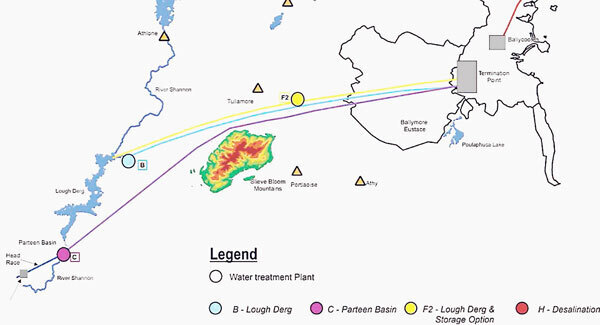
Any landowner affected will have the opportunity to participate in a public consultation process later this year.
Irish Water has identified the Parteen Basin on the River Shannon as its preferred option for a new supply of drinking water for Dublin and the Midlands, and proposes construction of a 165-kilometre pipeline from a reservoir on the Tipperary side, to the south of Lough Derg.
Irish Water says this option will have the least environmental impact of the four options it examined.
Counties to be supplied with water include Clare, Tipperary, Offaly, Laois, Westmeath, Kildare, Meath and Dublin.
In spring 2016, Irish Water’s landowner liaison officers will begin to make contact with landowners within the 2km least constrained route corridor to verify land ownership details or arrange walkover surveys required to identify the 200m wide preferred pipeline corridor envelope.
The 2km-wide least constrained pipeline route corridor has been positioned to avoid as far as possible, the major constraints such as population settlements, designated environmental areas, cultural heritage areas etc.
In positioning a pipeline route within this corridor, factors such as the hydraulic profile of the pipeline, avoidance of impact on non-designated but important habitat, and available space near existing residential and other development are also taken into account.
The position of the pipeline and chambers within land holdings is also considered for least impact on land use and potential.
In routing a pipeline within a 200m envelope, before finally fixing on a construction wayleave of approximately 50m in width, issues raised by landowners will be taken into account, as far as practicable and in a collective way, in final positioning of the pipeline. Issues may also be raised through the public consultation process.
The permanent wayleave, within which the pipeline will be laid, will be registered as a permanent ‘burden on title’ on the land.
The temporary working width is required to facilitate the laying of the pipeline during the construction period only. Both the permanent wayleave and the temporary working width will be fully reinstated post-construction.
Development of buildings or structures within the permanent wayleave will be restricted for the protection of the pipeline and to facilitate access for future maintenance purposes.
Landowners will be required to ensure that nothing is deposited over the pipeline that could interfere with access and to ensure that the depth of soil cover afforded to the pipeline is not materially altered.
Normal agricultural operations can resume once reinstatement has been completed including fencing, hedging and ditching not causing interference or obstruction to the pipeline or material reduction of the depth of soil.
In addition to the restrictions on development outlined above there will be restrictions on the planting of some trees and height of shrubs within the permanent wayleave.
Landowners will be compensated for the permanent wayleave and for any crop losses and/or disturbance incurred during construction.
It is anticipated that a wayleave package including a Code of Practice and financial compensation measures (including ‘burden on title’, crop loss and disturbance payments) will be agreed with landowner representatives, which will then be offered to landowners for their acceptance on a voluntary basis.