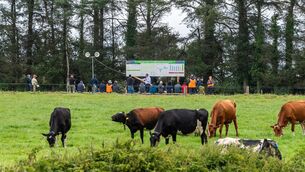
Green winter pasture grows better in spring
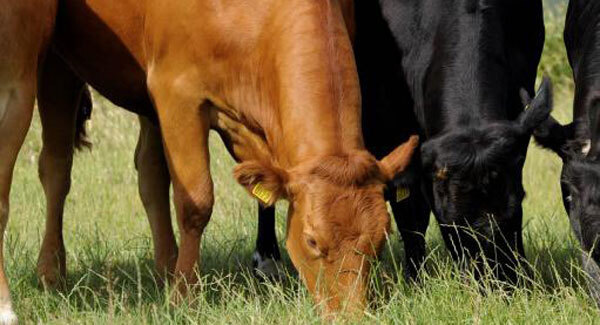
Autumn grass is very valuable and should be kept in the diet of cows for as long as possible.
Green winter pasture grows better in spring

However, early spring grass is much more valuable than autumn grass, and care has to be taken in autumn to maximise the availability of early spring grass.

Grazing pastures after late October can reduce grass availability in February/March as much as 50%.

Pastures selected for the earliest spring grazing should generally be grazed early in the last rotation, which should begin around October 10-15, and earlier on heavy land.

This should result in a nice green pasture over the winter, which encourages very early growth.

Therefore, preparation for early spring grass should begin in the early autumn.

The correct procedure should have been followed for building up a supply of grass for autumn grazing from around mid-August.

This procedure allowed grass to build up by gradually lengthening the rotation from about 21 days in mid-August to 27 days in late August and to 35 days in late September, on pastures that have been tightly grazed or cut for silage or topped, and treated with adequate nitrogen.

About 15% of these pastures should have got at least 50 units of N, and be treated as if for a third cut of silage — but actually for late grazing.

On wetter soils, care should be taken not to build up grass covers that cannot be grazed.

Grassland Management

The main objectives of autumn grassland management are to maximise the amount of high quality grass in the cow’s diet for as long as possible, and have all paddocks in good shape facing into the winter.

The target on reasonably dry soils is to have 60% of the farm closed off by early November, and the rest grazed off before housing.

This should result in a target cover of 220kg of dry matter (DM) per livestock unit, or 550kg of DM/ha at a stocking rate of 2.5 LU, at closing.

Good grassland managers use their experience to alter these targets to suit their own soil type situation.

It is essential to have the soil fertility up to standard. However, that is not the situation on most farms. Late slurry applications should be used to correct some of the nutrient deficiencies.

Of course, adequate reseeding is necessary, but it is too late to do anything about that this year.

If you have any doubt about soil fertility, get soil samples taken immediately, while there is still time to get deficiencies corrected.

Adequate fertility over the winter is essential for early spring grass.

Great care has to be taken with autumn grazing. Soil damage will reduce early spring grass production. Good grazing facilities with roadways and multiple entrances and back fencing will be a great help to minimise poaching.

Every effort should be made to graze paddocks out well in the last grazing. The target early October farm cover is 400kg of DM/cow.

It is vitally important to manage pastures to optimise grazed grass quantity and quality for the rest of the season. The current poor milk price makes it more important than ever to avail of autumn grazing and long lactations.

Good autumn grazing management will reduce feed costs, labour requirements, housing/ slurry storage requirements, and improve animal performance and profitability.

Autumn Supplementation

Many farmers will be milking cows later this autumn. The response to concentrates with autumn grass is generally good, but depends a lot on the genetic potential for milk production of the herd, and the supply and quality of grass available.

The vast majority of herds have the potential to respond very well to autumn supplementation. The higher the genetic potential, the better the response will be.

If grass is scarce, there is always a good economical response to feeding concentrates.

Because of the relatively low energy in autumn grass, there is a better response to concentrates than at any other time of the year, assuming milk yields have not dropped too low. Supplement while yields are still around 18 litres per cow, or higher.

With a reasonably good supply of grass, well-bred cows should give a response well over of one extra litre of milk per kg of concentrates, at a feeding rate of about 2kg to 3 kg concentrates.

With the likely prices of milk and concentrates this autumn, this should result in a return of at least €1 worth of milk for 70c worth of concentrates.

Where very high quality silage bales are available, they could replace much of the concentrates.

x

More in this section

Farming

Newsletter

Stay ahead of the season. Sign up for insights, expert advice and stories shaping Irish agriculture.

Cookie Policy Privacy Policy Brand Safety FAQ Help Contact Us Terms and Conditions

© Examiner Echo Group Limited