Sheep’s Head ‘Whackers’ lead the way on wildfires
A spate of wildfires has scorched the land recently. One group in West Cork has decided to take action
Sheep’s Head ‘Whackers’ lead the way on wildfires

2015 has been another year for out-of-control rural wildfires, with thousands of acres burnt in Killarney National Park in recent weeks.

2010 and 2011 were also particularly bad years.

In 2012, Ciarán Nugent, fire liaison officer with the Forest Service, advocated action nationwide, and set up a risk alert weather notification.

Out of that, Eugene Curran, forestry inspector with the Forest Service, set up the Cork Wildfire Co-operative Group, of which he is now chairman.

Cork has led the way, and the Co-operative Group has spawned an innovative local farmers’ wildfire group on the Sheep’s Head peninsula in West Cork, an example of the recommended way forward.

“The aim was to do something about it, rather than watch it going on year after year,” Eugene says.

There have been 10 wildfire-related deaths in 15 years. Burning, particularly out of season, is damaging the environment, property, forestry, and telephone and ESB wires, he says.

He puts the rising wildfire threat down to two changes in rural areas: The demographics, leaving fewer younger people on the land; and reduced grazing on the hillsides, allowing vegetation build up.

The Co-operative Group brings together the Forest Service, the National Parks and Wildlife Service, the gardaí, Fire Service, Community Alert, Teagasc, Cork County Council, Coillte, and the IFA.

The group’s objective is to reduce wildfires and encourage controlled or prescribed burning through interaction, information exchange, and education.

“The best way to go about it is to plan so that you know what you’re doing, and have a contingency plan in case things go wrong,” Eugene says.

Jerry Daly, a sheep farmer with some dairying, and Gerard O’Mahony, a mixed beef and sheep farmer on the Sheep’s Head, were among those who attended Co-operative Group meetings.

“As a result of some of our meetings, Jerry and his gang got together and realised the advantages in having numbers,” Eugene explains.

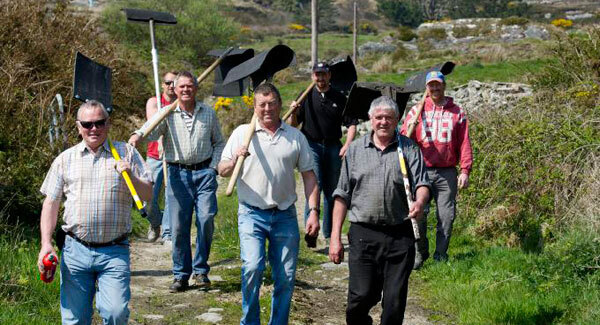
Both are now members of the 12-member group known as the Sheep’s Head Beaters.

“We actually called ourselves The Whackers the first time,” laughs Jerry. These farmers, within an 8km radius of the Sheep’s Head, west of Kilcrohane, have got together to manage burning. They reasoned that even with some farmers working, they would still always have the six or seven pairs of hands recommended by the Fire Service for burning control.

The group displays the same co-operative spirit which is behind the Sheep’s Head Way, a popular 88km long-distance walking trail.

“There was always the feeling out here that if there was a fire, people would come and help,” says Gerard.

The main reason for burning, Jerry believes, is getting the land in order for various payment schemes, including the new GLAS agri-environmental scheme. “With all the payments, you can’t have undergrazing or overgrazing, and there’s a problem now on a lot of hills with undergrazing.”

Jerry says the Fire Service is 100% behind the group. The farmers are on the spot, whereas it will take the Fire Service at least 45 minutes to get there, and then they have to climb the mountain.

“They have enough to do going to accidents, so if we can spare them any time, it’s about being responsible, I suppose,” Gerard says.

“We contact the Fire Brigade. We ring them when we’re going burning, and we ring them when we finish as well,” Jerry says, adding that it works well.

“I was burning, and I got a call from the Fire Brigade that they had been rung, but the fire was in a different area. It was about five miles away from me, and I was able to give them that information.”

Eugene says the Co-operative Group held two burning demonstrations, one in Kells, Co Kerry, and the other at Kealkil, near Bantry in West Cork. “Ciarán Nugent got some burners together, and Jerry organised some straw in a safe, confined area, and everyone could watch how the techniques could be used.”

Ciarán had attended demonstrations in Spain and in Northern Ireland beforehand.

Eugene agrees that their group is effectively going back to old methods of back-burning and fire-breaks that farmers in the past were familiar with, and notifying the authorities before and after burning. “The fire service had a tender there, just in case,” says Eugene adding that there was very positive feedback from that.

Jerry was impressed. “It was right alongside the forest,” he explains.

“They saw the equipment that was needed, the clothing that was needed and went through the whole process of how to go about it, so it was very beneficial.”

They were shown how to back-burn with a drip torch using 70% diesel mixed with petrol. Sourced in Spain, the torch has an adjustable wick affording control.

Fire-beaters, timber-handled with rubber flaps, are more effective than shovels, and they wear visors, boots, and fire-resistant overalls.

“You don’t have to wait until the weather is really dry. You can do this fire-break back-burning wherever you don’t want to go beforehand,” Jerry explains.

He says that if the wind changes, you can get caught out by the fire changing direction. A simple piece of tape on a stick was used to demonstrate the wind direction throughout the exercise.

Eugene got the job of using the walkie-talkie, and keeping an eye on the flag, ready to notify the others in case of a change in wind direction.

Jerry found his niche, too. “I was delighted, because they said it was important to have one fellow spare, standing up on high ground.

“When nobody’s on the look-out, a fire could start where it had already quenched.”

More in this section

Farming

Newsletter

Stay ahead of the season. Sign up for insights, expert advice and stories shaping Irish agriculture.

Cookie Policy Privacy Policy Brand Safety FAQ Help Contact Us Terms and Conditions

© Examiner Echo Group Limited