Denise Hall: Vanuatu rebuilding life after cyclone
“Live, Laugh, Love. Vanuatu — the happiest place on earth” the advert promised. Achingly beautiful photos of pristine coral sand beaches, beautiful lagoons, lush green bush and fertile little food gardens bursting with fruit and vegetables accompanied it. Plump, happy children romped about, carefree in the warm climate.
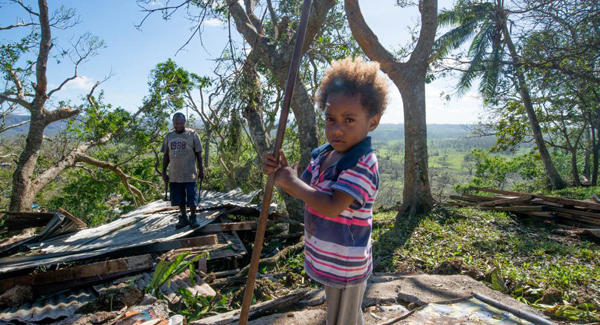
But that was last year. Now much of this green and pleasant collection of islands — 81 or 82 in all, depending on the prevailing tide, so residents say — has been reduced to grey, decaying foliage after cyclone Pam tore through the archipelago in March.
“Natural disasters are a part of our lives” a local woman commented before disaster struck.“ Our islands were born from fire within the earth. Both our origin stories and scientific explanation agree on this fact.
“We know that some come upon us unexpectedly such as earthquakes. We have warnings for other disasters such as cyclones. Being prepared can help limit the damage to our communities.”
But although there were warnings of the ferocious Cyclone Pam’s imminent arrival, no one was prepared for its terrifying force. There were winds of 270 kilometres plus per hour, with gusts peaking at 320kmph.
The cyclone’s eye passed close to Efate Island where the capital is located and an estimated 90% of the buildings in Efate’s capital Port Vila have been damaged.
The UN has estimated that about two thirds of the population make their living from agriculture and three quarters of Vanuatu’s people live in rural areas on remote islands where basic amenities such as electricity, water supplies, schools and health services were in scarce supply before Pam’s depredations. For many people these things are simply non-existent.
Tourism in this beautiful place, where exotic islands abound, is a mainstay of the economy. Such is the degree of damage the cyclone caused that it will be some time before the islands see a return of visitors. Some schools have managed to remain open but many children, especially those in senior secondary schools cannot reach school due to lack of transport as hardly any buses now operate.
I was in Sri Lanka just days after the 2004 tsunami, and I saw first-hand the effect such terrifying devastation has on those children who survive it. Their very grip on reality can be threatened; they may have lost parents, siblings, their homes and their few treasured possessions. For the children of Vanuatu, their loss has been great.
Vanuatu is a Y-shaped chain of islands between the equator and the Tropic of Capricorn. The capital Vila is about 1900km northeast of Brisbane, Australia.
Approximately 200,000 people live on its islands.
The archaeological remains found in Vanuatu indicate that human beings have lived here for a very long time, some 4,000 years in fact. New Guineans were believed to be the first to colonise the fertile islands.
Tradition has always been important to the Melanesian people. It is a whole way of life, which governs behaviour. Customs and traditions have thrived for centuries and are central to major events in village life. All the inhabited islands have their own languages and their own customs and traditions.
Their independence — cultural and otherwise — was hard-won after many years of colonisation. In 1774, Captain Cook named the islands the New Hebrides, a name that lasted until independence.
During the 1860s planters from Australia, Fiji, New Caledonian and the Samoan Islands encouraged an infamous long-term indentured labour trade that became known as “blackbirding” and resulted in the removal of more than one half of the male population of the islands.
In the book Vanuatu,by Harewood and Bennet, this memorable passage refers to the labour practices that were still prevalent in the 1920s.
“Drunken plantation owners used to gamble using the “years of labour” of their Melanesian workers as currency. Islanders used to be lined up against the wall at the mercy of their employers dice.” On the July 30, 1980, the Republic of Vanuatu was finally created.
Alice Clements is a New Zealander, a humanitarian worker and communications expert with UNICEF. She is based in Vanuatu and lived through the cyclone. She told me about that terrible night and what life has been like since.
Not long as it happens. And it was a night that I will never ever forget. Nobody expected it to be that bad. I was lucky in that the building I live in is pretty solid and built of concrete. But still, when it hit, it was like a beast from another world.
I took shelter under my sink and spent the night with my feet braced against the door, trying to keep it closed. Feeling the building move and watching the water surge in the toilet, it was the most scared I’ve ever been, winds as strong as 350 miles an hour. It was unbelievable.
It was quite heartbreaking. This place really is a slice of paradise and now it’s all grey trees, no bird song and the fruit bats are flying in the day, trying to get food. But what’s remarkable is the people, who are very resilient.
When you ask them how they are, the first thing they say is how glad they are to still be here. No mention of the fact that they have lost their houses, food, power and schools.
Everyone is so compromised and people don’t want to talk about what they are going to do next. They don’t want to go any further. It’s just too bleak for them to contemplate right now.
Of course fundraising is a top priority. The people here need so much, and especially the children. I think food is the single biggest concern though.
It’s going to take at least three to six months for any crops to grow again. We’ve also been working on a measles immunization project, over 10,000 children so far.
And a project that involves media savvy young people who we’ve recruited to interview over a hundred children who have lost so much.
Apart from that it’s a question of rebuilding and replanting.
Build back and build better, that’s the motto.