IFA celebrates 60-year rollercoaster journey

Ray Ryan looks at the proud history of an organisation which was set up to give farmers a voice in their own affairs.
IFA celebrates 60-year rollercoaster journey

Some 3,000 people attended the launch of what is now the Irish Farmers Association at the Four Provinces Hall in Dublin on January 6, 1955. The 60th anniversary of that event will be celebrated at the Convention Centre in the capital on the same date next week.

What happened between those dates is the story of farming and rural society in Ireland in the second half of the last century and the early years of the current one.

Pa Quinlan, then president of Macra na Feirme, who presided at that inaugural meeting, set out the vision for the new national body which was named the National Farmers’ Association.

The aim was to provide farmers with the means of coming together to work out the salvation of the country’s agricultural industry which was in the doldrums.

Mary McAleese, the president of Ireland, recalled the prevailing conditions when she spoke at the NFA-IFA golden jubilee celebrations 10 years ago.

She said the era of farm mechanisation had not yet arrived in any significant way and the business of running the family farm was labour-intensive to a degree that today’s generation could hardly imagine.

Water was still drawn by hand from wells on many farms and the rural electrification programme had still to reach many areas. Few farm families owned a car.

Much of the work was done by hand, farming was, by and large, mixed and tasks were invariably shared by adults and children.

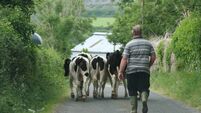
It was the era of horses rather than tractors, of cattle being driven on foot to the mart, of the creamery cans being brought by each farmer to the small local dairy or left at the end of the lane for collection. It was the era of the scythe and of long days of toil, sowing, reaping and gathering in crops from the fields.

Trade in agricultural produce was essentially confined to our neighbouring island and the European Economic Community, later to become the European Union, was a far-away entity and the preserve of a few Continental European countries.

Ireland was a country barely able to feed its own population. Almost a third of what a farmer produced was necessarily consumed by his or her own family. National milk production was around 250 million gallons. We imported almost 5,000 tonnes of butter. Bacon and other products were also imported. Our export of rabbits was double that of sheep meat.

Those were some of the challenges that faced the infant NFA, headed by Dr Juan Greene, Magany, Co Kildare, whose family had spent time in Argentina.

Early priorities included the right of direct negotiations with the Government and with the purchasers of farm produce, the right to a fair taxation system and the promotion of better farming.

A decade later farmers rebelled against high rates, low and falling incomes and other issues. Rickard Deasy, a Tipperary man with a trademark black beret and walking stick, led a march in October 1966 from Bantry Bay to Dublin to support a demand for farmers’ rights.

A mass rally outside Government Buildings was attended by 30,000 farmers. “Not a bad effort for a pipsqueak organisation,” declared TJ Maher.

It was a clever oratorical reversal of a term the Agriculture Minister Charles Haughey was said to have used earlier in the year in what was seen at the time as an effort to belittle the NFA.

Haughey refused to meet a delegation and a small group of farmers, who would probably be known today as The Merrion Nine, began a 21-day round the clock vigil on the footpath.

The NFA was sharply criticised by Taoiseach Sean Lemass who claimed in the Dáil that their parades and “harassing of ministers attending public functions” appeared to be designed to intimidate the Government. He claimed the issue was not a question of discussions.

“It is a campaign by the NFA to bully the Government into transferring to them the responsibility for agricultural policy now exercised by the Government through the Minister for Agriculture,” he said.

The NFA strongly rejected the charges and insisted it was seeking the legitimate right to represent the interest of farmers at a tough economic time. Lemass eventually decided in what was one of his last acts as Taoiseach, to invite the NFA leaders to meet Haughey and himself. Deasy, who had pledged to remain outside Government Buildings until “the crack of doom,” had won his demand to meet with the minister.

Tensions eased. Jack Lynch became Taoiseach and Neil Blaney was appointed Minister for Agriculture. But trouble erupted again. Farmers picketed rates offices and disrupted traffic. Troops were even deployed in Kilkenny to support gardaí and officials in seizing property for non-payment of rates. The protests went on for three years. Some 200,000 farmers and supporters were involved in demonstrations and 200 farmers were jailed.

However, the NFA eventually won the right to negotiate for its members. Ireland’s entry into the European Economic Community loomed and the NFA became the IFA which opened an office in Brussels. A new era of lobbying dawned.

The late Raymond Smith, who served for a period as NFA press officer, has left us with an abiding account in his book, Urbi Et Orbi and All That, of stirring days and nights during the campaign.

He claimed the spirit and solidarity that was born out of that campaign was later channelled by farmers into constructive ends such as the formation of FBD and other ventures that made it all worthwhile.

Smith wrote: “Before there had been a feeling that their individualism would never permit them to march under a common non-party political, non-sectarian banner to assert their rights. Now all was changed, utterly changed. They saw the new dawn. They discovered what they could do for themselves. They could respond to leadership and discipline as a body. They saw clearly, too, without a strong overall national organisation to crystallise their claims, they would get nowhere.”

There have been many campaigns since those heady days, notably the protest at meat plants in 2000, led by Tom Parlon, a tractorcade that John Dillon led from Bantry to Dublin in 2002, tracing the route taken by the rights marchers in 1966.

Today, The IFA has 87,000 members, 947 branches, 29 county executives, 4,000 voluntary officers and 60 staff.

It has been led by 14 presidents from 11 counties, and four general secretaries, Sean Healy 1955-1976, Michael Keogh 1977- 1982, Michael Berkery 1983-2009 and the incumbent Pat Smith.

More in this section

Farming

Newsletter

Keep up-to-date with all the latest developments in Farming with our weekly newsletter.

Cookie Policy Privacy Policy Brand Safety FAQ Help Contact Us Terms and Conditions

© Examiner Echo Group Limited