Fine lines: organic and free range eggs
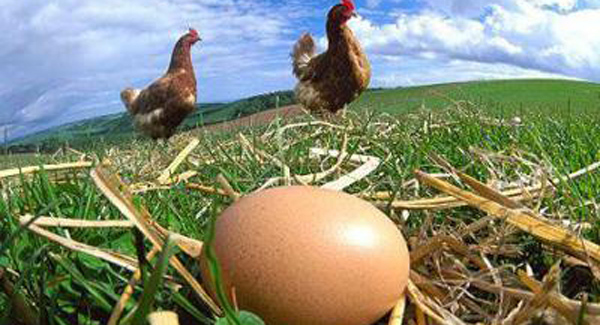
Answer: when it is called an organic egg!
The glory years are over. From spring 2012 until very recently, organic egg producers could also label their eggs free range. The logic of this was that as free range rules are an essential part of the organic standards, organic eggs could be labelled as both organic and free range. Simple and easy.
In fact, organic rules are more free range than the free range rules.
Maximum unit size is half that in organic as it is in free range. Organic housing units can be no bigger than 4,800 birds, whereas in free range there can be up to 10,000 birds.
In practice, many certified organic producers supplying local/regional markets have nothing like 4800 birds, but rather have a couple of hundred. However the rules on housing limits for both systems mean that the biggest organic houses are less than half the size of the biggest free range houses.
Not only that, the stocking rate differs too. Guess what? There are fewer organic birds per square metre than free range birds per square metre. This is the core of what it means to be free range— more room to roam.
In organic, the rate is a maximum of 21 kg per sq mt, in free range it’s 27.5 per sq mt.
This has been incorrectly written about, as the difference between six birds and seven birds per square metre, in other Irish media recently. This would presume a bird of 6.5kg, a fairly hefty creature, even by organic standards.
The lifespan of organic birds? Why that’s longer too. In free range, the bird typically lives to 56 days. In organic, the bird lives considerably longer, more usually 81 days.
So having a longer life, with more room to roam, better even than standard free range, surely means that you can at least call it free range? Not so, according to the Department of Agriculture. The Department decided to seek clarification from the European Commission, and it turns out that products cannot carry the label of two farming systems.
Though many consumers may think organic is only about the feed, that seems irrelevant. That free range is a far more familiar and used term is irrelevant too.
Both terms could be used by organic egg producers from 2012 up until recently.
Now it seems further clarification by the Department at EU level has knocked this back for the three dozen or so organic egg producers in Ireland.
Just to be clear, there are of course many other differences between conventional/free range and organic eggs and poultry.
Beak trimming and claw clipping are not allowed in organic. While not strictly an issue for free range, consumers of free range eggs could be said to be interested in this.
Routine or preventative use of antibiotic is also prohibited in organic: if an organic bird is healthy, it simply cannot get antibiotics. Withdrawal periods are also twice as long for organic birds that do receive antibiotics.
According to Professor Dame Sally Davies, Chief Medical Officer for England, antibiotic resistance — which she says travels from animals to humans — causes 25,000 deaths each year in the EU.
The feed for organic birds is always at least 95% organic and always GM free.
Eventually, this 95% will move to 97.5% and then 100%. Change is behind schedule —an achilles heel in the overall organic system.
Despite this one last minor blip, very strong differences are certainly there when comparing organic and free range eggs.
And organic birds certainly have the good life, when compared to birds from other systems. Just don’t call them free range.