Boucher spells out bank’s faith in dairy sector
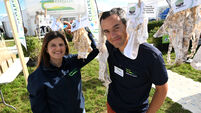
The line-up was impressive with BOI Group CEO Richie Boucher, Dairygold Co-op CEO Jim Woulfe, Glenilen Farm joint owner Valerie Kingston, and Jack Kennedy of the Irish Farmers Journal making presentations.
Richie Boucher set the scene, detailing Bank of Ireland’s performance, noting a continued improvement in underlying profits, improved interest margins, and reduced operating costs due to staff restructuring.
He said the bank’s consumer banking, wealth management, agri and SME business and corporate banking divisions are in working order following restructuring and rationalisation.
The bank’s capital ratio was strong, at 12.3% as of January 2014, and it has just completed a successful offering, raising €750 million at comparatively reduced costs.
Mr Boucher added that the Government and taxpayer investment in the Bank of Ireland, through the bailout, had now been fully repaid, and the bank had given a return to the taxpayer in the form of a 10% coupon yield, with the Government still retaining 14% of the share capital of the bank.
He noted that the bank’s primary function is to successfully deploy its capital in the form of lending into the economy. It was interesting to hear his positive statistics on the improving economic environment, increased employment, increased GNP, reduced unemployment, and a small but steady improvement in house prices.
On agriculture, Mr Boucher noted that Bank of Ireland was responsible for 50% of all new agri lending in 2013, and intends to lend €21 billion to the agri and SME sectors as part of its five-year plan.
The bank predicts that dairy farmers will be investing about €1.3bn in business expansion. Mr Boucher noted that Irish farmers are relatively lowly borrowed compared to similar grass-based production farmers in New Zealand, and many Irish farmers have capacity to borrow, should they wish to do so to fund expansion.
However, he cautioned against expansion for the sake of expansion, and said farmers should expand from an efficient base.
Commentating on volatility, he said business plans for dairy expansion must be stress tested for ability to meet repayments from reduced milk prices, and/or a higher interest rate environment. He said the bank offers flexibility to assist with volatility, through capital repayment holidays in times of poor returns, or higher repayments in good times.
For farmers who may be worried about the current wobble in commodity markets, the presentation from Jim Woulfe of Dairygold was a tonic.
At one level, our exposure to the export market is phenomenal, given that 85% of Ireland’s dairy production is shipped out, however, we should remind ourselves that Irish milk production is less than 1% of total global production. Our expansion beyond 2015 is therefore small in the global context.
Mr Woulfe highlighted UN studies showing that the world will need to produce twice the amount of food it is currently producing in order to feed the expected population. He highlighted increased global urbanisation, and said urban dwellers in Asia tend to consume six times more dairy that rural dwellers.
The outlook for growth in demand for dairy produce is therefore fuelled by increasing population, urbanisation, spending power, and demand for higher quantities of dairy products — for example through the expected opening of 1,500 new Starbucks and 700 new Pizza Hut stores in Asia this year.
Mr Wolfe suggested that returns for milk will remain relatively high, due to low stocks of dairy produce worldwide and increasing consumer sentiment arising from a recovery in the global economy. But farmers should be prepared for volatility but at the same time be optimistic for the future.
Valerie Kingston described how Glenilen Farm at Drimoleague in West Cork started in their kitchen with two saucepans, and they started manufacturing yoghurt and cheese cakes in 1996. Initially spurred on by sales at local markets, they have expanded since then to an annual turnover of over €4.2m.
Their story is one of the right product, and determination, establishing a multinational food brand from a 59-acre farm. Valerie said Irish produce is second to none. Glenilen is a member of Origin Green, the Bord Bia initiative to promote and market Irish food as sustainable food. Sustainability is becoming an ever increasing issue for consumers, according to Valerie.
Comparing Irish farms to massive operations of 3,000-cow plus herds recently established in Russia, Jack Kennedy of IFJ suggested that Irish farmers must not focus solely on scale. They cannot compete globally on labour costs or concentrate feed costs; instead, he suggested, our natural grass growing advantage is where our expansion strategy must begin.
He said farmers could, where it suits them, expand at their own pace over a number of years. But expansion doesn’t come cheap, as the costs of carrying extra stock and installing extra infrastructure can be significant. For example, the Kilkenny green field farm costs €4,000 per cow to set up, even with scant expenditure on buildings.
www.coughlanaccounting.com