Cash flow critical in dairy farm expansion
THE foul weather, soaring feed costs and milk price volatility of 2012 have given valuable insights to dairy farmers planning to expand their output post-2015.
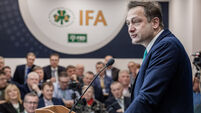
Farm efficiency and rapid access to cash flow to cope with an array of external shocks, and the need for every decision to be profit-driven — these were the core “expansion” issues on the agenda at last week’s Teagasc annual dairy conference in the Brandon Hotel, Tralee, Co Kerry.
Teagasc dairy advisor Laurence Shalloo observed that farmers are already keenly aware that expansion will mean enduring increased feed costs and probably losses for three or four years, as farmers retain heifers and build herd size.
“Dairy expansion is already under way,” said Mr Shalloo. “We have seen 100,000 extra heifers reared annually compared to four years ago. At a replacement cost of €1,500 per heifer, including the calf value, that equates to €150m invested already by farmers.
“That places a significant strain on cash flow, particularly in the first three to four years of expansion. This cost will grow even further when you take on board extra land and labour costs.”
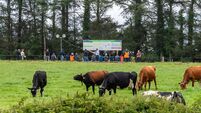
One clear positive, Teagasc studies show that the ratio of hours of labour per cow will reduce with expansion; 44 head of cattle require 13.5 hours of maintenance per cow per year, versus 8.4 hours for 147 head. However, the link between herd sizes is a more complex measure to gauge. The annual accounts for the Greenfield Farm in Kilkenny — an open book readily available as a guide to any dairy farmer — show a €48,000 cash surplus in 2010, then €110,000 in 2011, but €33,000 in 2012.
The starting plan for the Kilkenny farm was very well defined by its shareholders — Glanbia, the Phelan family, the Farmers Journal, FBD, AIB — but, for all their planning, the group’s year end cash surplus was still dictated by milk price volatility.
Teagasc director Prof Gerry Boyle suggested to attendees in Tralee last week that the Kilkenny farm’s open books offer far more real insights than a dry case study. In fact, the farm’s most valuable lessons are in its financial difficulties and rising costs.
“There is an open book on the Greenfield Farm,” said Prof Boyle. “People have learned a lot about how the farm’s efficiency is impaired as you try to expand. You have to take those challenges into account in your plan.”
The Kilkenny farm is built on a business plan of €1.8m to €1.9m, with 30% of the funding (€350,000) coming from equity, and about two-thirds (€850,000) from loans which were repayable as interest-only for the first two years. The partners are now repaying annual interest on the borrowed money.
To date, total investment has come to €1.24m. The herd has grown to 350 cows.
Leased for a 15-year period, the dairy farm was converted from a tillage farm.
It has required two full-time labour units, plus short-term labour in periods of peak demand.
Farm efficiency has been good. However, as the €33,000 year three cash surplus shows, there has not been much by way of surplus cash to cope with any potential crisis. The notion of banking away profits as a safety net has not really been an option.
Given the likelihood of a farmer having only a few thousand euro of surplus cash to cope with volatility in milk price, feed costs and any weather challenges, Teagasc insists that access to working capital is as critical to the business as management of livestock and pasture, the soil fertility and having the ideal grazing infrastructure.
“Capital will be scarce, so prioritising is crucial,” said Laurence Shalloo. “But, when buying in animals, don’t scrimp on the test; it’s €35 per animal well spent. Check the cell count history. As the herd size grows, you need to be more proactive in disease treatment, and you must be prepared to cull.”
Reviewing the first three years on the Greenfield farm, Mr Shalloo said that their contingency planning bar had been set too low. Volatility and other challenges are huge issues. Liquidity and cash flow are vital. Farmers need a risk mitigation strategy.
So where do the choices come in? Clearly, farmers need extra cattle. They need extra land, but they may be better off leasing than buying — in a crisis, quick access to cash can save you; owning extra land won’t.
One banker present in Tralee said that one of his most frequent reasons for rejecting a loan application for a dairy farm expansion is the absence of any projection for a cash flow requirement.
Laurence Shalloo accepted that this was a fair criticism of farmers, whom he urged to view the business plan not just as a tool to “get finance” but as a framework to drive their growth plans, giving banks a realistic plan they can believe in and buy into.
“Finance is not as freely available as it was, but it will be found for those who have a good business plan,” said Mr Shalloo. “There is a massive difference between 1985 and now. There are a lot of positives in farm management. The herd has better genetics. We have a good grasslands programme. But we need a big change of attitude when it comes to the finance side and business planning.”
The statistics of recent generations certainly back up the Teagasc dairy expert’s view that recent generations are seeing far greater efficiency being delivered by a reducing number of dairy farmers. Dairy output rose by 72% from 1975-85. In 1984, just prior to the advent of quota restrictions, Ireland was home to 76,000 dairy farmers and 1.5m cows. Now there are 18,000 farmers and 1.1m cows, giving roughly the same annual output.
While these figures indicate that there is already a marked swing towards efficiency, Teagasc believes that farmers can still enhance profitability with more focus on genetics, achieving target weights and by targeting calving at the start of herd calving.
For Ireland to realise the 50% milk output expansion goal of Food Harvest 2020, some beef farmers would have to convert to dairy.
These converting farmers may have some efficiency catching up to do, but they will certainly be attracted by the additional €750m in farm receipts likely to come from the 50% expansion projected in the FH2020 report. Add to this extra cull cow sales of €55m, extra calf sales of €22m, and you have a pot of €820m for farmers to share.
This pot may prove too attractive for many to resist. However, Laurence Shalloo and his Teagasc colleagues made it very clear that their view is that only the most efficient will be profitable, and only those with a meaningful business plan will be able to access bank funding.
Milk output will have to increase by 2,500 tonnes. Milk yield will have to increase by 15% per cow, from 4,570 litres to 5,270 litres per cow. Overall, the national herd must rise by 330,000 head of cattle.
With price volatility and other challenges, post-2015 dairy profits may prove a race for fool’s gold for some. There is a very real opportunity, but success will require a sound long-term financial strategy, which begins with at least three or four years of scraping by as the herd size grows; though some in the dairy sector are already mid-way to clearing this first hurdle.