Food business satisfies two retired couples’ appetite for success
STARTING a new business later on in life can be daunting. Doing so in the middle of a recession, without a formal background in food production, can be all the more so.
But, in their golden years, two couples in Co Kerry have shown how to turn a love of food into thriving, quality food businesses. Both Sásta Sausages and Skellig Pantry sell at the Tralee Farmers’ Market, opposite the Brandon Hotel every Saturday.
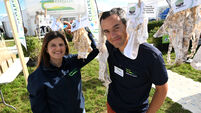
John Paul and Kate O’Connor’s Sásta Sausages, and Harry and Ann Perry’s Skellig Pantry stalls won gold at the recent Blás na hÉireann Irish Food Awards. Sásta black and white puddings, and Skellig Pantry paté also won silver medals in their respective product categories.
Oliver Moore: Your background is far from food, it’s fair to say, John Paul. The buildings in London, to be specific.
John Paul O Connor: My family moved from Beaufort, Co Kerry to London when I was 11. In my teens I went into construction. I was doing slabs, kerbs, pipes and the like for John Murphy Construction, an Irish construction company in London. Eventually I went out on my own, doing price work.
I met Kate, my wife, on holidays in Killorglin. We eloped after four weeks — she came over to London with me. We got married in 1977 after two years. She worked in cafes and Corrigan’s butchers’ shops in London. They were originally a Co Kildare company, and had ten butchers’ shop around London at the time. I used to go into Corrigan’s at the weekends and see how it was done. I gained some experience there, got a liking for making sausages and puddings. It was always in the back of my mind as a thing I might do someday, but I never took it up seriously, until now of course.
When did you return home?
We moved back to Ireland in the 1980s; it was a bad move in a way, there was recession on here at the time. I did odd jobs on the buildings, sold insurance, couldn’t make a living out of it. Like so many others, I went back to London, this time in 1988. This time my wife and family stayed in Co Kerry. I came back every five or six weeks on Slatterys coaches, which were filled with people going to London, to be dropped off at Cricklewood Broadway. That’s where the Irish met to get jobs, outside the Crown pub in Cricklewood. Contractors, builders and subcontractors would come along, and you’d wait until you got a job.
I did this for five years, and then in the 1990s, came back for good. When the economy picked up, I started subcontracting in building, which I kept up until 2009.
So how did the Sásta sausages food business come about, John Paul?
When the downturn came, I’d 22 people working for me in subcontracting. I had to let lads go, and found that there were all entitled to benefits, but I wasn’t entitled to anything, as I was self-employed.
I thought about construction work abroad again, but it’s a young man’s game. I had a greenhouse, grew my own veg and herbs, and was always making black and white puddings and sausages.
Everyone used to taste them and tell me they should be made on a larger scale. I researched it for nine months, and felt ready. I couldn’t find food incubation units in the region, but found an old building that had been used for fish processing. I did it up to food hygiene standards, and built a 60 square metre plant here in Cromane for about 40,000. My background in building meant I could do nearly all of it myself really.
So myself and my wife started a food business, in the middle of a recession. People said we were mad, but we knew we had a good product.
The first week, we went out to a farmers’ market in Glenbeigh, on the Ring of Kerry, in 2011. We brought 30lbs of black and white pudding, and people loved it. We sold out in an hour. The next week, we brought double, and sold out again. It was great market research, there were people from different countries and counties, and every Sunday we’d sell out.
We kept growing, and moved onto Listowel, and now the Killorglin and Tralee farmers markets. We also supply some country houses, butchers’ shops and restaurants. Places like Carrig Country House and restaurant, the Moorings in Portmagee, Cahillane’s Speciality Butchers, COR — OrigTxt: (Cahillanes Speciality Butchers)and Hannah Mary’s Country Store in Killorglin and more. Now, we do 700 lbs per week of meat, between the sausages and the puddings.
What’s special about the puddings and sausages you and your wife produce?
Our pork comes from Kieran Hartnett’s wholesalers in Tralee. We produce in an old-fashioned, artisan sort of way. So it’s not a mass-produced factory food. We don’t use collagen tubes. The sausages are 93% pork, and the vegetables and herbs I grow myself. We use gorse flower — furze bush as we call it down here — which is dried and used in the black pudding, like my grandmother used to do. We also use wild garlic in the spring time.
What drives you now John Paul? Is it up scaling for export, or are you happy as you are?
I’d love to create jobs, so people don’t have to emigrate, and families don’t have to be broken up. I built the unit we work in myself, but had to get an electrician, in as I couldn’t do that part. He’s now emigrated to New Zealand with his entire family, and I feel for them, I know what it’s like. So if I can create jobs here, I will. The business is growing fast, I have a European meat
licence, so I’d be hopeful I can start to employ people here — even just part-time. Even if people could just come in at seven in the evening and do a few hours, I’d rather employ 14 people part-time than seven full time.