Searching high and low for the elusive haymaker
Like the Scarlet Pimpernel, his whereabouts are unknown.
It’s not surprising, given that there has been only a handful of fresh sunny days mingled with stacks of wet ones over the summer.
With no suitable weather having appeared on the horizon, the haymaker, like the corncrake, has become an endangered species.
Not only has it been impossible to make hay, even the saving of silage has proved a difficult task, particularly on heavy ground.
The old concerns of dry matter content are redundant words this summer, as many farmers have simply been hoping that the silage can be kept mud-free, not to mind rain-free, for the duration of harvesting.
Back in the 1980s on the family farm in Aghabullogue, we made hay each summer for ourselves and to sell.
In those days before the invention of baled silage, haymaking was a major gamble. There was no safety net.
You mowed it, turned it, and hoped you would get the week’s weather needed to save it.
Sometimes it paid off. With small square bales selling for over a pound, and maybe up to £1.40, you could strike the jackpot some years.
It might be harder to sell the hay in other years. But the worst of all were years like this. Years when you’d get a good day or two for mowing, but then you might see nothing but rain for a week.
Back then, if you failed to save the hay, you had no alternative but to dump the lot.
Even when it was made into small square bales, it could still be lost in the field if the weather took a nasty turn before you got around to stacking the bales in a shed.
Farmers hadn’t yet come up with the idea of plastic wrapping the hay in round bales, in the hope that some feed value will be found in the bale when it is opened later.
Of course the problem with a wrapped round bale of anything, especially fodder, that had been destined for hay is that the farmer can never be sure of the quality contained within the bale.
Although some call them ‘lucky bags’ due to the dodgy nature of their contents, the days of pushing wet hay into a ditch are over.
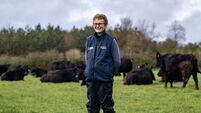
Haylage maker Stephen French agrees that making hay is like playing with fire. You can get burned badly.
This year, he didn’t get the right conditions necessary to make his haylage, and has fallen back on bales made and wrapped last year.
Fortunately, he had made more haylage bales than usual last year, due to store cattle being too expensive to purchase.
Because of the horrible weather, sales have been brisk, with sheep and goat farmers calling to his farm in Lissarda, Co Cork, in addition to his usual pony and horse owning customers.
In this country of ours,
With heroes aplenty.
We now have a new one,
A surprising new entry.
Not from the battlefield he comes,
Nor from the Olympians of our nation.
But from the fields of dear old Ireland,
He’s a farming creation.
This new hero of ours
Needs no introduction.
He’s the brave farmer with a mower
Planning a hay production.
A brave man indeed
Who dares such a chore,
In a summer of dark clouds
And rain showers galore.
This summer has been,
In the words of a friend
“An unmitigated disaster
From beginning to end”
With no spark of the sun
To brighten our day,
Sure t’is only the brave, or a fool,
Would contemplate hay.
In the gaming rooms of Las Vegas
It is said men risk the lot,
On games of poker and roulette
And dreams of jackpot.
But in all of their gambling
They don’t know a thing,
About real risk-taking
Done by Ireland’s brave hay men.
And as for them forecasters
So fashion-conscious its clear.
All listened to nightly
With a mixture of dread and fear.
They tell us of the weather
In far away quarters
From Singapore to Helsinki
Right down to Gibraltar.
But with all their great knowledge
They sometimes go wrong
And forecast dry weather,
When its rain that comes along.
But can we blame them really?
For making such a mistake
In a year of great depression
It’s a mess, for feck’s sake.
All we can hope for now
Is that the man up above
Will look kindly upon us
With compassion and love.
So God up in heaven
In our time of great need
Please being back the sunshine
For the men in the field.