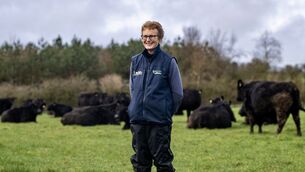
More farmers willing to share gains and risk
Michael Hennessy, of the Teagasc Oak Park staff, said share farming is an arrangement where two parties, the landowner and a share farmer, carry on separate farming businesses on the same land without forming a partnership or company.
Each party agrees to share in the costs of growing the crops, and to take a share of the gross output (grain, straw, etc.) The cornerstones to a share farming agreement are trust between the parties, and correct operation of the agreement. The share farmer and landowner keep their own financial accounts and calculate their own profits as independent businesses.
In share farming, there is no guarantee of a fixed return for the landowner, and both parties carry a production risk. It offers the share farmer an opportunity to increase their farmed area with shared risk, but without up-front payments or set payments for the landowner.
Share farming offers the landowner the opportunity to leverage the buying power, knowledge and expertise of the share farmer to increase output. The increased output, at lower costs, ultimately benefits both parties in the agreement.
The agreement is fully compliant with Department of Agriculture, Food and the Marine schemes, and with the Revenue Commissioners.
Farmers at the Teagasc tillage conference heard from Ollie Whyte, who farms at the Naul, Co Dublin with his six brothers, and seven of their sons. They run a substantial business of over 1,200 hectares, focusing on first wheats, with some potatoes and other enterprises. The business relies heavily on conacre, and deals with a diverse base of land owners.
Ollie has recently seen landowners’ expectations change, due to higher grain prices (and returns) and also due to the reform of the Common Agricultural Policy (CAP) for 2014.
For the Whytes, protecting their single farm payment is vital. Share farming has allowed the business to claim all entitlements (both for the Whytes and for landowners) and to farm all lands fully under increasingly stringent cross compliance rules.
The Whytes have five share farming agreements, three of which were signed in early 2012. The approach taken to share farming with landowners is to outline the agreement, then encourage landowners to seek independent advice. Once the landowners are happy with the share farming concepts, both parties sit down and negotiate a deal. Everything is discussed, including purchasing, invoicing, sales, cross compliance.
The key to success with share farming is to keep the agreement simple, and understandable for the landowner. Another vital aspect is a reliable record-keeping system, and the ability to be transparent with all aspects of purchases.
Whytes offer landowners various options for sales of grain (direct delivery to a merchant’s yard, etc), but in all cases, the land owners are encouraged to sell grain in their own name. Ollie keeps in constant contact with landowners through the season, concerning market trends and input spend.
“Share farming is working well for us and has allowed us to develop a sustainable business, while farming within all aspects of cross compliance rules,” said Ollie Whyte.