Pumice to mud: different dairy worlds
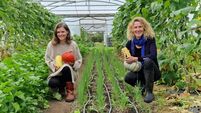
Linda, from Castletownbere in West Cork, and Esther from Rathgormack in Co Waterford, headed south after qualifying as dairy herd managers through Clonakilty Agricultural College and the Farm Apprenticeship Board.
They used family connections to find work in New Zealand's famed dairy farm sector, and after an enjoyable and educational stint as Assistant Dairy Herd Managers for Fisken Farms of North Island, New Zealand, they're heading home, taking in a three months world tour along the way.
"We've already seen all of New Zealand, we got very good time off", says Linda. "We could stay if we wanted, they offered us permanent jobs, and they hope we return. We may come back", she says. But, for the meantime, the pair will be looking for Irish jobs as qualified farm managers.
Will they find it hard to settle down after experiencing New Zealand style dairy farming, which is a world away from Ireland, in more ways than one?
"At home, it looks hard for small farms to get ahead, there are much more limits than here", says Linda. "One of the things that gives better possibilities here is share milking. It's a great idea, you can have your own farm within 10 years, if you start out with a bit of capital. That's not likely at home."
"We need share milking in Ireland", she says, a sentiment shared by thousands of young Irish people frozen out of the closed shop that is dairying in Ireland.
As for the day-to-day management of a dairy farm, Linda knows it will be different at home from the New Zealand style. "Extended grazing is possible for certain parts of Ireland, but we can't do it 365 days", she says.
The basic difference is in the New Zealand soil, which comes from a geology unimagined in Ireland.
New Zealand's volcanoes, still active, with four eruptions this decade alone, may be a frightening prospect to have in your backyard, but they are the ultimate source of the easily managed soils in the main dairying areas.
Linda and Esther worked in the Waikato Valley near Rotorua, at the centre of New Zealand's North Island.
Rotorua is known as Sulphur City, and it is a popular tourist destination due to its volcanic attractions and is Maori culture. The local volcano erupted 100 meters into the air at the end of January 2001, but its long-term effect over 140,000 years has been the formation of about 4,000 square kilometres of volcanic soil.
Bob and Karen Fisken, helped by their son Matthew, manage 670 cows, but their job is made easier by the free draining nature of their soil, which is derived from pumice, the "frothy" volcanic rock familiar to most people for its use in soaps, abrasive cleansers, and polishes.
On this soil, all stock are out wintered on the land.
"Here, cattle are reared outdoors from day one, they are hardier", says Linda. She and Esther found it easy moving strip fences and feeding silage onto the new grass. "It's very clean, they clean up the silage first and then eat the grass. There's no cleaning up after, as you would have in easy-feed or self feed systems, and the soil stands up".
What else will she miss in Ireland, beside the volcanic soils used for outdoor silage feeding?
"Irish cows are looked after better, they need to be. Here they milk from a basic diet, no meal and they do fine, but bad weather hits the cows at home", is one of the comparisons which impressed Linda.
She says: "It's an eye opener how such large numbers of cows are handled and how quickly they can be milked and managed, there is no cleaning out of sheds, the rotary parlour is a dream to work in. Calving is not labour intensive, at home you have to feed and clean out from calving boxes, here you calve at grass, we calve 10 to 20 per day here. There's no extra labour with bedding, but if there is calving difficulty out in the field, you have to bring them in, that can be a problem. But cows here are very well trained for herding with the quad bike and a dog, it's a lot easier than on foot."
Contrary to Linda and Esther's expectations, there are limits to dairying expansion in New Zealand.
"We thought there were no limits on supply, but not so. You buy shares from Fonterra". (Fonterra is the co-op which controls 95% of New Zealand's milk supply, making it the world's largest exporter of dairy products).
Linda says: "There's 183,000 kg of solids produced on this farm, a share for 1 kg is 2.76, you can buy as much as you want, but most farmers are sitting tight. They get 1.875 a kg, and there's a 10 or 15c price increase soon. Milk was over 2.60 a year ago. Shares last indefinitely and you can cash them in after. The milk production cost is between 94c and 1.35 per kg".
As the main component in the diet all year around, grass keeps down costs. It is supplemented with grass silage and maize through the winter and spring.
The Fiskens' cows are grazed on 240 hectares, giving a stocking rate of 2.79 cows per hectare.
Over the year, 153kg per hectare of nitrogen are applied (as urea), with 47kg of P and 34kg of K.
Fertiliser is applied from a four tonne trailed spreader. Urea, purchased loose in 10 tonne batches, costs 180 per tonne.
Over the winter, the cows are sub-divided in "mobs" of 170 for strip grazing and silage and maize feeding in the paddocks, on a 120 day rotation.
They are allocated 2.5kg of grass silage dry matter per cow per day over the winter; the silage is 72 DMD, 25% dry matter. The bought-in maize silage is 70 DMD, 35% dry matter, 28% starch; 3kg of dry matter per cow per day is fed.
During the milking season, the cows are divided in three "mobs" younger, older and antibiotic and they graze a 21 day rotation.
Heifers do better on their own; and it is legally required to keep any cows treated with antibiotic on their own.
When Linda and Esther left Rotorua in mid-September, there were just 10 or 15 cows out of 650 milkers in the antibiotic herd.
Preventing contact with the other cows and milking them last ensures that no mistakes are made which could contaminate the farm's huge milk delivery.
The Irish girls enjoyed working in the newly built 60 bail rotary cow shed, designed and built by Nu Pulse and De Laval. It takes two milkers and one herds-person 2½ hours to milk the 670 cows during the summer months.
They left while the calving season was still under way.
The cows, 80% Friesian and the rest Jersey crosses, are put in calf to Friesian bulls mainly, and some Jerseys to boost milk solids and for easy calving.
Calves are collected daily by ATV and trailer and taken to the calf house.
Replacement heifers are reared separately; bull calves go to the factory at four days of age, for 20 to 30 each.
All calves are fed colostrum through to weaning at six to eight weeks of age, with calf feed offered from day one. Heifer calves are fed outdoors from two weeks of age; 110 to 180 replacements are kept per year, on the basis of yield records.
Routine health care includes administering all minerals through the water system, supplemented with magnesium oxide and lime flour fed out during the winter and spring from the diet feeder in the silage and maize.
Herd mineral levels are checked regularly by random blood sampling liver biopsy. Calf creep feeds include a bacterial agent to prevent coccidiosis
The Fiskens deliver 183,000kg per year of milk solids to Fonterra, for which they are paid 1.875 a kg. Cows average 310kg at 4.38% fat, 3.44% protein, SCC 185,000
The future plans for the farm are to increase milk solids per cow, and to produce milk in a low cost environment.