Disability inclusion is a strategic imperative, not just a box to tick
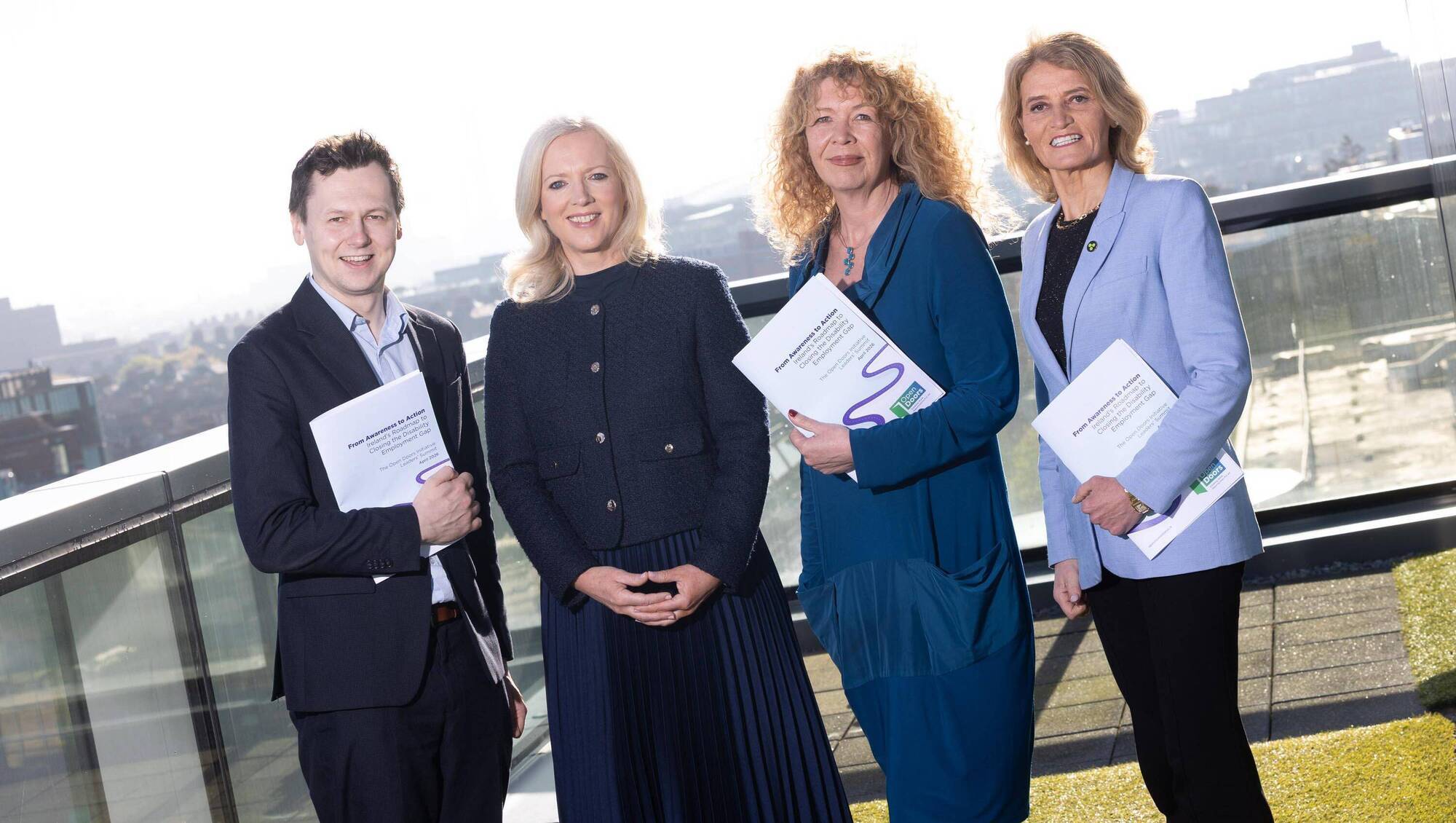
Adam Harris, CEO of autism charity AsIAm, Ciara Foxton, MD of Circle K Ireland, Jeanne McDonagh, CEO of the ODI, and Mary Buckley, executive director of IDA Ireland, at the Open Doors Initiative’s Leaders Summit launching the ODI and EY report 'From Awareness to Action: Ireland’s Business and Policy Roadmap to Closing the Disability Employment Gap'. Photo: Kenneth O'Halloran
Disability inclusion is a strategic imperative for any business seeking to enhance workplace culture, boost productivity, profitability and, a new report has found.
The report, entitled ‘From Awareness to Action: Ireland’s Business and Policy Roadmap to Closing the Disability Employment Gap’, has been produced by The Open Doors Initiative (ODI) in partnership with EY.

The report spotlights that despite being at near full employment, Ireland has one of the worst disability employment records in the European Union. In response, ODI is issuing an urgent call to action for CEOs and government leaders to take positive action to promote inclusion in the workplace.
ODI’s mission is to guide those who are facing barriers to employability and to support companies through collaboration and innovation.

In this Q&A interview, Jeanne McDonagh, CEO of The Open Doors Initiative, outlines the some positive actions to support people with disability in the workplace, and the benefits that businesses and society can enjoy as a result.
The figures should trouble every business leader and policymaker in this country. According to the Census 2022, one in five people in Ireland (22%) live with a disability, yet only 49.3% of working-age people with disabilities are in employment, compared to 70.8% of those without a disability. That's a 21.5% employment gap, one of the largest in the EU.
However, EU-comparable data presents a more acute picture as The European Disability Forum highlights that Ireland has one of the lowest disability employment rates in the EU at 32.6% and a disability employment gap of approximately 38.6%, significantly above the EU average of 24.4%.
What makes this so hard to justify is that we are operating at near full employment, with businesses actively struggling to hire. And yet we continue to exclude a significant portion of the working-age population, not because they lack capability, but because our systems were never designed with them in mind.
It's also worth remembering that disability will affect all of us at some point of our life through injury, illness, a mental health challenge, or ageing. We are all looking at when, not if.
Unequivocally, yes. The business case tells us it is essential for any organisation seeking to drive innovation, enhance employee experience, and deliver sustainable performance. Inclusive workplaces are more equitable, effective, creative and resilient. Research from Accenture has found that companies leading in disability inclusion were 28% more productive and had twice a higher net income.
According to the 2024 Global Economics of Disability report, the spending power of people with disabilities and their families globally is over $18 trillion. Companies that include disabled people and their insights within the workforce, reflecting wider society, will benefit. Knowledge and understanding of disability makes for a powerful commercial tool.
Disability inclusion is a strategic imperative and not simply a matter of compliance or corporate responsibility. Organisations that design accessible products, services, and workplaces are better positioned to respond to diverse customer needs and to anticipate change in complex environments.
Beyond that, we are all trying to hire good people, yet leaving 22% of the population out of scope limits our ability to build successful organisations. Stigma and fear of the unknown cause us to underestimate the transferable skills, lateral thinking, and creativity that come from hiring beyond those who unconsciously fit our existing idea of the ideal candidate.
Recruiting people with disabilities also builds a positive culture for employees, stakeholders, clients, and the wider community in which you operate. Accessible workplaces lead to higher engagement, greater productivity, and stronger retention, particularly when people feel genuinely valued.
The ODI roadmap was co-created through our roundtable series, bringing together business leaders, inclusion practitioners, policymakers, and people with lived experience of disability. It sets out five priority recommendations.
The first is to redesign recruitment and workplace systems for inclusion by default, moving beyond individual advocacy to embed accessibility and flexibility from the outset. The second is to build employer and business trust through transparent data and communication, encouraging disclosure through trust-building and clear impact reporting.
Third, organisations must equip managers with practical and proactive tools, not just awareness training. Resources such as reasonable accommodation passports and clear step-by-step guidance give managers the confidence to act, embedding inclusion into everyday systems rather than leaving it to individual interpretation.
The fourth step requires Government action to reduce the financial risk associated with taking up employment, by decoupling essential supports such as medical cards from employment status and implementing a permanent, non-means-tested Cost of Disability payment.
Finally, we must increase the visibility of disability leadership. People with lived experience must be actively present in leadership and decision-making roles. Visible disabled leadership shifts the narrative and reframes preconceived ideas of what disability looks like.
Disability is a natural part of the human experience, and inclusive organisations recognise this by designing systems that work for everyone from the outset, rather than retrofitting solutions later.
The report frames disability inclusion not as a charitable act, but as a critical economic, business, and societal imperative. We can no longer view disability inclusion as a 'social issue' managed by the state through welfare. It is a systemic failure within the labour market and a missed economic opportunity for Irish businesses. As a CEO with a disability myself, I advocate for the hiring of my peers. When barriers are removed and an equitable playing field created, people can work to their full potential.
There needs to be a fundamental shift from Corporate Social Responsibility (CSR), which is often viewed as charity, to Corporate Social Justice (CSJ). CSJ demands that businesses actively dismantle systemic barriers within their core operations to ensure equity, dignity, and justice. It recognises that a business operating somewhere, has a ripple effect on all its stakeholders, employees and wider community. This needs to be a positive one.
Closing this gap requires a collaborative approach with business and whole of government support. It calls for workplace redesign, system reform and leadership accountability.
For employers, get informed, broaden your knowledge and understanding, and reap the benefits of a diverse workforce. For support, please contact The Open Doors Initiative which works with over 130 organisations to make Corporate Social Justice the benchmark for responsible business. We invite you to join us as partners in transforming challenge into an opportunity — info@opendoorsinitiative.ie