Spend and be damned? Minister for Finance walks a budget spending tightrope
Budget planning sees the return of the economic debate of when is a spending limit a spending limit as the Fiscal Council issues another warning to ministers McGrath and Donohoe, writes Ronan Smyth
Spend and be damned? Minister for Finance walks a budget spending tightrope

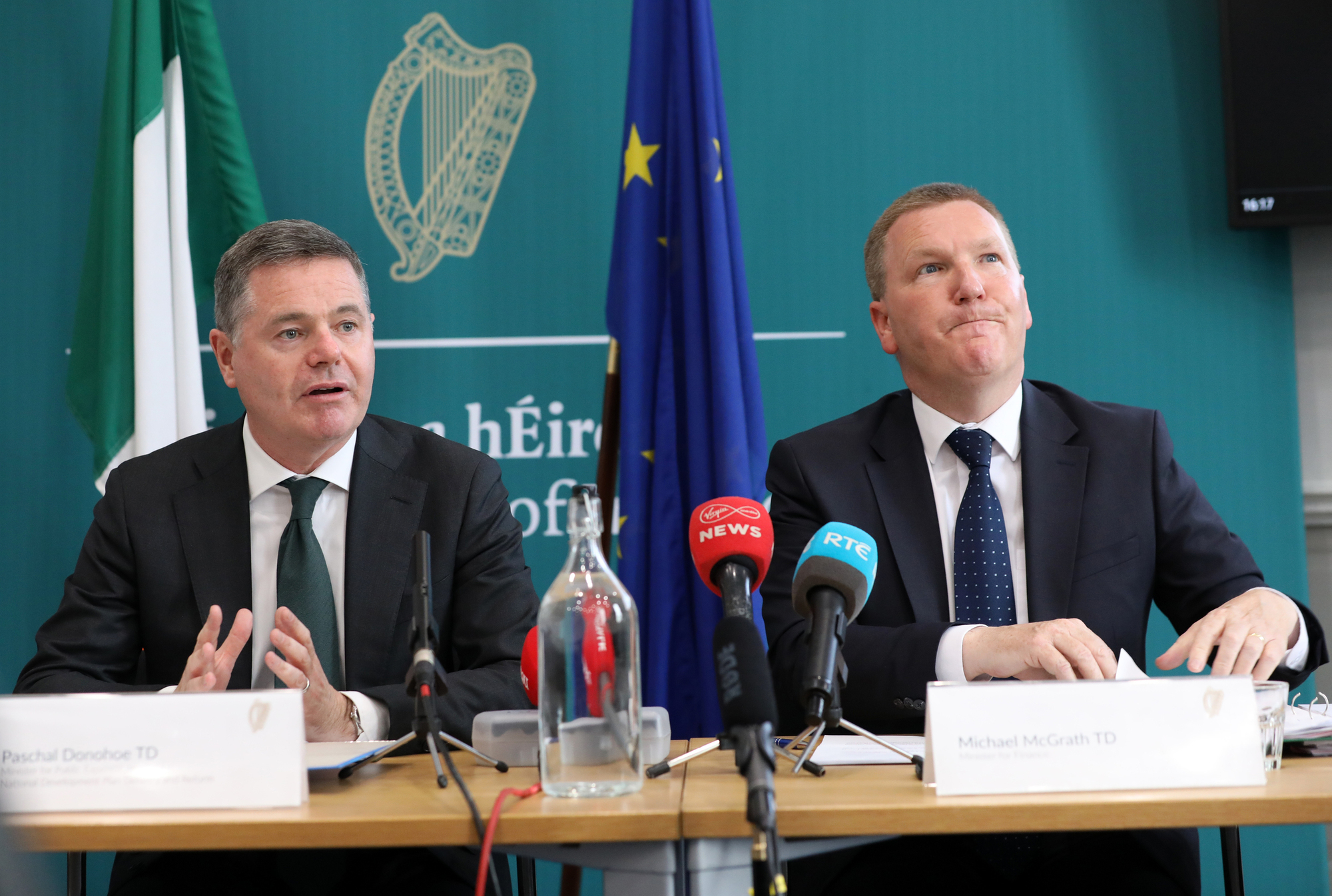
Minister for Finance Michael McGrath (right) and Fine Gael Minister for Public Expenditure Paschal Donohoe (left) have decided to go beyond their own spending rule again and increase spending, modestly, by 6.1% in the budget. File photo: Sasko Lazarov/RollingNews.ie

The preparations for the forthcoming budget in October has both the finance minister and public expenditure minister walking a tightrope, carefully trying to navigate spending some of their excess corporation tax, currently burning a hole in their pockets, but not adding to inflationary pressures either.

In the lead-up to the Summer Economic Statement (SES), released on Tuesday, there have been numerous fiscal advisory organisations who preached a prudent approach to spending, telling the ministers that they need to stay within their own rules and not increase expenditure by more than 5%.


In 2021, the Government instituted an expenditure rule which would allow core expenditure to increase by 5% per year. It effectively sought to tie expenditure growth to the estimated sustainable nominal growth rate of the economy. However, the covid pandemic and the cost-of-living crisis in 2022, which has bled into this year, meant that the rule has never actually been followed.

For Budget 2024, the Irish Fiscal Advisory Council (Ifac) and the Central Bank of Ireland both called on the Government to stay within the 5% spending rule, while the Economic and Social Research Institute (ESRI) advised that there is “no rationale” for tax cuts as it could lead to overheating in the economy.

However, Finance Minister Michael McGrath and Public Expenditure Minister Paschal Donohoe have decided to go beyond their own spending rule again and increase spending, modestly, by 6.1% in the budget.

According to the ministers, Budget 2024 will deliver an overall package of €6.4bn, €5.2bn of which will be in increased public spending while €1.1bn will be in taxation measures. In addition, €2.25bn of windfall tax receipts will be utilised to boost the delivery of critical infrastructure over the period 2024 to 2026.

Inflation

Ifac, the State’s own fiscal watchdog, came out loudly against the budget plans saying not only does it breach spending rules but runs the risk of adding to inflation.

Michael McMahon, acting chairman of Ifac, said when inflation is high you don’t want governments coming along and adding extra demand stimulus to the economy and potentially making the situation worse.

“They could make their own choices about reallocating funds, or because it is a net spending rule they could tax some people more and get extra resources to spend,” he said.

“What they have done is they have used inflation as an excuse to violate a rule when actually the economy right now is cyclically in a position.

"Unemployment is at historic lows, inflation although it has come down a bit, it remains quite a bit above the European Central Bank’s target, and clearly we’re seeing the ECB fighting to raise rates in order to lower inflation."

Mr McMahon said the spending rule has ECB’s medium-term inflation target of 2% already built into it, which means that during times of high inflation the Government is a “bit more constrained” in what it can spend and the choices it has to make.

“That is exactly the time you want them to be constrained and making these choices. Similarly, let's say the economy was very weak and inflation was very weak, they would have more scope to increase.

“There is a counter-cyclicality built into their nominal net spending rule, and that is, I think, a favourable design of the rule. But they don’t seem to be embracing it as much.

“Particularly right now in certain sectors, it is difficult to imagine large-scale investment projects when the construction sector is so tight and there are capacity constraints.”

Mr McMahon added that there is the Government’s credibility and the credibility of future fiscal plans to consider, and it harms each of these to breach the spending rule. He said for the spending rules to do their jobs “you have to actually stick to them”.

“With this latest SES, that looks like it is not going to have been the case for a couple of years,” he said. 

The council also warned that there are risks of spending overruns this year in areas such as health, children, and social protection, and that medium-term fiscal challenges, such as the costs associated with an ageing population, must be addressed.

Ifac's frustrations

Ifac was set up as a statutory body in the wake of the financial crash over 10 years ago with a singular purpose: Stop any repeat of the disaster caused when slack regulation by government and the Central Bank of financial regulators led to economic disaster and the return of unemployment and emigration for Irish citizens.

However, since its inception, it has faced a number of challenges from Governments well before this latest spending rule breach set the scene for another classic budget row between the finance minister and the watchdog.

It took only a few years before new Fine Gael-led coalitions were coming up with reasons to ignore, for the most part, the watchdog’s missives. The first significant spat broke out when Ifac, then led by professor John McHale, entered into close verbal combat with then finance minister Michael Noonan and his senior officials.

Ifac faced its first test that cruelly exposed the weakness of such watchdogs, which have fangs but no sanctions with which to bite back.

Professor Micheal McMahon, acting chair of the Irish Fiscal Advisory Council, said the ministers "have used inflation as an excuse to violate a rule when actually the economy right now is cyclically in a position."

The watchdog had warned Mr Noonan it had enough of governments springing fiscal surprises. The pool had been poisoned in late 2015 when Mr Noonan infamously sprung such a fiscal surprise by announcing €1.5bn in additional spending in a supplementary budget, no less, just days before unveiling his official budget.

Ifac nonetheless went on to endorse the budget sums. In more recent years, the huge bounty from probably unreliable corporation tax receipts started to loom large.

In October 2018, Ifac, then under chairman Seamus Coffey, the UCC economist, told the Irish Examiner that the watchdog was set to step up its warnings to the Finance Department, then led by Paschal Donohoe, about locking in extra dollops of spending based on uncertain tax flows, namely those tax revenues derived from the byzantine world of multinational accounting.

The budget cycle rolled on. In the summer of 2019, following mild criticism, Mr Donohoe insisted his new budget sums added up.

The covid years then led to something of a ceasefire in the healthy hostilities between Ifac and Government.

The watchdog broadly praised the European-wide response to a crisis that meant the Irish authorities also injected billions of euros to subsidise businesses and households, and thereby saved the economy from mass unemployment.

The Keynesian response worked. By 2021, Ifac was a good deal happier with the Government’s budget sums. Then led by chairman Sebastian Barnes—who has in recent days stepped down and been replaced by Mr McMahon—Ifac said it was reassured by the Government’s self-imposed pledge to peg back spending growth.

Current Budget

Following the announcement of the SES earlier this week, Mr McGrath defended the increasing expenditure by citing inflation and the need to maintain public services and people’s living standards.

He said while inflation is decreasing, it is still expected to remain above trend next year, and on that basis they have had to make adjustments to the spending rule.

“It's not static,” said Mr McGrath. "It is a rule that has to be adapted to the circumstances that we face at a point in time. This is our considered view as to what would be required to deliver an appropriate budget.” 

According to figures from the Central Statistics Office last month, annual inflation has dropped to 4.8%—the first time in two years it has dropped below 5%—with the eurozone seeing an annual inflation rate of 6.1%.

The Central Bank of Ireland is predicting that headline inflation will average 5.3% for this year before dropping to 3.4% next year and 2.5% in 2025. The ECB’s target is 2% inflation over the medium term.

Speaking to the

Irish Examiner

about the recent SES, Mr Coffey said the public finances need to be able to respond to higher inflation and while the 5% spending rule is “simple”, it is “not necessarily adaptive”.

He said:

You obviously don’t want to stoke domestic inflation, but pay, social welfare rates, incomes taxes, all should respond to the inflation we’re seeing. 

Mr Coffey said that while the Government shouldn’t ignore adding to inflationary pressures by spending more, it has to be noted that while inflation is forecasted to go down, there are “no forecasts for price levels to fall”.

“It is not a case of having no restraint," he said. "Yes, you want to be careful to avoid stoking domestic inflation, but the inflation is certainly there.” 

Mr Coffey added that the proposed €1.15bn tax package earmarked for the budget will be presented as a tax cut, but it will probably be an adjustment to credits and the standard-rate cut-off in order to keep up with inflation.

“People are seeing higher earnings, absent an adjustment to the income tax system, they’d see their average income tax rate rise because more of their income will be taxed at the higher rate," he said.

"If you want to keep income tax rates constant, you should adjust the credits and the standard-rate cut-off. It is revenue reducing but the inflation is revenue increasing. If people are earning more or getting pay increases, that will bring in more income taxes.”

Additional reporting by Eamon Quinn

x

More in this section

The Business Hub

Newsletter

News and analysis on business, money and jobs from Munster and beyond by our expert team of business writers.

Cookie Policy Privacy Policy Brand Safety FAQ Help Contact Us Terms and Conditions

© Examiner Echo Group Limited