Eamon Quinn: Parallels between SVB collapse and 2008 banking crisis are very real
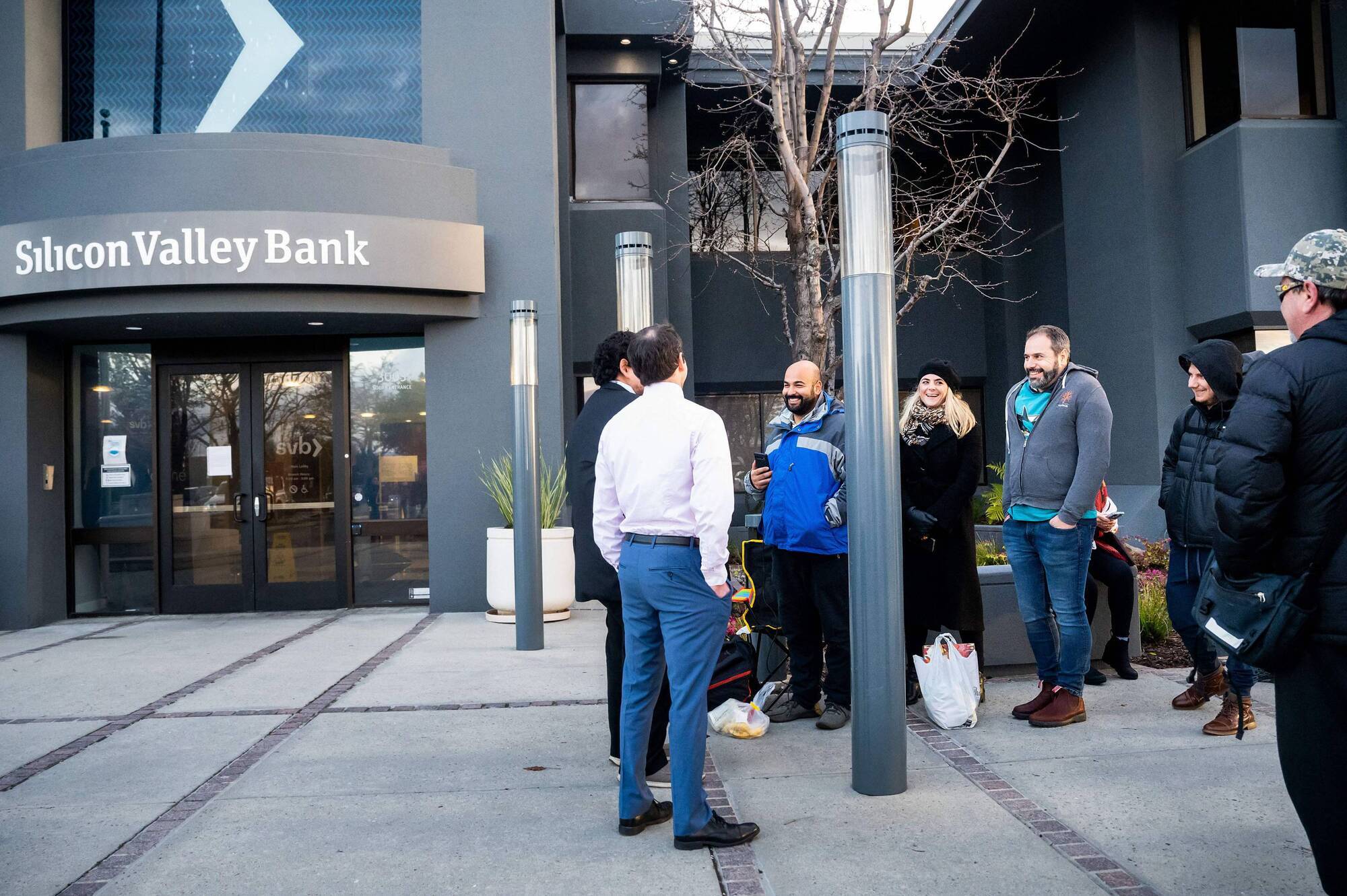
Silicon Valley Bank customers listen as FDIC representatives, left, speak with them before the opening of a branch SVBs headquarters in Santa Clara, California today. Picture: Noah Berger/AFP via Getty Images)

A banking black hole in the balance sheet, customers scrambling to get their deposits, and the subsequent intervention or fire sale when the lender fails to raise emergency funding are all too familiar.
The collapse of Silicon Valley Bank (or SVB) will come as little surprise to Irish observers and painfully recall the disastrous banking and property market collapse that unravelled at pace from 2008.
Bank failures are significant events, no matter where they occur. The speed of the demise of SVB — a name that wasn’t widely known in Ireland before the weekend — has shocked regulators and rocked banking markets across the globe.
In the US, SVB loaned to a surprisingly large concentration of tech start-up clients and held deposits from tech start firms and tech investors alike.
The pandemic years had helped to turbo-charge most tech companies, and on the eve of its weekend collapse, the Californian bank’s deposit base had ballooned to $175bn (€164bn ) — equivalent to almost half the size of the Irish economy.
The troubles of the parent group quickly spread. Although tiny in a British banking context with only £5.5bn (€6.2bn) in loans and £6.7bn in deposits, its UK offshoot was nonetheless deemed sufficiently important to the rest of the British banking system for the authorities there to scramble through Sunday night.
They facilitated the sale of SVB UK to HSBC for a nominal £1 — before markets reopened today.
And in other echoes of 2008, regulators and politicians in the US and Europe rallied to reassure that the emergency measures had worked. US President Joe Biden declared “the banking system is safe”.
Troubling, however, is the fact that SVB was not the only US bank to go under in recent days: Silvergate Capital had closed its doors, and on Sunday, US authorities stepped in to save customers at Signature Bank from losing their money.
The New York lender at one time held as much as $89bn in deposits.
Today, as fears spread about other banks potentially facing funding trouble, pressure led to a widespread sell-off of US bank stocks.
Trading in shares in lender First Republic first slid and were then paused despite the US lender having secured supposedly life-saving funds on Sunday from the household banking name, JP Morgan.
There were other echoes of 2008 that will be familiar to Irish observers. The US authorities will face questions about their failure to monitor SVB, a Californian lender that built a huge concentration of loans to a single industry, the tech sector, across the US.
In Ireland, during the boom years, Anglo Irish — which was once a small commercial property lender, along with AIB and Bank of Ireland — pumped up its balance sheets to disastrously lend billions to a small group of Irish property developers.
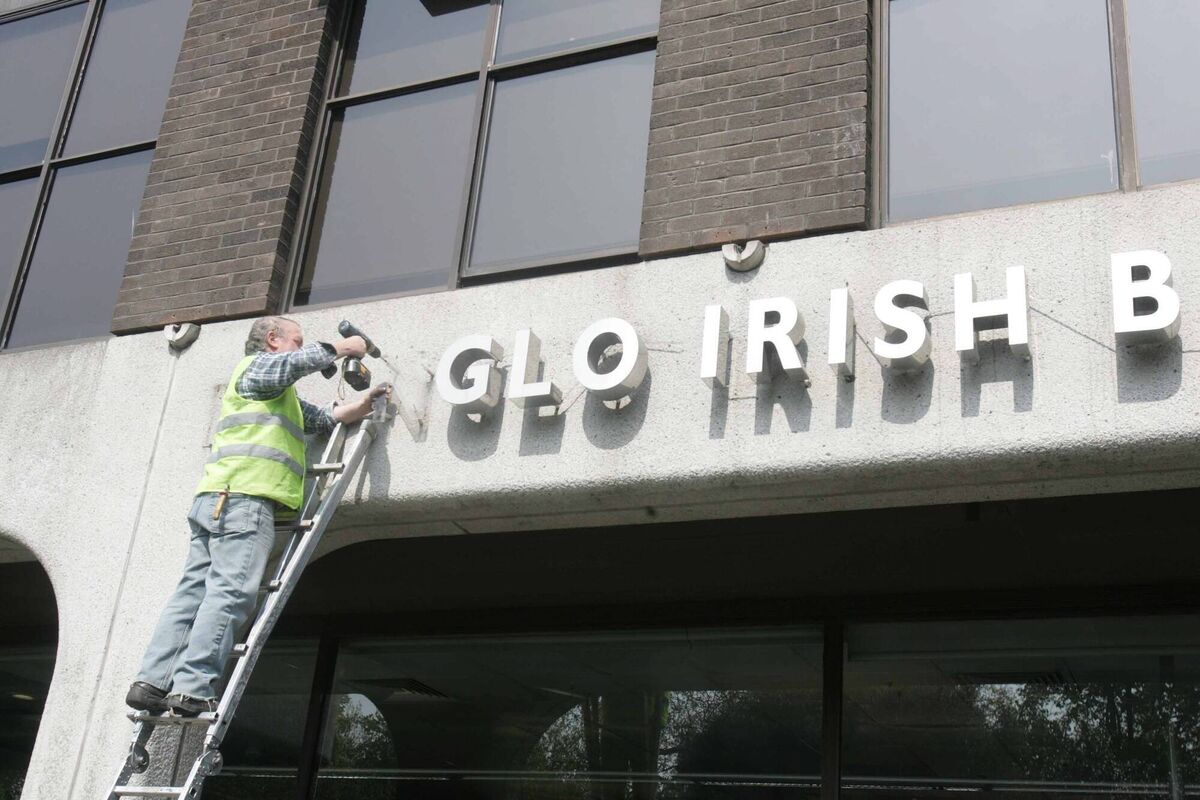
Irish bank shares joined today’s sell-off of global banking, even though there was no apparent over exposure to tech loans here. Shares in AIB and Bank of Ireland dropped by around 7% — in line with European peers.
In Ireland, SVB’s failure, although startling its small client lending base, was by no means a systemic lender. However, that may matter little in the wider context of a banking crisis that is rooted in lenders and their customers failing around the world to cope with rapidly rising interest rates.
The other glaring lesson from 2008 is the banking authorities appear to have been as much blind-sided by events as any banking market participant looking on from the outside.
Banking corruption and the construction by Wall Street of rotten US mortgage loan for selling onto investors worldwide, provided a spark for the 2008 crisis.
The banking stress this weekend has been caused by the huge rise in interest rates since the recovery from the global financial collapse.
Economist Jim Power said the climb of US interest rates from zero to 4% in the last 12 months had raised huge issues for exposed industries and households.
“When you get that size of tightening it causes problems. You have no idea where they will emerge, and what happened to SVB is an example after its bond portfolio fell in value because of interest rate rises.”
Mr Power said a loosening of US banking regulation under the Donald Trump administration following lobbying by the banking industry may also have played a part in obscuring the signals of distress.
Kieran McQuinn, of the Economic and Social Research Institute (ESRI), said the fallout of the market crisis may give the US and other central banks cause for concern over the pace of future interest rate increases.
Market expectations of the scale of future US Federal Reserve rate hikes fell on Monday, and the price of crude oil slid, providing signs of the seriousness of the SVB crisis.
In the rush to temper inflation by increasing rates, central banks may have failed to fully reflect on the risks, meaning the strains in the financial system may not have been “fully costed in”, Mr McQuinn said.
He said the problems faced by the short-lived UK premiership of Liz Truss last year were also sparked when interest rates climbed rapidly, causing dislocation in UK markets.
The regulation of banks has improved across Europe since the last crisis.
However, there is no real evidence as of yet that the multinationals based here that provide so many jobs and which last year paid €21bn into the Irish exchequer in corporation tax receipts have been sorely tested by rate hikes.
That benign picture could change should tech face a wider challenge from a stumbling world economy.
Economist Conor O’Toole at the ESRI said it is hard to know whether the authorities have contained the risk.
“These type of events always shake confidence in markets,” Mr O’ Toole said, especially after SVB got their maturity funding wrong that led to “a traditional run” on the bank.
However, a collapse like SVB is rare enough because it was a lender into the high-productivity tech sector. More failures would test the nerves.
Like in 2008, “financial systems are complicated and interwoven and sometimes you do not see the exposures until they start to unravel”, Mr O’Toole said.
The US authorities have stepped in to try to prevent further runs on banks. “We are still at a nervous period to see where all this settles down in the coming weeks,” he said.


CONNECT WITH US TODAY



Be the first to know the latest news and updates