State still mulling full banking withdrawal after Bank of Ireland share sale move
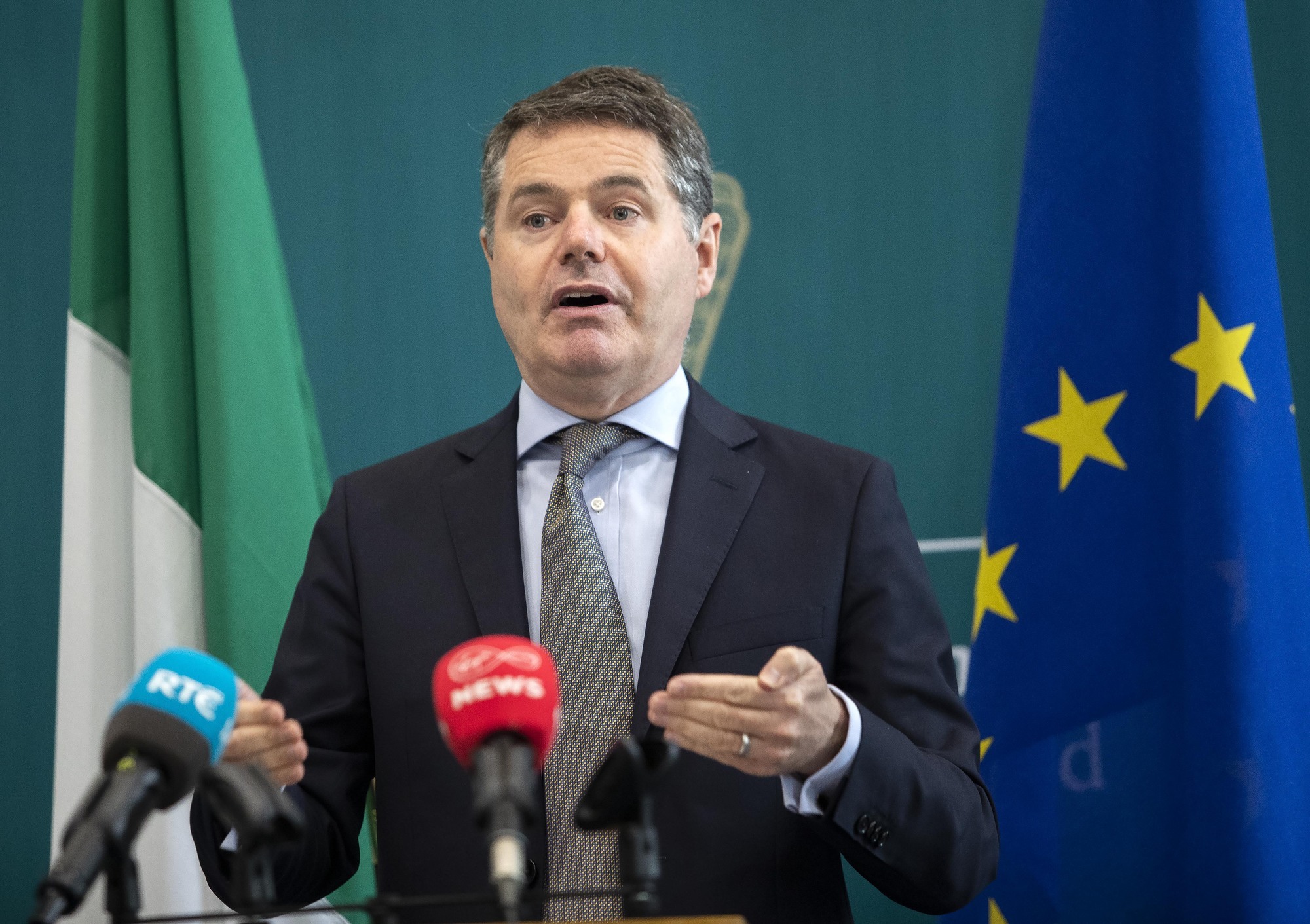
Finance Minister Paschal Donohoe at a media briefing at the Department of Finance on Wednesday morning where he announced plans to sell the State's 13.9% shareholding in Bank of Ireland. Picture: Colin Keegan/ Collins Dublin
Finance Minister Paschal Donohoe made the announcement of the “phased exit” from Bank of Ireland with the State set to potentially earn €700m through the sale.
The State had stepped in to support the bank in the wake of the financial crash in early 2009. The total investment in the bank was €4.7bn. By 2013, Bank of Ireland had returned about €6bn to the State.
“The Irish taxpayer put into this bank, it has been recouped and more, and we will make decisions in relation to all the other banks if the time was right, market conditions are right, and if it’s consistent with us getting as much money back for the taxpayers as we can,” Mr Donohoe said.
The minister said there is “no connection, whatsoever” with the selling of these shares to the fact that Permanent TSB may need to raise funds to buy loans from Ulster Bank, which is leaving the banking market in the Republic.
Mr Donohoe said “this decision, and any potential or future decisions are completely unrelated”.
“I was always very clear, and have been for many years that over time I do want to find opportunities to unwind the shareholding that we have in our banks, for the last number of years, but [that] has not been possible,” he added.
Despite the Bank of Ireland sale, the State remains a key player in the Irish financial sector, holding majority stakes in AIB and Permanent TSB after bailouts during the financial crisis.
Overall, the State injected about €64bn into Ireland’s banks. About half of that was spent on the former Anglo Irish Bank and Irish Nationwide, both of which have since been wound down.
Currently, the State retains a 71% stake in AIB, while it owns 75% of Permanent TSB.
Starting in the next few days and ending in six months, a trading plan managed by Citi Group Global Market will see up to 15% of the expected aggregate total trading volume in Bank of Ireland sold.
“I’ve made this decision because I believe the prospects for the Irish economy and the ability of our economy to grow are very strong,” Mr Donohoe said.
“I believe the value of our banking system will benefit from it. So, this is the right point to indicate my intention to, over time, sell part of our share in Bank of Ireland,” he said.
The six-month plan is to ensure the State does not disturb trading in the price of shares on any given day. The number of shares that will be sold each day is dependent on market conditions, amongst other factors.
In order to ensure the taxpayer’s interest is protected, shares will not be sold below a certain price per share, which the Department of Finance will keep under review.
However, the Financial Services Union (FSU) questioned the timing of the announcement to cash out on Bank of Ireland.
“In the last couple of weeks, the Minister for Finance and the Taoiseach have both publicly commented on the need for a review of banking in Ireland,” FSU general secretary John O’Connell said.
“Change is taking place in the sector at a rapid pace and there is common agreement that a strategic discussion needs to happen involving all stakeholders on the future of banking in Ireland. The sale of the State shareholding in Bank of Ireland should have been part of that discussion and not taken prior to that review taking place.”
Mr O’Connell also said the governor of the Central Bank made it clear recently that banks need to play their part in supporting SMEs as the economy reopens.
“To weaken the Government's influence in Bank of Ireland at this important stage of our economic recovery needs a wider explanation for stakeholders," he said.
Meanwhile, Permanent TSB chief executive Eamonn Crowley has poured cold water on the notion that the State’s selling of its Bank of Ireland stake is chiefly a mechanism to raise cash for the 75% State-owned PTSB to fund its planned takeover of part of the departing Ulster Bank’s loan interests in the Republic.
PTSB is looking to buy elements of Ulster Bank’s retail lending business and SME banking business.
Mr Crowley told the Oireachtas Finance Committee that PTSB has financial headroom to partially pay for any acquisition, but that the need for additional capital would come from all shareholders, not just the Government.
He said the 25% of PTSB's private investor ownership has shown interest in the transaction.
Last month, Mr Crowley said PTSB would approach both the Government and the stock market for cash, if needed. He recently said he hoped a deal with Ulster Bank would be agreed by the end of this year.
Mr Crowley told the committee that discussions, between the two banks, are constructive and ongoing.
“If we are successful in agreeing commercial terms, Permanent TSB will be a bank with more customers, a larger footprint, greater reach and a greater ability to bring new and better products and services to retail and SME customers,” he said.


CONNECT WITH US TODAY



Be the first to know the latest news and updates