Ireland faces 'unending cycle' of global assault on the way it taxes multinationals
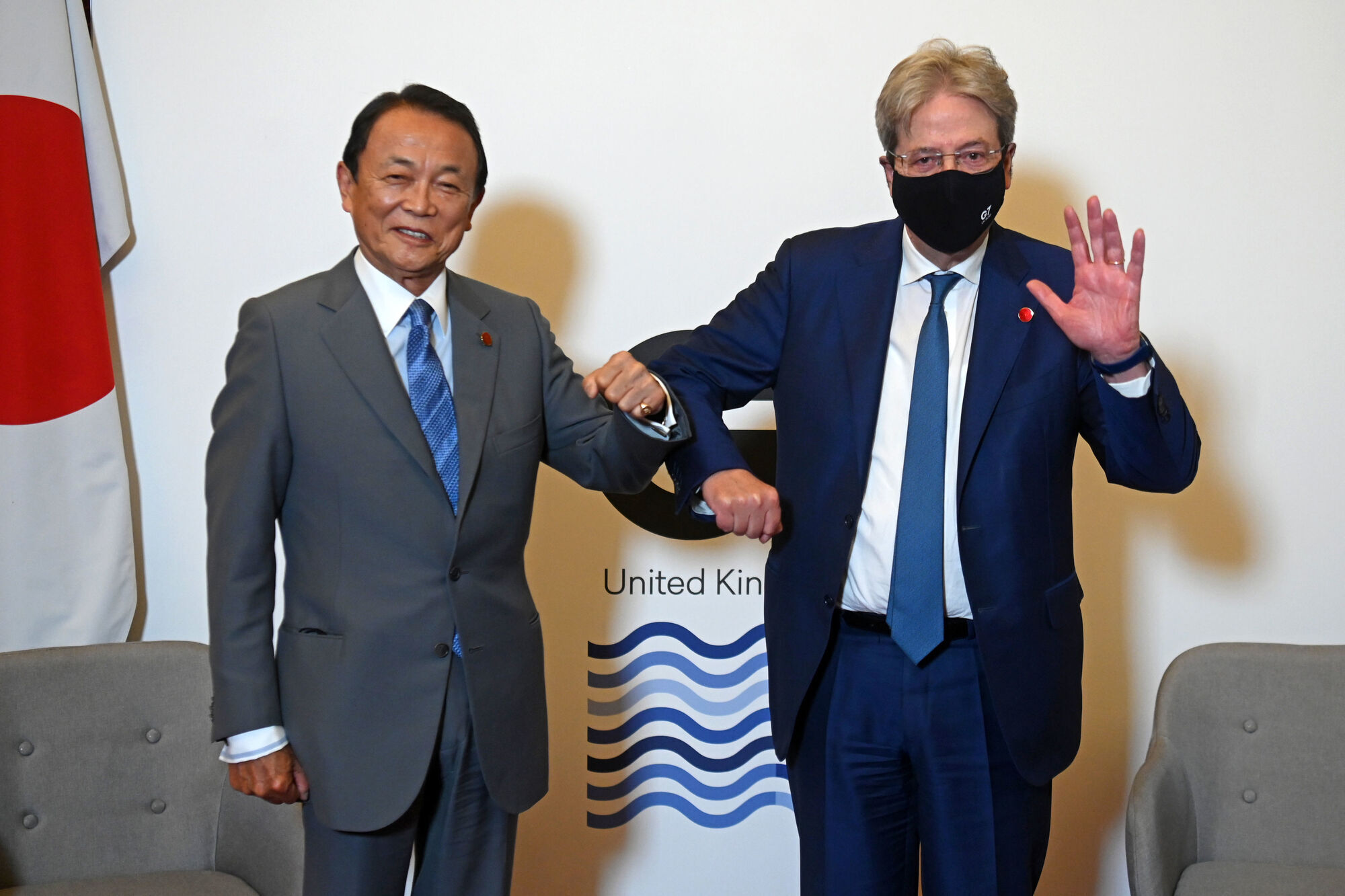
Japan's finance minister Taro Aso and European commissioner for economy Paolo Gentiloni during their meeting, as finance ministers from across the G7 nations meet at Lancaster House in London ahead of the G7 leaders' summit. Picture: Daniel Leal-Olivas/PA Wire
The G7 group of the West's largest economies is close to setting a global minimum corporate tax rate, as the overhaul of the way countries tax multinationals gathers pace.
The gathering in London means that Ireland faces a continuing period of uncertainty over its competitive tax rate of 12.5% that has helped attract a huge number of multinationals, including Apple, Pfizer, Google, and Facebook, to set up bases here. The multinationals through their corporate taxes also paid the lion's share of the €11.8bn the Government collected from all companies last year.
Ireland's dealings with multinationals have never been far from the world headlines and the amount of tax paid by multinationals to Ireland has long been targeted by France and Germany. The speed of reform has quickened this year after US president Joe Biden gave his backing to major reform because he needs to raise billions more from large companies to help pay for his plan to invest $2trn in creaking American infrastructure.
The significance for Ireland is that just four multinationals, Apple, Pfizer, Google, and Amazon, employ 25,000 people across their major European facilities located in the Cork and Dublin regions.
However, it is far from clear whether Ireland will face any immediate hit to its exchequer tax haul and the exchequer will likely face greater tax challenges from other tax proposals driven by the EU and the Organisation for Economic Co-operation and Development, experts said.
Seamus Coffey, a former chair of the Irish Fiscal Advisory Council, said Ireland will face much greater challenges if the US continues to press Congress to levy a higher rate on the earnings US multinationals generate around the world. A minimum rate agreed by the G7 doesn’t automatically change much for Ireland because the difference with Ireland’s 12.5% headline rate “isn’t very great” and "more significant implications” will come down the road, Mr Coffey warned.
"It looks like we are in an unending cycle of proposals and changes to how companies are taxed,” said Mr Coffey.
Under the G7 agreement, Ireland would have to ensure its multinationals, including CRH, Ryanair, Kerry Group, Kingspan, and Glanbia, are taxed at the minimum global rate.
John Whelan, a former head of the Irish Exporters’ Association, said the G7 decision will have little effect on the amount the Irish exchequer collects in corporate tax revenue but that the challenges facing the IDA in attracting investments have increased nonetheless.
Brian Keegan, director of public policy at Chartered Accountants Ireland, said that Mr Biden is seeking to raise billions more from taxing US corporates and needs to ensure by way of the global agreement that the US doesn’t lose out in attracting investments.
“The significance is that it erodes the principle of sovereignty over taxes,” said Mr Keegan.
Peter Reilly, tax policy leader at PwC Ireland, said that both "the interests of small open economies and not just those of large market jurisdictions" need to be considered.
CONNECT WITH US TODAY



Be the first to know the latest news and updates