Insurance firms need to correct gender disparity in salary covers

Billy O’Shea, senior consultant with financial advisor Insight Private Clients.
Life assurance companies should review gender disparities in their product offerings, notably with the higher premiums applying to women than to men for executive salary protection, says Billy O’Shea, senior consultant with financial advisor Insight Private Clients.
“Historically, life assurance companies set premiums based on various factors, including gender. For instance, males often paid more for life assurance due to shorter life expectancies to that of females,” said Mr O’Shea. “This has been addressed by EU regulations, but some life assurance companies are not operating within the spirit of those regulations”.
“In Ireland, that gender disparity has led to an anomaly in the assurance market that needs to be addressed. In many cases, a female company director will pay more than a male for income protection.
“If you are a female company director, you would feel disenfranchised to have to pay 45% to 50% more to achieve the same level of cover as a male in the Irish market. This is something that needs to be reviewed and corrected by the life assurance companies.”
Since 2012, all EU member states have been required to apply the principle of gender-neutral pricing to all assurance policies. Having raised the subject with life assurance companies, Insight Private Clients reviewed the personal and executive insurance cover packages currently available in the Irish market.
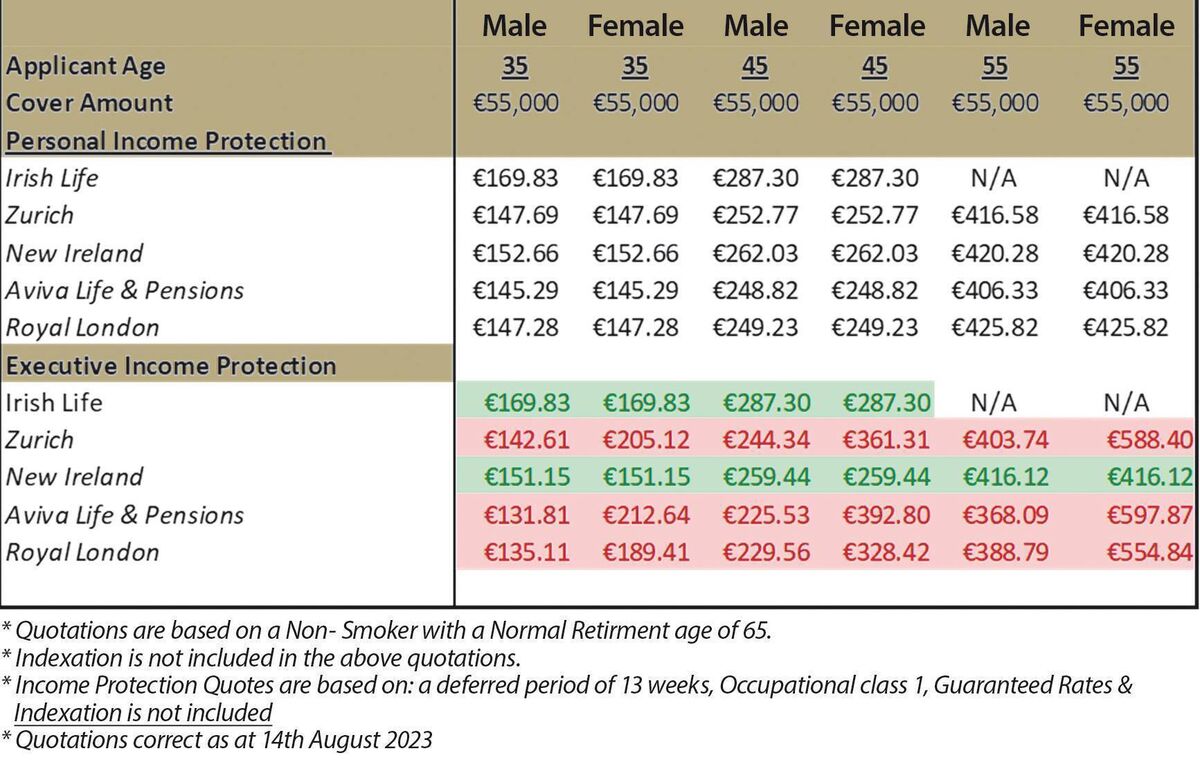
The accompanying table captures a comprehensive range of products available in Ireland. The table suggests that Irish Life is the only company to fully adhere to the EU principle on gender-neutral pricing for salary protection products, with most of New Ireland’s packages also adhering.
“The Irish marketplace is very fair and competitive. When you look at the figures, this gender disparity jumps out. When we approached the life assurance companies, they were genuinely surprised. Our goal with this research was to be informative. We believe the insurance industry will act quickly to address the issue.”
Historically, males often paid more for life assurance due to shorter life expectancies to that of females. However, societal changes, including increasing numbers of women in senior executive roles and evolving gender equality laws, have prompted a shift in this practice.
A 2004 EU directive aimed to address gender-based discrimination in the sale of goods and services, including assurance, was transposed into EU law in 2007. This directive allowed member states to permit gender-based pricing differences in assurance under certain circumstances.
In 2008, a Belgian consumer group challenged the 2004 Gender Equality directive, asserting that insurers were not applying equal treatment and costs. The ensuing "Test Achat" case concluded that using gender as a determining factor in assurance premiums was incompatible with the principle of equal treatment. All EU member states were required to apply the principle to all assurance policies by 2012.
While the directive covers "private, voluntary pensions and assurance," exceptions were made for situations involving an employer-employee relationship. This led to discussions about whether the directive's equalisation rules applied differently to individual and group policies.
“Assurance companies responded to the directive by adjusting their pricing strategies,” said Billy O’Shea. “Some companies adhered to the directive's principles, while others adopted selective approaches, applying equal pricing to certain policies but not others. While this approach may be adhering to the letter of the law, it seems inconsistent and may go against the spirit of the directive.
“As an independent advisor, with a duty of care for our clients, we compared different assurance providers, and found varying approaches to gender-neutral pricing. Irish Life and New Ireland can be cited as examples of companies that adopt unisex pricing across the board, while others such as Aviva, Royal London, and Zurich Life still exhibit gender-based pricing discrepancies for employer-funded executive income/salary protection policies, as opposed to personally purchased income/salary protection arrangements. Same risk, same person, just a different premium. Why?
“We can see from the table that gender-neutral pricing is applied for personal income/salary protection policies, but not consistently, for company-funded executive income/salary protection. The cost differences between male and female clients for company-funded executive policies can be substantial, with premiums for female clients sometimes being up to 61% higher.”
Mr O’Shea said that the requirement exists for a more consistent approach to gender-neutral pricing. Insight Private Clients is calling upon all providers to apply the principles of the EU directive to avoid discrepancies and ensure equality of treatment.
“The importance of transparency and clear communication to clients cannot be over-emphasised,” he said. “Some assurance companies would argue that whilst cost is a very important consideration, it is not the only factor when considering which provider to favour with such business. Policy exclusions, claims processes, underwriting or 'financial strength of the insurer' have all been cited. It is our view that such conditions apply to all underwriters and therefore cannot be employed by some and not others.”
Mr O’Shea said it would be prudent for assurance companies to provide more transparent and equitable pricing structures to their clients. If not, advisors need to ensure that such assurance companies' products merit their placement on issues other than simple cost.


CONNECT WITH US TODAY



Be the first to know the latest news and updates