€1bn offshore wind project for Ireland's 2030 climate target goes to Bord Pleanála
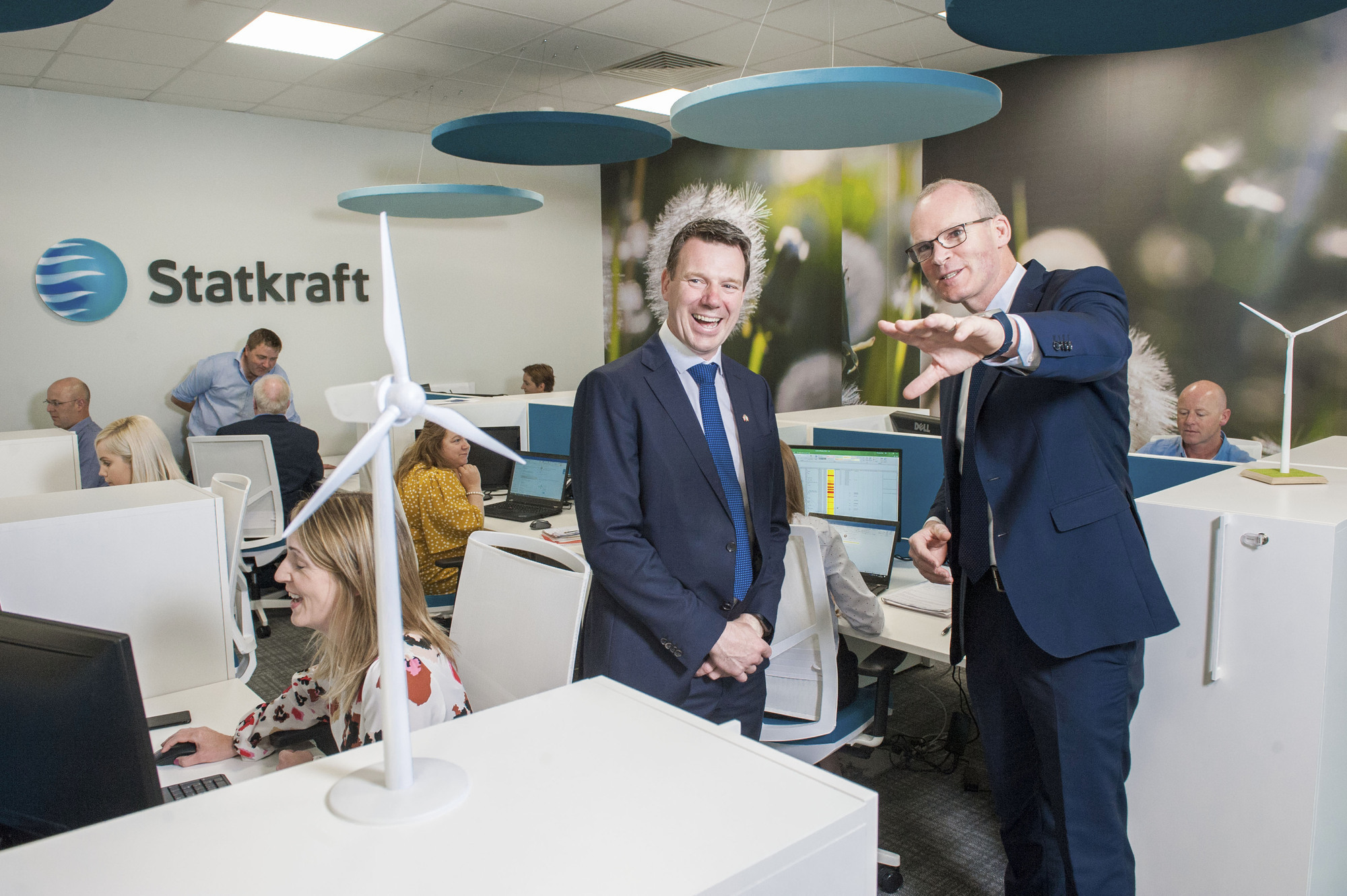
Minister for Foreign Affairs, Simon Coveney shares his vision of the Irish renewable sector with Statkraft Ireland managing director, Kevin O’Donovan at company’s Irish headquarters in Cork in September last year
Plans for a €1bn offshore wind farm in the Irish Sea off the coast of Dublin, Meath and Louth have moved a step closer with An Bord Pleanála being asked to carry out a preliminary assessment of the project.
North Irish Sea Array (NISA) Windfarm has lodged an application for a pre-application consultation with the board as part of the process for securing planning permission for the development.
The company which is owned by Statkraft, the Norwegian state-owned renewable energy provider, is planning to build an offshore wind farm of up to 36 fixed-base turbines arranged in three pods around 5km apart as well as an onshore grid connection point at Belcamp in Co. Dublin.
The pods will be located between 12.5km and 23.5km from the coast at their nearest points and in depths of water between 30m and 63m.
The offshore development covers an area of over 227 square km, spanning a total distance of 31km along the coast from Rush in Co. Dublin to Clogherhead in Co. Louth.
An Bord Pleanála is due to give its preliminary assessment of the plans by mid-September, while NISA Windfarm said it is targeting submitting a formal application for planning permission in 2022.
It hopes that construction could begin in 2024 with the turbines becoming operational in 2026.
The company claims the proposed offshore wind farm will have the capacity to provide renewable energy for up to 500,000 homes.
“It has the capacity to be a project of potential national significance in addressing the very serious impacts associated with climate change,” the company said.
NISA Windfarm said it would consult with local communities and wider stakeholders during the design stage of the project in order to develop the most suitable and appropriate proposals possible.
The company said it wished to minimise any impacts which the development might have on commercial fishing in the area.
It claimed discussions during the initial design phase had already led to a reduction in the proposed number of turbines which was originally in excess of 50 as well as potential visual impacts.
"A lot of the attributes and natural resources that Ireland has are viewed by companies such as @Statkraft as having huge value, and means that Ireland has great potential to be a world leader in climate action." #nordicstrategy #renewableenergy #ClimateAction pic.twitter.com/ZPwyXHXniw
— Statkraft Ireland (@StatkraftIE) June 2, 2021
NISA Windfarm said views of fishing communities had resulted in the adoption of a pod concept of the layout for the wind farm as well as the orientation of the rows of turbines in a north-north-west and south-south-east direction.
“We believe that these design features will allow the wind farm to be navigable and fishable in the preferred directions by the fishers should they wish to do so at any point during the 30-year plus life of the wind farm,” it said.
Plans for the offshore wind farm were first proposed by Gaelectric in 2009 which was later taken over by Element Power before its Irish interests were bought out by Statkraft in 2018.
The NISA wind farm is one of seven offshore wind projects with a combined capacity of 3.5 GW designated in May 2020 by the Department of Housing, Planning and Local Government for special status under proposed maritime area planning legislation which will fast-track the planning process for such developments.
CLIMATE & SUSTAINABILITY HUB
CONNECT WITH US TODAY



Be the first to know the latest news and updates