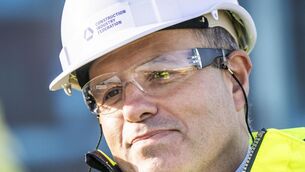
Enron chief: I knew nothing about company fraud
Enron founder Kenneth Lay said he was had no knowledge of fraud when he retook the reins of the energy giant in 2001.
“Throughout that whole period, a lot of information was flowing to me from a lot of different sources,” he said.
Lay said he was clueless about fraud at Enron when he returned to take over, after the abrupt resignation of his protegé, former CEO Jeffrey Skilling.
He also said that even as he was being warned about questionable activities, he was working hard – and legally – attempting to straighten out the company’s financial problems.
Convincing a jury of that may prove to be crucial if he hopes to avoid a long prison term, since US prosecutors claim that when the long-time Enron chairman regained the CEO’s title, he took the reins of a long-standing conspiracy to fool investors and regulators into believing the company was healthy.
Lay spoke to The Associated Press in his Houston, Texas, office about the 11 counts of conspiracy, fraud and lying to banks against him and other topics - namely his relationship with President George Bush and his personal finances - as part of his uncommon public defence blitz to return the US Justice Department’s punches.
Lay last week became the 30th person charged in the US government’s two and a half-year investigation.
He said he tried and failed to save Enron, which rose to number seven on the Fortune 500 under his leadership, but he did not know crimes that sealed the company’s fate had been committed on his watch.
Lay insisted he was duped by Andrew Fastow, the financial expert he trusted to ensure its operations were legal.
After Skilling left, Lay said he met division heads and representatives of various groups regarding organisational changes, personnel changes, strategic decisions, investments, regulators, legal issues, finance, operations “or whatever”.
He heard complaints, most notably from Sherron Watkins, the former Enron executive who warned Lay of impending doom less than four months before the company crashed.
He also heard assurances that Enron could handle hundreds of millions of dollars in write-offs for money-losing ventures in broadband and water as well as some of Fastow’s convoluted financing methods.
“Out of that I’m sure an awful lot of things came to me, but again, from my standpoint, I was convinced all the way through that period, literally well into October, that the company was strong,” Lay said.
Fastow, Enron’s former finance chief, pleaded guilty in January to running schemes and partnerships to hide Enron debt and inflate company profits while funnelling millions of dollars to himself.
Fastow is the US government’s most high-profile co-operating witness – and the object of Lay’s scorn.
“It looks like Fastow was the mastermind of all of it,” Lay said. “And again, he apparently did a pretty good job of selecting those he wanted involved in it. But we’re more likely to think there was bad activity going on very close to him than anywhere else in the company.”
Enron’s collapse led a series of corporate scandals that prompted the US congress to pass sweeping reforms of securities laws.
Thousands of Enron’s workers lost their jobs, and the stock fell from a high of $90 (€72.80) in August 2000 to just a few cent, wiping out many workers’ retirement savings.
President Bush received more than €539,400 from Enron, its employees and their relatives during his political career – the most from any source.
More than 250 members of congress from both parties also received Enron contributions, although three-quarters of the nearly €5.2m given to candidates since 1989 went to Republicans.
“Clearly I and many people at Enron were strong supporters of President Bush, both when he ran for governor and when he ran for president,” Lay said. “I think we had a fairly strong relationship. Was I his best friend?
"No, I wasn’t his best friend or somebody that … he might more likely call for day-to-day advice or whatever.”
Lay is on €494,500 bail while he awaits trial and says his and his wife’s €397.2m net worth has dwindled to less than €19.5m, and most of that is earmarked for legal fees. If convicted on all counts, Lay could receive up to 175 years in prison plus fines, possibly totalling more than €5.2m.
He hedged when asked if he may be bankrupt by the time his criminal case and countless lawsuits were resolved.
“It’s impossible to predict from day to day what the next day will hold,” he said. “I certainly never expected to be indicted and certainly my legal team and I believe there’s no reason I should have been.”
CONNECT WITH US TODAY



Be the first to know the latest news and updates