First rise in interest rates still some time away
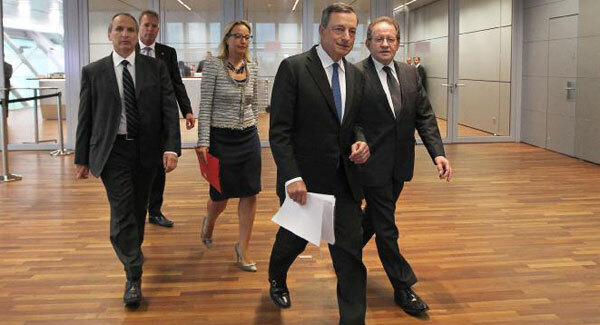
The first increases in interest rates still appear to be sometime in the distance despite ECB president Mario Draghi signalling that the central bank was preparing to scale back its huge stimulus programme that has helped boost economic growth in the eurozone, say economists.

First rise in interest rates still some time away

Traders were left waiting after the ECB’s initial statement reaffirmed its ultra-easy policy stance, but leaped on the euro as Mr Draghi said the bank’s staff were looking at how to wind down its €60bn a-month buying programme.

Against the dollar, the euro jetted as high over $1.20 from under $1.197 before Mr Draghi spoke, while European stocks saw their day’s gains halved at the prospect of ongoing euro strength.

Mr Draghi said he was watching the euro’s gains as policymakers edge towards settling the future of their bond-buying programme. The ECB held interest rates and kept stimulus measures unchanged.

The euro’s surge — more than 14% against the dollar this year — was reflected in a downgrade to the ECB’s inflation outlook even as Mr Draghi said economic growth remains solid.

“We will be ready for much of what we have to decide (to scale back stimulus) by October,” Mr Draghi said at the ECB’s news conference.

“Right now, judging the way the world is going we should be ready.”

The strength of the euro has complicated the ECB’s decision-making.

Alan McQuaid, chief economist at Merrion Capital, said interest rates would still be unlikely to start to rise before 2019 even as the ECB sets course to reduce its stimulus programme.

Capital Economics in London said that though Mr Draghi had said the currency’s rise was a “source of volatility” he had not attempted to talk it down.

“Admittedly, the ECB will probably lay out plans to taper its asset purchases at its next meeting in October. We think it will continue to tread very cautiously when it comes to reducing the pace of its asset purchases, and that it will leave interest rates on hold until 2019,” Capital Economics said.

Brendan Lardner at State Street Global Advisors said the ECB had deferred making any decision on the tapering of its purchase programme until next month.

“A tapering of the purchase programme will have to take place from next year due to technical constraints. It appears when the decision to taper is made, policy accommodation will be withdrawn at a cautious pace that is heavily data dependent.”

The key problem for the ECB in deciding whether to continue or wind down the asset purchases is that while growth, driven by eurozone consumer spending, is robust, inflation will remain under the ECB’s target of almost 2% for years to come given a sizeable slack in the labour market and the absence of meaningful wage growth.

Mr Draghi cited the strong euro as a reason for the lower inflation forecasts, with price growth now seen at 1.2% next year compared with 1.3% predicted in June and at 1.5% in 2019, down from 1.6%.

He simply reiterated that policymakers would decide this autumn, adding: “Probably the bulk of these decisions will be taken in October.”

Online broker IG said the “the big question is whether tapering will begin in 2017 or 2018”.

Additional reporting

Bloomberg and Reuters

x

More in this section

The Business Hub

Newsletter

News and analysis on business, money and jobs from Munster and beyond by our expert team of business writers.

Cookie Policy Privacy Policy Brand Safety FAQ Help Contact Us Terms and Conditions

© Examiner Echo Group Limited










