Securing organ donations for lifesaving transplants just another day for Lynne Martin
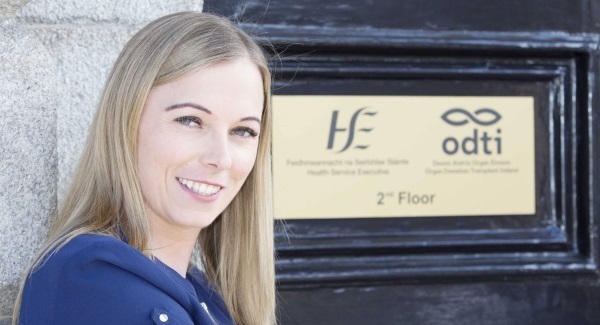
ORGAN Donation and Transplant Ireland (ODTI) has a dedicated premises on Dublin’s Temple St from which to co-ordinate its lifesaving services.
Last year, 280 organ transplants were carried out, with an average rate of 23 transplants per month, including kidney, liver, lung and heart, spread across three transplant centres — the Mater, St Vincent’s University Hospital and Beaumont.
Within the ODTI, the National Organ Procurement Service (NOPS) is managed by six donor co-ordinators, providing a 24 hour on-call service, 365 days a year, planning and arranging transplants when donor organs become available, guiding and advising the patient’s healthcare team and recipient centres, and supporting the family of the donor throughout the process..
The ODTI now has officially opened its dedicated premises and 2016 annual report published https://t.co/tCbsiN1de1 pic.twitter.com/cA2E7Ga7mt
— HSE Ireland (@HSELive) May 8, 2017
Lynne Martin is one such co-ordinator. She takes us through an extremely busy day.
I get up and make my way to the gym for a boxing session. I try to go before work when I’m on call as I won’t know where I in the country I might be later on this evening.
After a quick shower, I’m in the ODTI office and take charge of the on call phones. I get a handover regarding any matters arising from the previous on call co-ordinator. A bite to eat and then I check that the donor database and log books are complete and up to date.
I am working on the letters to a donor family who generously donated their loved ones organs a month ago. These letters contain a snippet of information on the people who received an organ, ie, their gender and age bracket.
We also offer donor families keepsakes of their loved one that we send along with the letters. The donor families find comfort and solace in these letters at what is undoubtedly such a tragic time. We also facilitate written communication between recipients and donor families. Not all recipients write as it is hard to express thanks for such a life altering gift.
The call phone rings, a nurse from an intensive care unit informs me that there is a patient in their ICU who meets the criteria to become a donor and the family have expressed a wish to donate their loved one’s organs.
Families still amaze me as there are very specific criteria that need to be met in order to become a potential organ donor. It is often sudden and tragic and in the depths of their despair they think of others in need. You are three times more likely to need a transplant than to be a donor.
Once I’ve gathered all the information required, I refer the potential donor onto the recipient centres. I co-ordinate and interface with recipient centres in Ireland and the UK where organs may be allocated.
I have specific bloods en route to specialist laboratories, from the potential donor, for cross matching and screening.
These bloods take a minimum of 6-8 hours which influences when I set theatre time. I organise an ambulance car to take me to the specific hospital.
I expect to be there around 7pm to meet with the family of the potential donor. I make approx 200 phonecalls to communicate, liaise and provide support between ICU staff, theatre staff, recipient centres, labs and transport to ensure all aspects of the donation sequence run smoothly.
I arrive onto the intensive care unit and I meet with the potential donor’s family.
I explain about organ donation and the process involved. I provide support and time to the families and answer any questions they have.
I inform them that I will remain with their loved one throughout the donation process and thank them as without families willing to donate their loved one’s organs we would not have a service and people would not have their lives enhanced and changed for the better through transplantation.
I then obtain the next of kin’s consent for organ donation.
Theatre time is set for 11pm. All the recipient centre teams are arriving and theatre is being prepared by the local hospital staff. The family of the potential donor are at the bedside.
They are aware of theatre time and know that the operation can take approximately five hours. I make a quick call home to ensure my husband has fed and walked the dog, as I won’t be home until tomorrow morning. I grab a quick cuppa and a slice of toast on the go.
The family has said their goodbyes and the donor is brought to theatre.
I promise to give them a call tomorrow when I get home to let them know how everything went. It is heartbreaking for them to say their goodbyes but hopefully donation will help them make sense of something so senseless.
The donation procedure is complete. I make my way to the ambulance transport which will have me home around 10am.
Back at home I will grab a small bite to eat and head to bed for some rest.
It is an exhausting but very rewarding job that makes me thankful for mine and my family’s health.
My last thought of the day is always for the donor and their family.