CLODAGH FINN: I’m too long in the tooth to worry about whitening
Smile? You must be joking. Like the six in ten people who this week told pollsters they found it hard to smile, I, too, am inclined to skip the grin and just bear it.
Healthcare retailers Superdrug found that 66% of people were too stressed to smile. And yes, there’s a lot to be solemn about, but the reason I’m afraid to open my mouth, these days, is not stress but fear I’ll out myself as an unreconstructed female; one who hasn’t quite cottoned on to the fact that dazzling white teeth are the new, oh I don’t know, all-over spray tan/shoes/must-have accessory.
Though, ‘new’ is probably pushing it because, for quite some time now, you’re the odd one out if you don’t have American film-star teeth; big, white and straight like the newly painted lines of a zebra crossing.
And it’s getting worse – or maybe I should say better. I passed a woman on the street the other day who had teeth so glaringly white they looked like they might have come off a colour-palette test card for paint.
In fact, it’s a wonder dental whitening clinics don’t include the kind of poetic names used by the manufacturers of paint along with their promise of cosmetic transformation. Didn’t you always want a ‘white dove’ smile?
No?
Then perhaps a different shade of white: slipper satin, cotton ball, cloud white, bone white, man-on-the-moon white, pocket-watch white, great-white-shark white?* I made up only one of those, though it might be hard to tell which one.
In dental terms, the convention when teeth-whitening, I understand, is to match your newly whitened teeth to the white of your eye.
If that is so, then the whites of our smiling Irish eyes have never been more glistening, more glaring, more incandescently glowing. It is, surely, a sign of progress.
There’s no harm in it – except to your pocket – if you heed the Irish Dental Association and get the procedure down safely and professionally. The EU has already put guidelines in place banning products that contain more than 6% of the whitening chemical, hydrogen peroxide.
On a little aside, I’ve just come across an article on the “amazing benefits” of hydrogen peroxide – as well as being an excellent tooth-whitener, it’s good for foot fungus, mite infections and wound care.
That little piece of information along with the thought of having to listen to the terrifying snap of the dentist’s rubber glove when it’s not a matter of excruciating toothache, will wipe the smile off this particular face for some time to come.
In any case, where does it all end? What’s the good of having a white smile if it is a crooked smile? White is no good without straight, is it? Before you know it, you and your white teeth have disappeared down the rabbit hole into the world of invisible braces and orthodontics.
I miss the days when dental advice was a simple exhortation to brush twice a day. Now, you’re not down with the celebs unless you ‘strengthen, straighten and whiten’.
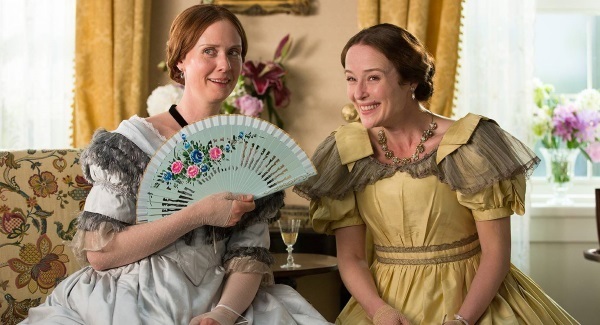
Though, we can’t lay this on the celebs. Or at least not on all of them. Cynthia Nixon, who plays poet Emily Dickenson in A Quiet Passion, tells the revealing story of a photographer who, during a shoot, told her to keep smiling: “Yes,” he said, “that’s lovely, amazing, brilliant.”
Then he added: “I love your teeth. Don’t get them fixed.” Mind you, her teeth look pretty fixed to me, but then my eyes – whites and all – are clearly not properly adjusted to what constitutes grooming, 21st century-style. I’m stuck in a past that looked upon a slightly crooked eye tooth as a thing of charm; a small individual idiosyncrasy that set its owner apart from the herd.
In family albums, you’ll still find people whose teeth are untouched and obviously their own – the cigarette-stained smile of a loved one here; the misaligned front teeth of a granduncle there; their dental formations as much a part of their personality as their facial features.
In years to come, there will be no such variations; just rows and rows of porcelain perfection.
Any talk of teeth always reminds of a dentist acquaintance who said he was very bad on names but extremely good with teeth. When he met a person, he didn’t know who was in front of him until they opened their mouth. Then he had it in a split second; their smile opening up before him like an address book with name and mobile number.
That poor man will be lost now, but I can’t help thinking we’ve all lost something with the rush to mass produce the perfect smile.
It’s not that I’m against good dental care or, indeed, progress. Thank heavens for advances in dentistry, which have brought with them an ease to the pain and agony that must have afflicted so many of our ancestors.
If you want horror stories, you don’t have to look much further than the history of dentistry. If you needed false teeth in the 19th century, for instance, you might have been offered a set that had been harvested from the corpses on the battlefield after Waterloo.
The desire to have the pearliest of pearly whites is not even new, though the recent stampede surely is. In 1939, toothpaste enriched with a certain type of Milk of Magnesia promised to turn “the dingiest teeth” to “snowy white”.
Strangely enough, the desire for that dazzling smile hasn’t done much for toothbrush sales. The Irish Dental Association website has a fascinating section called ‘Trivia’. One of its items informs us that even in these white-teeth obsessed days, only 46% of Irish households buy toothbrushes.
How can we interpret that? Does it mean that 54% get them second-hand, or don’t even bother at all?
Now there’s something to take the smile off your face.
*Great-white-shark white is a complete fabrication, but of course you knew that.