Brexit storm eases but UK slump looms

Irish shares — among the worst casualties in the world from the outcome of Thursday’s vote — rose 2%, and London’s Ftse 100 index also gained, up 2.6% on the day.
However, there were many signs that investors continue to fret about the outlook for Europe’s banks.
Analysts cut earnings targets for Bank of Ireland, which is exposed through its UK Post Office loans venture to a depreciating sterling.
The shares slipped back to 18 cent and remain about 50% down from a year ago. Other Irish-based big stock market names exposed to sterling fared better: Ryanair shares rose 2% but are still 26% lower this year.
Sterling rose for the second session, to 82.3 pence, easing pressure for the time being on the many Irish firms and the jobs they provide which depend on exporting goods and services across the Irish Sea.
Sterling has slumped from 78 pence against the euro on the eve of the vote and is down from 69 pence late last year. A depreciating sterling erodes the profits of firms in the Republic selling into Britain.
Germany’s Siemens became one of the first firms to say it had reviewed a UK project, saying it will freeze plans to expand its €193m wind power investment in the UK, until it has further clarity on the UK’s future trade relationship with the EU.
Europe’s largest engineering company said the plants near Hull will only service UK orders for the time being.
In all, investment in the British economy will fall 5% next year in the wake of the Brexit vote, credit ratings firm Fitch said in a report.
“This uncertainty will prompt firms to delay investment and hiring decisions, while elevated financial market volatility will further damage business confidence,” it said.
By 2018 investment levels would be 15% lower than forecast before the referendum, Fitch said, while economic growth in 2017 and 2018 would be 1 percentage point a year lower than before.
“Consumption will not be immune to this shock and overall spending by UK residents will see a mild decline in 2017. The sharp fall in the value of sterling will provide some offset to the demand shock, with exports likely to benefit somewhat in the near term,” Fitch added.
A Bloomberg survey predicted the UK economic outlook is worse again and that a slump may loom.
Almost three-quarters of respondents to its survey say the economy will slip into a recession for the first time since 2009.
A majority also predict the Bank of England governor and fellow policy makers will add more stimulus, including cutting interest rates in the third quarter.
The economists believe uncertainty will loom for as long as the UK’s future relationship with the EU remains in limbo.
As European leaders threaten to play hardball in any negotiations on the country’s withdrawal from the bloc, a political vacuum at the top of UK government is compounding the negative sentiment.
Bank of England governor Mark Carney warned in May a vote for Brexit could tip the country into a technical recession — defined as two consecutive quarters of contraction.
“The UK is in a mess,” said Alan McQuaid, chief economist at Merrion Capital.
“It will most likely be left to the central bank to clean up the politicians’ mess, with Mark Carney and his colleagues probably implementing further monetary stimulus before the year is out,” he said.
In research published in the wake of the referendum, Goldman Sachs and Bank of America Merrill Lynch were among those forecasting an economic contraction. Both said the impact of the vote could subtract about a cumulative 2.5% from GDP.
According to the survey, 71% of 35 respondents said the decision to exit the EU will lead to a recession.
Of the 25 economists who forecast a time period, there was an almost even split between those expecting it this year and those who predict 2017. Just one said it will come later.
Investors also predict policy makers will opt to support growth, with traders pricing in a 34% chance of an interest rate cut at the UK’s Monetary Policy Committee’s July meeting, and a 54% probability of a loosening in August.
The pace of UK economic growth was already cooling before the vote, slipping to 0.4% in the first quarter from 0.6%. That may have continued this quarter as uncertainty amid the referendum campaign damped hiring and investment.
Industry group Ibec and the CBI Northern Ireland yesterday urged Dublin and Belfast to step up spending on infrastructure.
“Irrespective of the Brexit vote, investment in all-island infrastructure and initiatives must progress with added urgency. Ibec and the CBI will continue to identify and facilitate all-island investment and funding mechanisms as the island adjusts to the expected UK exit from the EU,” the group said in a joint statement.
“While this is not the result businesses either side of the border wanted, the task now is to ensure investment in infrastructure is delivered as we navigate through this unwelcome period of uncertainty. Indeed, there is particular disappointment in Northern Ireland where a majority voted to remain,” they said.
An illustrated history of the pound sterling 1791-2016: pic.twitter.com/8BFTi0nvgM
— Ed Conway (@EdConwaySky) June 29, 2016
Máirtín Ó Muilleoir, the North’s new finance minister, who joined the Ibec talks in Dublin, said that with Stormont “working closely with the Irish Government, we can minimise the damaging impacts of Brexit north and south and ensure the northern vote to remain is respected.”
With the vote prompting David Cameron to resign and leading to turmoil in the opposition Labour Party that saw leader Jeremy Corbyn lose a confidence vote, UK investors and households seeking reassurance may increasingly look to the Bank of England’s Mr Carney.
Within hours of the referendum result, the governor had said the bank was ready to act to support the financial system and the economy if needed. In the Bloomberg survey, in addition to rate cuts, a majority expect the Bank of England to restart asset purchases, while almost half forecast measures to aid credit.
But many analysts believe the potential breakup of the UK and political tensions in the EU following the Brexit vote will also lead to market nervousness years to come.
US bank JP Morgan said yesterday it now expects Scotland to vote for independence and introduce its own currency before Britain leaves the EU in 2019.
“Our base case is Scotland will vote for independence and institute a new currency at that point (2019),” JP Morgan economist Malcolm Barr said in a note yesterday to clients. Scottish First Minister Nicola Sturgeon is seeking a way for Scotland to remain in the EU.
Meanwhile, Germany’s finance minister Wolfgang Schaeuble favours stricter budget rules for EU states and a downsized European Commission as part of a post-Brexit reform plan for the bloc drafted by his aides, the Handelsblatt daily reported yesterday.
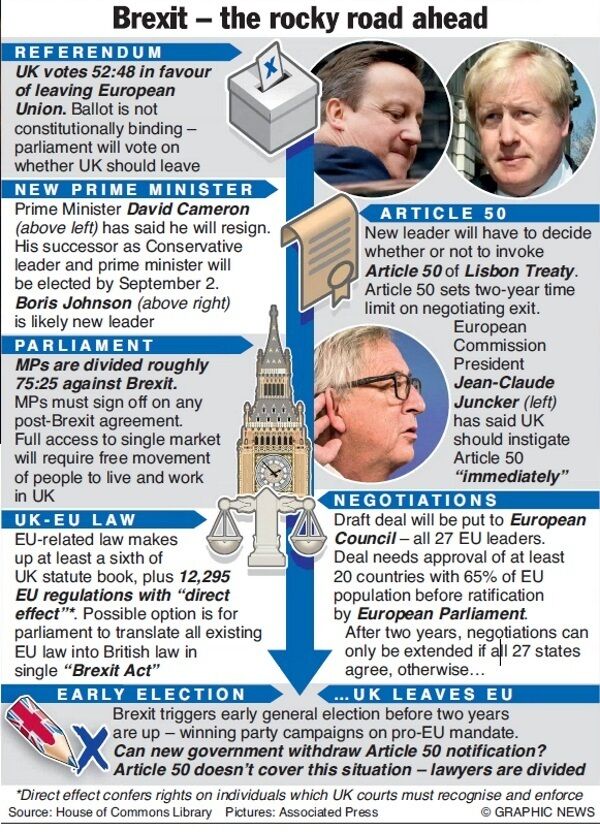
Asked about the plan, a finance ministry source said: “At the moment, consolidation is not the main focus”.
UK mortgage approvals rose in May and house prices continued their steady advance in the weeks leading up to the vote, according to figures published yesterday, but the decision to leave may undermine future demand.
According to James McCann, European economist at Standard Life, looser Bank of England monetary policy “can’t be far off.”
He sees a UK rate cut at the July 14 meeting and asset buying potentially a month later, though that will partly depend on an orderly sterling depreciation.
“The shock to the economy justifies easier policy and the Bank of England is unlikely to be deterred by a short-term pickup in inflation as sterling depreciates,” Mr McCann said.
“It looked through a similar inflationary bump after the financial crisis,” he said.

CONNECT WITH US TODAY



Be the first to know the latest news and updates