Kenya’s burning of its elephant ivory is the example to follow
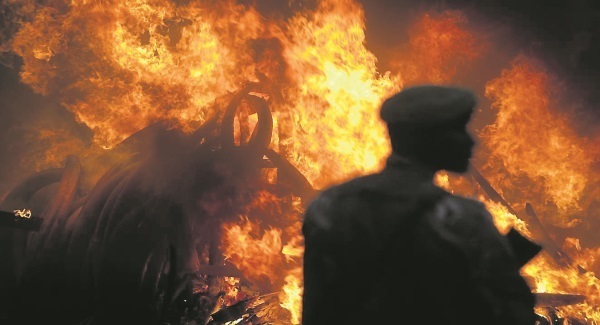
KENYA has burned its stockpile of elephant ivory. That’s 100 metric tons of ‘white gold’, both illegally harvested (confiscated from poachers or traders) and naturally accruing (from natural mortality), valued at €110m (based on the price of $1,100 per kilogram in China, where the majority of the world’s ivory is consumed or stockpiled).
To most economists, destroying something of so much value is anathema. But there are good reasons for a country — even one as poor as Kenya — to surrender its ivory wealth to the flames. Stockpile destruction fortifies the credibility of demand-reduction campaigns in East Asia, without which the poaching problem will never be solved. Demand reduction aims to weaken the market for the product by changing consumer tastes. As prices drop, so does the incentive for poachers to kill elephants.
When countries keep their stockpiles, they anticipate being able to sell ivory in the future. This undermines the credibility of demand-reduction efforts; if the trade is likely to be legalised one day, the stigma associated with ivory consumption will be eroded.
Proponents of a regulated, legal, international ivory trade argue that demand-reduction can coexist with a limited, legitimate supply. But this reasoning has a dangerous weakness: It assumes that a legal cartel — one proposed model for regulating supply — would crowd-out illegal suppliers by providing ivory to the market at a lower cost.

This assumption is dubious. The quantities traded through a legal mechanism would be insufficient to flood the market and suppress the price. With legalised trade undermining demand-reduction efforts, the price of ivory is likely to remain high, ensuring that poaching continues.
Some southern African countries argue that they should be allowed to sell their ivory in CITES-permitted, one-off sales to fund conservation of healthy elephant populations. But, aside from the low probability that the revenue would be directed to that end, it is not clear that much money would be made.
Under CITES regulations, governments are permitted to sell only to other governments. But what other governments are willing to pay may be as low as one-tenth of the illicit value. And governments can sell only naturally accrued ivory, not what was confiscated from poachers or illicit dealers.
China and the United States are formulating bans on domestic ivory trade, so it is not obvious which governments would be interested in purchasing African stockpiles.

Vietnam and Laos are likely candidates, but they are also part of the infamous ‘golden triangle,’ where illegal trade in wildlife and wildlife products continues to thrive. The possibility of the legal ivory trade shifting to poorly regulated markets calls for a concerted international response, spearheaded by African governments, through coalitions like the Elephant Protection Initiative, together with countries such as China.
Preserving stockpiles is operationally expensive, and often pointless. Inventory management is labour-intensive and technologically demanding. The ivory also must be air-conditioned, to prevent the tusks from cracking or becoming brittle (these reduce prices).
Given the low probability of being able to sell ivory in the future, the cost of storing and protecting it is unlikely to be recouped. Meanwhile, criminal syndicates need only corrupt a handful of officials to acquire the goods. The scarce human and financial resources allocated toward stockpile management could be more efficiently used on landscape preservation (which can become self-sustaining, through payment-for-ecosystem services).

Finally, burning ivory worth millions has a symbolic impact. It sends a message: Ivory belongs to elephants and to no-one else, and elephants are worth more alive than dead.
Elephants are a keystone species for preserving important ecosystems. And yet, rampant poaching is destroying elephant populations across Africa, killing 30,000 a year.
Poaching also impacts on communities, benefiting a few at the expense of the many. Community conservancies (areas set aside for wildlife conservation) in northern Kenya are highly effective forms of landscape (and therefore elephant) preservation, provided the right incentives are in place. This is important, because, in countries like Kenya and Tanzania, the majority of wildlife exists outside formally protected areas.
Kenya should be commended for making a wise — and efficient — decision. Its neighbours, as well as countries farther south, should follow its example. Ideally, all range-state countries should destroy their stockpiles to overcome the regional collective-action problem. Doing so would send an unmistakable signal to the global market: Ivory is not for sale; not now and not in the future.












