Tom Clifford ’16 went to fight without hope of victory
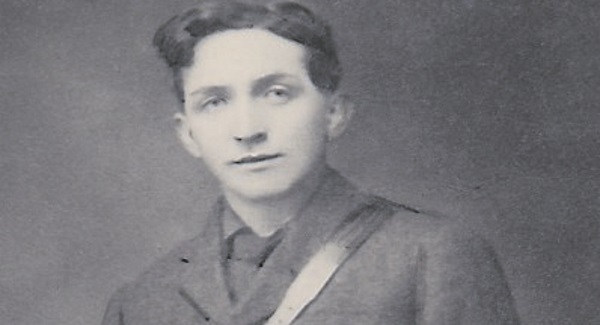
“Dear Dan, I’m just going to confession and communion now. How is it that neither of us has written to the other this long time? Well, at any rate, I have to start now or perhaps you may never hear from me. Times are more than troublesome here.”
Tom was a member of G Company 2nd Dublin Batallion of the Irish Volunteers. One of his officers in G Company was Dick McKee, who would later be tortured to death in Dublin Castle on Bloody Sunday 1921.
Since Holy Thursday, Tom had been instructed to “stand to” in preparation for something big. He hadn’t attended work at Pim Brothers drapery store in Georges St since the previous Wednesday. Like hundreds of other volunteers in Dublin, he had a scent that something big was about to happen. He was also under instructions to be careful with loose talk or even letter writing.
“We’re expecting serious work this evening and I don’t expect you will see me for a while again, but perhaps you would. God is good. I expect you won’t be allowed to hear. It is very hard to imagine such a change inside 24 hours but thank God I am not going against my will. I am going with my eyes perfectly open. I HOPE THIS IS VERY CLEAR.”
Tom Clifford was born in 1894, the seventh of ten children of Jeremiah and Catherine Clifford of Clahane, a townland outside Cahirciveen, Co Kerry. Jeremiah had a farm and an interest in a shop in the town.
In 1913, Tom came to Dublin seeking work. Some months later, the Irish Volunteers was founded and Tom joined up immediately. He was assigned to G Company, which was based in Glasnevin, not far from his digs in Gardiner St.
“I am afraid to write home as all communication is stopped from Kerry but I think I will chance it later on in the day. I had a letter from Johnny a few days ago. He is well. I suppose you heard Con Keating was drowned in the Laune a few days ago [see panel]. LHMOHS [Lord Have Mercy On His Soul].”
As might be expected for a Kerryman, Tom quickly got involved in playing football in the capital. Pictures survive of him togged out for Pim’s company team which won the CJ Kickham Cup — named in honour of the well-known Fenian — in 1915. By the time Easter 1916 came around, Tom was 22, full of idealism, and infected with the sense of nationalism that was fervent at the time.
“How are ye all getting on there? I hope all are well. Now, Donal, old son, don’t forget to say a few prayers and go to communion for me and get others to do so. I knew Bride, Kitt and Nelly [their three sisters] will do so. I have a new navy suit here for you. It might not be useful here. I don’t expect to be wearing it longer. What about the Darby scheme? [see panel] Does that affect you? I hope you will not be caught napping.”
Tom had one more paragraph to compose before signing off. “I have so many things to do and think about that I don’t know where I am, Dan. This is a case of giving a man’s life for his country, and a good chance and we could not refuse our poor martyrs that never got the chance we got. Goodbye now dear Dan from your ever loving and affectionate brother Thomas. Pray for me.”
Like all the volunteers, Tom had to wait an extra 24 hours as the Rising was postponed for a day. On Easter Monday, he was assigned to join the garrison at Jacob’s Mill with his company. That morning, he was tasked to travel up to Phibsboro to retrieve ammunition. By the time he got back to the southside of the city, the guns were blazing.
“I did not get in at all [to Jacob’s Mill],” Tom later told the Military Pensions Board. “I was sent up to Leinster St for some supplies. I got a car from the late commandant Connolly and I went up. The man who came up beat it. I came back. I got a hackney car with some ammunition and stuff and I got to the top of Grafton St. I was fired on and I went into Stephen’s Green.”
The Commandant Connolly referenced was Sean Connolly, an Irish Citizen Army officer who, in an assault on Dublin Castle, killed the first British soldier to die that week. Soon after, he became the first Rebel to die when he was shot in the environs of the Castle.
Tom Clifford fought in the Green under the command of the Citizen Army’s Michael Mallin, who was executed the following week. On Tuesday, the Citizen’s Army retreated into the College of Surgeons where they remained for the rest of the week.
Tom later described his contribution in his pension application as “actually under fire and returning the same. Fighting with the Citizen Army in Stephen’s Green until we had to retreat to the College of Surgeons. Subsequently acted as a sniper with positive results and helped repulse enemy attacks”.

He didn’t provide a statement for the Bureau of Military History outlining his involvement that Easter Week, or his far more significant role in the War of Independence.
His pension application revealed that following the garrison’s surrender on the Sunday, he, along with nearly 1,500 others, was shipped off to the UK, where he served time in Wandsworth prison and then in Frognach.
A photograph shows Tom in the company of the Irish detainees, including Michael Collins. Tom is fifth from the right at the back of the gathering.
He was released and returned home that summer. “It was about the time that Roger Casement got hanged,” he later related. Casement was hanged in Pentonville Prison on August 3.
Immediately, Tom threw himself back into the fight for independence. He moved back to Kerry and opened a shop in Tralee. The premises would become a valued location for storing arms. Tom joined the North Kerry brigade and was officer commanding of No 2 company, operating out of Ardfert.
Those few years were eventful in his life. He was imprisoned on three occasions, one of which involved a stint in a Belfast jail where he and two volunteers went on hunger strike for 11 days, effecting their release.
He directed and participated in a number of engagements with the crown forces in North Kerry. He oversaw the execution of two alleged spies. This was a period he would rarely ever reference later in life.
Young men and women from conservative, rural, and religious backgrounds found themselves caught up in a savage conflict that demanded the suspension of basic humanity. While others would later look back in pride or hubris on the brief years of killing and the fear of being killed, that was a place where Tom Clifford didn’t want to go.
After the truce was declared in July 1921, Tom continued to train volunteers in North Kerry until the Four Courts was shelled by Free State forces the following June. At that point he removed himself from the conflict. He was unwilling to turn his guns on his fellow Irishmen, whatever principles of politics were involved.
There was one tragic postscript to those turbulent and violent years for Tom. While he took no part in the Civil War, the brother with whom he corresponded on Easter Saturday 1916 joined the Irregulars on the Republican side. Dan Clifford joined a local company and was involved in action in south Kerry.
His involvement created problems for his family, including his brother Mick [your correspondent’s grandfather] who had by then taken over the family shop. Mick was at one stage warned by elements connected to the Free State forces that his premises would be burnt down.

That didn’t come to pass, but in the dying days of the conflict in March 1923, Dan was sleeping rough, on the run in the mountains outside Cahirciveen when he was captured by Free State forces. He and the other two were disarmed, put against a wall, and summarily shot.
Word reached Mick Clifford down in the town that his brother’s body was lying in an outhouse a few miles up the road. He went to investigate and was shot on, forcing him to retreat. He later returned to retrieve the body.
Dan and Tom had been close, as evidenced by the letter dispatched on Easter Saturday 1916. At that time, Tom was the one taking up arms to awaken slumbering nationalism. By the time the guns fell silent seven years later, it was Dan who had paid with his life.
Tom moved to Ballinasloe, Co Galway, where he worked in the postal service throughout the 1920s and ’30s. He applied for his army pension in 1938, but was denied the full stipend over some petty official dispute as to whether he had served a period between 1917 and 1919. He dropped the appeal “because I needed the money at the time”. He reapplied in 1944 and was awarded a full pension.
By then, he had returned to live on the family farm in Cahirciveen with his brother Din and Din’s family. A quiet man, Tom never married and rarely referenced his role at the birth of the new state.
However, when he went into town on a Saturday night, he was in a habit of harking back to Easter 1916 and all that had transpired during that fateful week. Pretty soon, some wag in the town began referring to him as Tom ’16 and he was known by that handle thereafter.
Such was his association locally with the Rising that he was listed on the register of electors as “Tom Clifford 1916”.
He died on New Year’s Day 1970 after a short illness. As was tradition at the time, arrangements were made for a firing party to travel to his funeral for a graveside salute to honour his contribution.
Unfortunately, that winter was quite savage and they were unable to make the journey from Tralee to Cahirciveen, to mark the death of one of those who had gone out in Easter 1916, without hope of victory, but secure in the knowledge that history was on their side.
Tom Clifford will feature in an exhibition remembering the volunteers who occupied the Royal College of Surgeons in Easter week. Surgeons and Insurgents — RCSI and the Easter Rising runs from March 23 to April 17 and includes a series of public lectures.
www.rcsi.ie/2016












