Adrian Hardiman offered up refreshing decisions and never afraid to 'go against the grain'
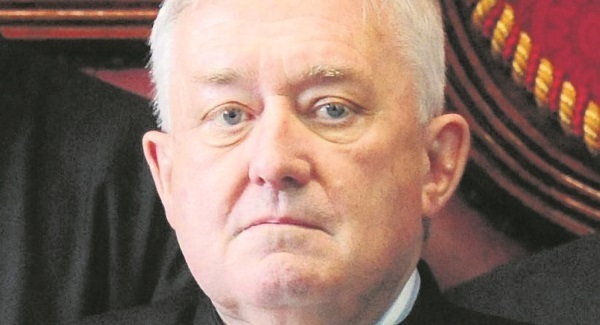
IN THE usually arid language of Supreme Court legal judgments, Adrian Hardiman’s contributions delivered a welcome drop of refreshment.
Not shy about injecting passion into his conclusions, he would declare a contrary claim as “astonishing”, a perceived breach of legal principle as “horrifying”, and an ill-argued point as “bewildering”, “nonsense”, or, on a good day, both.
Eloquent as might be expected of a Joycean scholar, he could deliver a hammer blow of a put-down with Wildean succinctness — as witnessed when he was left to pass judgment in the troubling case of a woman seeking the right to be recognised as the legal mother of her twin babies, created from her eggs but born to a surrogate.
Admonishing successive governments for their failure to legislate for the stampede of advances in assisted reproductive technology, Hardiman described the situation as one akin to where “road traffic law had failed to reflect the advent of the motor car”.
Another time, he figuratively banged the heads of Department of Justice officials together by declaring them guilty of an “extraordinary form of groupthink” in their mishandling of an immigration case.
And in one of his particularly devastating critiques, Hardiman said the wrongfully convicted Donegal businessman Frank Shortt had been “perjured into prison” by “out of control” gardaí in a campaign that was “nothing less than an obscenity”.
He could never be mistaken for being populist, however. Nobody who pens a 166-page dissenting view — as he did in last year’s admissability of evidence ruling — is going to be popular in the common sense.
In recent years he had unsentimentally ruled against hard-luck immigrants and victims of sex abuse, while delivering in favour of criminals, a Garda killer, a member of Seán Quinn’s family, and expenses scandal TD Ivor Callely.
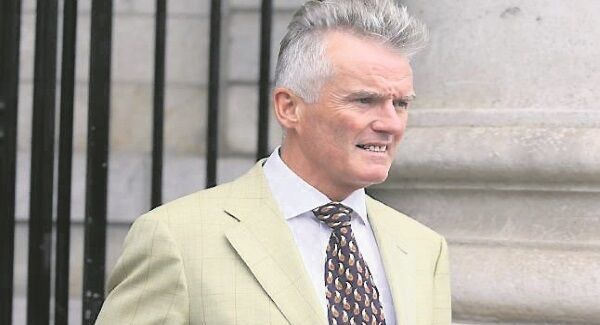
Just last month, while majority opinion was slapping the back of Operation Yewtree in Britain over its, albeit belated, crackdown on celebrity sex abusers, Hardiman was questioning the unquestioning belief that the accuser must always be believed at the expense of the right to the presumption of innocence of the accused and acquitted.
His propensity to go against the grain never seemed contrived, nor even, though many have said it, courageous. It just seemed natural, even necessary, for him to present an alternative viewpoint and, where warranted, stamp it with his approval.
Adrian Hardiman was born in 1951 in the newly created suburb of Coolock on the northside of Dublin City. His father was a teacher and for a time the president of the Association of Secondary Teachers of Ireland.
He went to school at Belvedere College where he excelled at English and then studied history at UCD where he was president of the student representative council, the forerunner to the students union.
He was auditor of the Literary and Historical Society, and it was in UCD that he met his wife-to-be, Donegal girl and now retired circuit court judge Yvonne Murphy, who was studying law part-time while working at the Revenue Commissioners.
The pair went to Kings Inn to train as barristers and Hardiman graduated in 1974, quickly earning a reputation as a confident and capable counsel in the grim environs of the Dublin criminal courts before going on to develop a wide brief covering everything from crime to constitutional law and libel to public liability.
His interest in politics survived his student days and in 1983 he acted as chair of the Anti-Amendment Campaign against the referendum that brought in the constitutional ban on abortion.
He would later show his liberal cards again when he successfully represented the Well Woman Centre against the Society for the Protection of the Unborn Child over the provision of information on abortion.
In the meantime, he stood unsuccessfully for Fianna Fáil in Dun Laoghaire in the 1985 local elections. His attachment to the party did not survive the Haughey era, however, and, disaffected with the leadership, Hardiman left and became a founding member of the Progressive Democrats.
He acted as legal adviser to the party’s first leader, Des O’Malley, whom he also represented during the Beef Tribunal, where he famously cross-examined then-taoiseach Albert Reynolds. His questioning of Reynolds led to, or at least accelerated, the collapse of the coalition government after he offered Reynolds the choice of describing O’Malley’s claims as incorrect or dishonest and Reynolds plumped for dishonest.
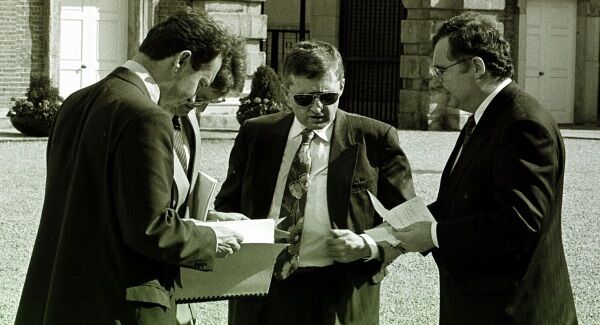
He made another memorable contribution to tribunal history when he represented Liam Lawlor against the Flood Tribunal and secured the late TD’s right not to be compelled to turn up for questioning in a case that went all the way to the Supreme Court.
He represented yet another politician, Democratic Left leader Proinsias de Rossa, in the landmark libel case that resulted in colourful exchanges with Eamon Dunphy in the witness box, an unprecedented €380,000 award against the , and a 13-year battle that only concluded in the European Court of Human Rights in 2005.
After 26 years at the bar, Hardiman was appointed to the Supreme Court — a somewhat unconventional selection given he had never presided over a lower court.
He was 49 and one of the highest earning barristers in the country, taking a drop in income to commit to the new job, so he took it not a little personally when the row over judges’ salaries broke out and the 2011 referendum was passed to enable governments cut judicial pay.
It wasn’t the money he cared about, Hardiman insisted, but the dangerous principle that judges could be cowed into submission by fear of financial uncertainty at the hands of a given government without an independent mechanism being in place to adjudicate on the matter.

He lost that argument but sometimes, even when he was on the losing side, it was his contribution that was remembered most. He dissented from the majority judgment in favour of relaxing the bar on admissibility of evidence in cases where there was a breach of constitutional rights in obtaining the evidence last year.
While his Supreme Court colleagues ruled to allow wriggle room for inadvertent breaches, he was adamant that such a change could propagate all sorts of “inadvertent” breaches. He was “horrified” at his colleagues’ opposing view, he said. They didn’t hold it against him — praise came in thick and fast after news of his loss broke yesterday.
He is mourned by his wife Yvonne, their sons Hugh, Eoin, and Daniel, and their grandchildren.
CONNECT WITH US TODAY



Be the first to know the latest news and updates











