Time for Super Mario to save day
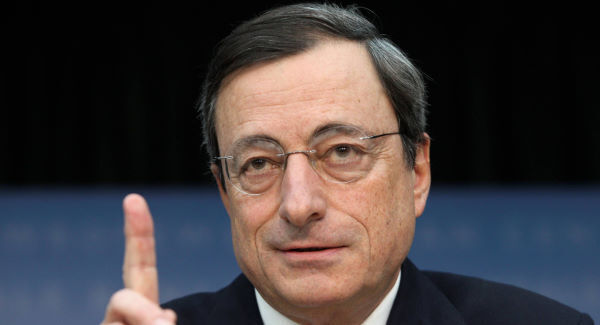
The guns of August and the lack of buttery business prospects have sent investors across Europe into a tail spin. Time for Mr Draghi to start greasing those monetary wheels?
This month, Europeans are marking the centenary of the outbreak of the First World War by staging another war, a proper conflict complete with real blood. So history is repeating itself, only this time the tragedy is on a smaller scale.
In 1914, financial markets crashed as the threat of conflict during July that year grew all too real. On this occasion, events in Ukraine have to date merely had a modestly depressing effect. The first impact of the sanctions war between Russia and the West has begun to be felt in the macro-economic data released in recent days from the eurozone.
The statistics show that for the first time in quite some time Germany’s economy contracted along with that of Italy, while growth in the eurozone as a whole halted. The data has caused concern rather than consternation but there are real fears about Italy’s debt mountain and ongoing stagnation in France. Spanish unemployment still stands at a shocking 25%.
Last month, the ECB president Mario Draghi berated the Italian government over its tardiness in implementing long awaited structural reforms, but at his most recent press conference, he appears to have switched tack, raising hopes that the bank may move more quickly than expected to press ahead with full- scale quantitative easing.
With inflation across the eurozone down at an anaemic 0.5%, way shy of the near 2% target set by the ECB, the big question is whether the bank president can win around all his fellow governors to a full-blown strategy aimed at countering debt deflation.
German complacency has certainly taken something of a hit, but there are no compelling signs that the public are ready yet to envisage monetary helicopter drops.
It has been expected that the tit-for-tat sanctions war exacerbated by the downing over eastern Ukraine of the Malaysian airlines plane would impact on the figures for the third quarter, but the underlying slowdown is apparent for everyone to see. The froth appears to be coming off markets worldwide. The great boom in corporate flotations has tailed off. Share prices are trading down.
Draghi had already warned, ahead of publication of the latest figures, that “heightened geopolitical risks” threatened to halt the weak recovery in the eurozone.
The second wave advance of the “Islamic State” Sunni jihadists has renewed concerns about security of energy supply in the Middle East, while just to add to the gloom, some pretty poor GDP figures emerged out of Japan, where the economy shrank by over 6% on an annualised basis in the latest quarter, as anticipated sales tax increases kicked in.
Amid the gloom, there were bright spots on Europe’s periphery where Ireland, in particular, has continued to release very positive numbers. Davy Stockbrokers issued a particularly upbeat forecast, raising the prospect of a budget adjustment of just €500m, one quarter of the amount pencilled in by many economists less than a year ago.
The Irish economy is being pulled along in part by its larger UK neighbour and by the US.
Growth has spread from the services to the goods sector following a relatively poor year in 2013 due to the pharmaceutical ‘cliff’. Now, a recovery is being primarily driven by food exports up by around 10%.
Across the water, the Bank of England governor, Mark Carney, appears at this stage to be skilfully taking much of the heat out of London’s previously booming property market.
However, poor demand in the eurozone is taking much of the shine off British performance with growth in exports failing to match the surge in domestic demand.
Sceptics question whether what we may be witnessing is a classic pre-election boom. British chancellor George Osborne will be under pressure to show that this time round this is a broadly-based recovery rather than one driven by consumer credit.
The latest jobs data is revealing in that it shows rapid job creation alongside lagging wages. This could be further evidence of the impact of immigration on the labour market, all grist to the mill of UKIP ahead of the general election there next May.
One interesting bump in the road is presented by the upcoming referendum on Scottish independence: If the surge in blue collar support claimed by the yes camp materialises, it could have a big impact on financial markets, and not just in London.
A referendum on Catalan independence could be on the horizon. Suffice to say that a Scottish yes vote will not be welcomed in Brussels or Frankfurt, never mind London.
Political fractures in Spain, whose economy is in the very early stages of recovery could have a seismic impact on the eurozone, which is already being hit by renewed concerns centred around stagnation and the threat of deflation.
There are signs that the markets have begun to take events in Ukraine in their stride, with a weakening in demand for haven currencies.
However, many believe that the euro could weaken into the autumn. Timothy Ash, chief economist at Standard Bank’s emerging markets group has warned that Russia’s relationship with the West has permanently changed. This could be bad news for Germany and for Eastern European economies with heavy trade exposures to Russia.
However, Russian analyst Ivan Mazalov, MD at Prosperity Capital Management, told Bloomberg that the idea of a Russian invasion of Ukraine was a “distant prospect”.
The latest polling shows support for this option among the Russian people has fallen below 25%. Mr Mazalov argues that there is a large potential upside in Russian share prices assuming that this turns out to be the case.
He instances Gazprom, which is trading at below three times earnings. Closer to home, London analysts fret about the impact of sterling strength relative to the euro on exports.
Elsewhere, there is growing evidence that European companies are turning their attention to North America in search of acquisition opportunities as CEOs take note of the contrasting economic vistas in continental Europe and the US.
Analysts and investors are watching for signs that Super Mario may be about to don his cape and take flight.











