Default hangs over Argentina again as talks fail
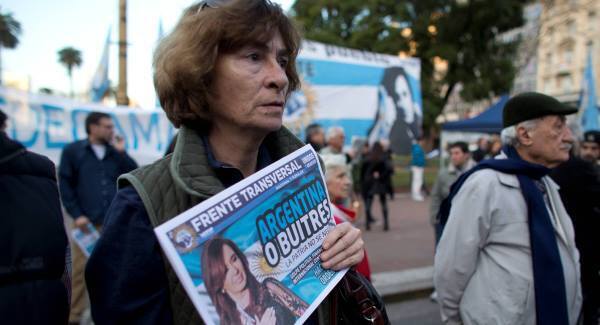
After a long legal battle with hedge funds that rejected Argentina’s debt restructuring following a 2002 default, Latin America’s third-biggest economy failed to strike a deal in time to meet a midnight payment deadline.
Journalist Joaquín Morales Solá, writing in the national daily paper La Nación, accused president Cristina Kirchner of being in denial. “The government’s attitude is unexplainable,” he wrote.
The immediate focus was on whether a group of big banks and funds overseen by the International Swaps and Derivatives Association would declare the situation a “credit event”.
Any such ruling would set off a series of insurance payments and give most of Argentina’s current bondholders the right to demand their money back immediately.
The deadline is Tuesday according to analysts.
However, the cost of
insuring Argentina’s debt against default fell sharply yesterday, data provider Markit said, as investors speculated a deal could be struck, even if only in the long-term.
The country’s five-year credit default swaps fell more than 400 basis points to 1,444 basis points.
“It is still not clear whether the credit default swap of the country will be triggered,” said Emiliano Surballe, fixed income analyst at Bank Julius Baer.
“The situation that generated the default was a lawsuit, not the failure of the country to transfer the proceeds to pay existing debt,” he said.
Argentina parked with its bankers the money to pay its current bondholders, but a US legal ruling prevented it from doing so unless it paid off the holdout bondholders first.
“It’s probably going to be more a soft default scenario, where prices will slide a bit.
“There is confidence in what the government is going to do,” said Rune Hejarskov, senior portfolio manager at Jyske Invest, which holds Argentinian debt.
The default could get much messier and take longer to clear up if creditors force an “acceleration” for early payment on their bonds.
Some investors saw this as unlikely.
“I don’t think, at the moment, there is a clear answer to whether bondholders will accelerate a deal. It’s probably not something most bondholders would like to see,” said Olivier De Timmerman, fixed income fund manager at KBC Asset Management in Luxembourg.
“My expectation is that they will eventually reach an agreement with holdouts.
“I do not think it will be in the short-term, but likely after the foreclosures have expired towards the end of the year,” he said.
The bonds at the centre of the struggle had rallied strongly on Wednesday, along with Buenos Aires stocks and the peso as bets on a deal rose, but traders were left up in the air after the talks fell apart.
Even a short default will raise local companies’ borrowing costs, pile more pressure on the peso, drain dwindling foreign reserves and fuel one of the world’s highest inflation rates.












