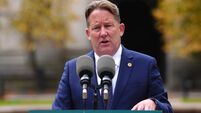
Europe’s future on his shoulders

With Jean Claude Trichet preparing to step down as president of the European Central Bank, Mario Draghi, an Italian banker with more than enough experience, is the person likely to step into his office, writes Kyran Fitzgerald

Europe’s future on his shoulders

ON Tuesday, French President Nicholas Sarkozy arrived in Rome bearing a big gift for Italy’s top banker, Mario Draghi.

Mr Sarkozy informed his Italian counterpart Silvio Berlusconi that he would be backing Mr Draghi’s candidacy for the presidency of the European Central Bank (ECB), a post that is due to be filled next October following the retirement of Frenchman, Jean Claude Trichet.

This Franco-Italian stitch up leaves Germany out in the cold. This weekend, a spokesman for the German Chancellor, Angela Merkel, hinted that Berlin could yet veto the appointment. This, however, seems highly unlikely at this stage.

On Thursday, the Spaniards weighed in to support their fellow southern European, with suitable alternative candidates are simply not on the horizon. A decision to appoint a central banker from a smaller European country to the job would mean, in effect, that France would be without a seat on the six-person ECB executive board — the key decision making body — when Trichet steps down in the autumn after eight years in the job.

Such an outcome would simply be inconceivable — an insult to the glory of France. What Sarkozy has done is pull off a classic pre-election stroke at the expense of the Germans.

France gets to walk tall. Frau Merkel is not amused.

The German public has become increasingly inward looking, more and more reluctant to dip into their purses to support profligate southern Europeans and other fiscal delinquents, such as the Irish.

Bild, the German equivalent of The Sun, recently suggested that “Italians and inflation go together like spaghetti and tomato sauce”. The idea that a “profligate southerner” should take the reins at the ECB is a nightmare vision as far as many Germans are concerned.

It galls that, up until February, a German, Axel Weber, was in pole position for the job. Then, Mr Weber unexpectedly took himself off the scene.

Mr Draghi is not exactly your stereotypical, pasta gorging, napkin wearing, singing Neapolitan. Born and reared in Florence, acquaintances suggest he has more than a touch of a calculating Renaissance nobleman about him.

Florentines are reserved, business-like, shrewd. This city was one of the original centres of banking and finance in Europe.

No candidate for the position could be better prepared for the job.

A distinguished academic, Mr Draghi completed his doctorate in the US at MIT in Boston. His supervisors, Robert Solow and Franco Modigliani, were among the most distinguished economists of their generation.

Mr Draghi returned to an academic career before taking on the top job at the Italian Treasury (finance ministry) in the early 1990s, a time when Italy was running an annual deficit in excess of 10% and was inflating at breakneck speed.

The Italian steadied the national ship by applying an austerity programme, before heading off into the private sector as vice chairman of Goldman Sachs Europe. The austerity plan was accompanied by Europe’s largest programme of privatisation.

In 2001, Mr Draghi chaired an EU committee designed to promote economic co-ordination.

At the time, the European Commission was hauling Ireland over the coals over our government’s decision to slash taxes and hike spending, at a time when the economy was already roaring ahead.

Mr Draghi was no fan of the Charlie McCreevy approach to economic management which helped set in train the banking and property bubble.

The Italian’s move to Goldman Sachs was an unusual one — Mr Draghi is one of the very few top central bank officials with direct, inside knowledge of the world of banking and investment. This job shift came with strings of controversy attached to it.

Last year, it was claimed Goldman Sachs had helped the Greek government to massage its statistics ahead of the country’s accession to the eurozone in 2001. It was alleged that through the use of cross currency swaps, the Greeks were able to show a smaller budget deficit than would otherwise have been the case.

While all this happened before Mr Draghi’s time, the controversy proved embarrassing at a time when Greece’s reputation had sunk to new lows in Germany, in particular. Goldman Sachs in the US has also won few friends after it earned large profits, in 2008-09, shorting investments in which client funds had been placed.

What is also clear is that Mr Draghi has won the trust of many senior German officials following a series of interviews and statements in which he pledged support for the ECB austerity programme. The Irish Government may have to think again if it believes that Mr Trichet’s departure will lead to a softening in Frankfurt’s approach. Mr Draghi has appeared keen to withdraw the exceptional measures currently propping up our banks, in particular.

He has also hinted at support for further interest rate rises, a move that would strike a further hammer blow to struggling peripheral nations.

One question mark over the Italian lies in a lack of experience in handling full scale financial crises. Here, the outgoing ECB boss, Mr Trichet, earned high marks for decisive action taken to boost short-term liquidity following the Lehman Brothers meltdown.

As chairman of the Financial Stability board, set up by the G20 in 2009, Mr Draghi has shown his mettle, suggesting it was time to take a tough line with banks and bank supervisory authorities. He has also been highly critical of the failure of the Berlusconi government to begin serious reforms of the Italian economy.

Italy’s public debt has reached 120% of GDP and while it escaped the financial crisis intact due to the conservatism of its bankers, Italy could yet find itself under attack from the bond market vigilantes who drove Ireland to the wall.

There have been bailouts in Greece, Ireland and Portugal, which is currently negotiating the terms of its financial rescue. The emphasis has shifted towards a restructuring of sovereign debt — in Greece, initially.

A tussle is underway between Berlin, which is keen to grasp the nettle, and both France and Italy, which fear the consequences of a restructuring of Greek debt. The ECB, meanwhile, has been ploughing its own anti-inflation furrow, piling on the interest rate agony as it battles to control commodity price led inflation.

Economist critics fear that Frankfurt yet again has grasped the wrong end of the stick, fighting a 1970s ghost while the real threat of deflation and mass unemployment looms larger by the day. The markets continue to give the thumbs down to Ireland’s austerity plan. The leeches continue to be applied by the fiscal doctor while the patient bleeds slowly to death.

There are no indications yet that Mr Draghi is prepared to depart from this economic orthodoxy. Last December, when the Luxembourg prime minister, Jean Claude Juncker and Italian finance minister Guilio Tremonti called for the issuance of euro bonds in a move designed to assist the strugglers to raise cheaper money, Mr Draghi was openly sceptical.

His prescriptions are familiar: in his view, struggling economies must engage in programmes of austerity and restructuring. the problem is that the financial markets no longer believe that this approach can work in the absence of a major restructuring of sovereign debt.

So will Mr Draghi, assuming he gets the ECB job, be remembered as the man who restored the euro and the whole European project, or as the apostle of economic orthodoxy who stood by while it sank slowly beneath the waves? Your guess is as good as mine.

Profile

Age: 63.

Place of birth: Florence.

Education: Florence University, Massachusetts Institute of Technology, PhD, Economics.

Career: Academic, University of Florence. Executive, World Bank, Washington DC.

1991-2001: head of the Italian Finance Ministry.

2002-2005: Vice chairman, Goldman Sachs, Europe.

2005 to date: Governor of the Bank of Italy. Member of ECB Executive board.

2009 to date: head of the Financial Stability board.

x

More in this section

The Business Hub

Newsletter

News and analysis on business, money and jobs from Munster and beyond by our expert team of business writers.

Cookie Policy Privacy Policy Brand Safety FAQ Help Contact Us Terms and Conditions

© Examiner Echo Group Limited