David McNamara: Ireland avoids trouble in latest US trade skirmish
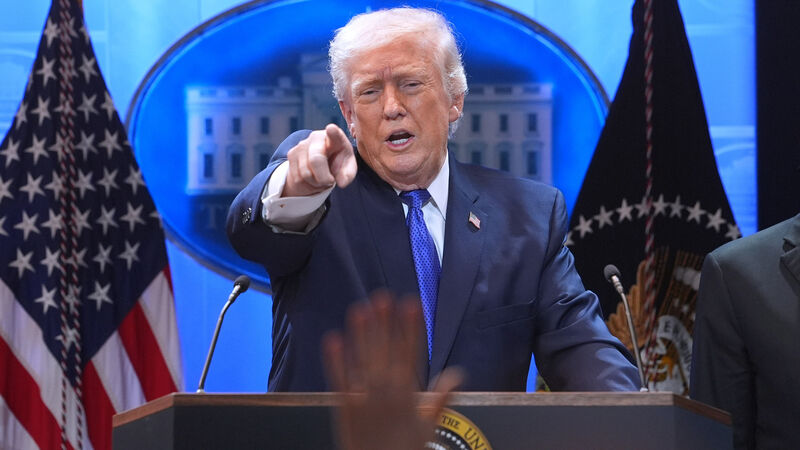
The news the US Supreme Court struck down the bulk of President Donald Trump’s tariff agenda created a fresh bout of risk for markets and the global economy over the weekend. Picture: AP/Evan Vucci

The news the US Supreme Court struck down the bulk of President Donald Trump’s tariff agenda created a fresh bout of risk for markets and the global economy over the weekend.
Predictably, investors have been doubling down on the recent ‘buy gold, sell dollar’ trade, as markets price in further uncertainty.
The court ruling annulled the US tariffs, which had applied under the International Emergency Economic Powers Act, stating these tax-raising powers should be a matter for Congress. A question left open by the court ruling is the amount of the c.$130bn in tariffs paid under the act.
This may lead to litigation as corporate America seeks refunds. Indeed, recent Federal Reserve research suggests US firms and consumers have paid the vast majority of the uplift in tariffs, rather than any hit to exporters selling into the US.
The ruling was expected, and the US government responded immediately by levying a temporary a 10% tariff, which was quickly raised to 15%, under an alternative ‘Section 122’ instrument.
Under this law, the tariffs can only last up to 150 days, calling into question the durability of the slew of trade deals agreed by the US over the past year, including the maximum 15% rate on EU goods.
Early trade analysis suggests some countries will fare better in the temporary dispensation, largely Asian and South American countries, which had faced tariffs well in excess of the new 15% rate since last year.
For European countries, some may see tariffs rise slightly, but the overall impact, for now, is minimal change. One exception is the UK, which will see a material uplift in its effective tariff, given it previously negotiated a lower 10% rate, which is now annulled.
Once again, Ireland looks to have avoided any significant uplift in tariffs, given the continued zero-rate for chemical and pharmaceutical products.
Analysis by Global Trade Alert suggests Ireland’s effective rate will rise minimally, but continue to average about 5%. This relatively low rate masks potentially damaging 15% rates for exports outside the pharma sector, but many Irish producers, including those in the agri-food sector, have already been operating with US tariffs in this range for several years.
The question now turns to what happens once the 150-day period is up. The ruling now empowers the US Congress to drive the trade agenda, which was never as gung-ho as the president on tariffs. However, an underappreciated feature of the US political system is the bipartisan liking towards trade protectionism.
Indeed, President Joe Biden unwound a few of the first-term Trump tariffs during his time in office, and his administration was aggressive in its support of US industry through its flagship Inflation Reduction and Chips Acts, which drew ire from the European Commission and other trade partners at the time.
The current uncertainty might also provide the EU with some leverage to renegotiate its existing deal, which has yet to be ratified by the European Parliament.
- David McNamara is chief economist at AIB