Jim Power: Addressing infrastructure now an emergency for our exposed economy
Reliance on multinationals leaves Ireland open to US president Donald Trump's volatility
Jim Power: Addressing infrastructure now an emergency for our exposed economy

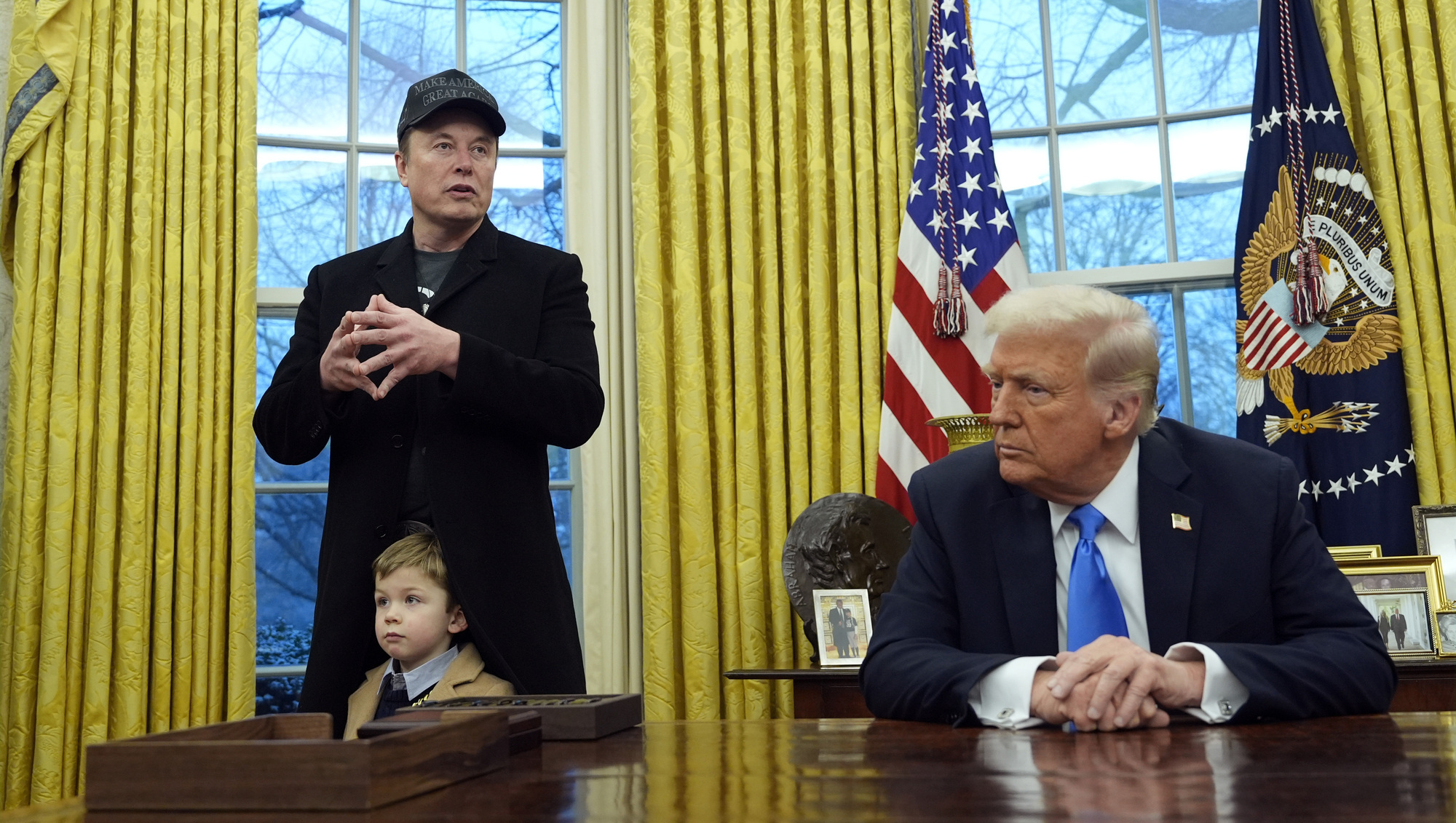
US president Donald Trump in the Oval Office as Elon Musk, joined by his son X, 'postulates on waste and fraud in US public sector bureaucracy'. Picture: Alex Brandon/AP

It has long been feared that Donald Trump’s second presidency would be more extreme than his first and would be characterised by chaos, volatility, and uncertainty. Less than a month in, I think it is safe to say the situation is evolving in a more dramatic way than could have been imagined.

The images of Elon Musk in the Oval Office with young X on his shoulders postulating on waste and fraud in US public sector bureaucracy is astounding, but so much has happened over the past month, it is difficult to keep up with events.

From a global economic and trade perspective the narrative so far has been dominated by the promise and threat of trade tariffs. Mr Trump announced a 25% tariff on all steel and aluminium imports into the US, applicable from March 4. It remains to be seen if such tariffs will apply to goods that use a lot of steel and aluminium, such as cars. 

In terms of total global steel production, the World Steel Association estimates that China accounts for 53.9% of global steel production, India is in second place at 7.4%, and the EU accounts for 6.7%. It is estimated that 18m tonnes of steel are exported to the US, with 3.7m tonnes, or 20%, coming from the EU. Canada, Brazil, and Mexico supply around 49%, and China less than 2%.

From an Irish perspective, it is far from clear how the proposed tariffs might affect our economy. In a direct sense, Ireland will not be affected by US tariffs. At an EU level, the loss of a 3.7m tonnes market to the US would do serious damage to an already struggling and contracting EU steel sector. With the US market set to become much more difficult, it is probable that countries such as China and Indonesia will seek to sell more into the EU market and compete directly with more expensive EU production. Perhaps, Ireland might benefit from increased cheaper steel supply, but that remains to be seen.

At a general level, it seems certain that very few countries will escape the wrath or attention of the Trump administration. 

South Africa has come in for harsh treatment, ostensibly because of land seizures from Afrikaners, but there must be a deep suspicion that South Africa may be suffering because it took a case against Israel to the International Court of Justice. Ireland did likewise and is also now trying to legislate for the Occupied Territories Bill. These facts alone would raise the ire of a president who is on good terms with Israeli prime minister Benjamin Netanyahu.

Ireland is also running a merchandise trade surplus with the US, which stood at €46bn in the first 11 months of 2024. That has the potential to single out Ireland in the mind of Mr Trump.

Our inordinate dependence on US multinational investment in terms of direct and indirect employment, and income tax and corporation tax receipts, should be a cause for concern for every politician and business leader in the country.

There are key concentration risks for Ireland, including 302,566 employees working in IDA companies at the end of 2024; corporation tax accounting for 36.2% of tax revenues in 2024; 10 companies paying 52% of corporation tax in 2023; three sectors — manufacturing, ICT, and finance — accounting for 70% of corporation tax and a third of income tax; the top 10 companies accounting for 10% of income tax; the top 20% of income tax payers paying 80% of income tax, and the chemical and pharmaceutical sector accounting for 66% of merchandise exports in the first 11 months of last year.

The message is clear: Ireland is seriously exposed to the vagaries and unpredictability of Mr Trump. 

We need to move on from squabbling in the Dáil and address areas of national competitiveness such as energy, water, and housing as a matter of extreme urgency, and stop wasting fiscal resources on populist policies.

x

More in this section

Cookie Policy Privacy Policy Brand Safety FAQ Help Contact Us Terms and Conditions

© Examiner Echo Group Limited